Facts
Appellant No. 2 suffers from 100% locomotor disability due to Cerebral Palsy, seizures, and mental retardation
Source reference: para. 7-8His sister, Appellant No. 1, filed a Writ Petition seeking appointment as his guardian for person and property following the death of their parents
Source reference: para. 7The learned Single Judge dismissed the Writ Petition on 25.02.2026, holding that Appellant No. 1 is a citizen of New Zealand and thus ineligible for guardianship under statutory rules
Source reference: para. 6, 10-11The Appellants challenged this order via an intra-court appeal, noting that both currently reside in Australia and Appellant No. 2's visa has expired
Source reference: para. 16Issues
1. Whether a non-Indian citizen can be appointed as a guardian for a person with disabilities under the National Trust Rules, 2000
Source reference: para. 10-112. Whether a mechanism can be devised to ensure the welfare of a person with disabilities when the primary caregiver is a foreign national
Source reference: para. 12-15Law Applied
Rule 17(1)(iii)(a) of the National Trust for Welfare of Persons with Autism, Cerebral Palsy, Mental Retardation and Multiple Disabilities Rules, 2000, which mandates that a proposed guardian must be a citizen of India
Source reference: para. 10-11The court relied on the Division Bench precedent in Sunil Podar v. National Trust for the Welfare of Person with Autism, Cerebral Palsy, Mental Retardation and Multiple Disabilities and Anr. (2023), which upheld the constitutional validity of Rule 17 and established a framework for appointing statutory guardians in cases involving foreign national caregivers
Source reference: para. 10-12Reasoning
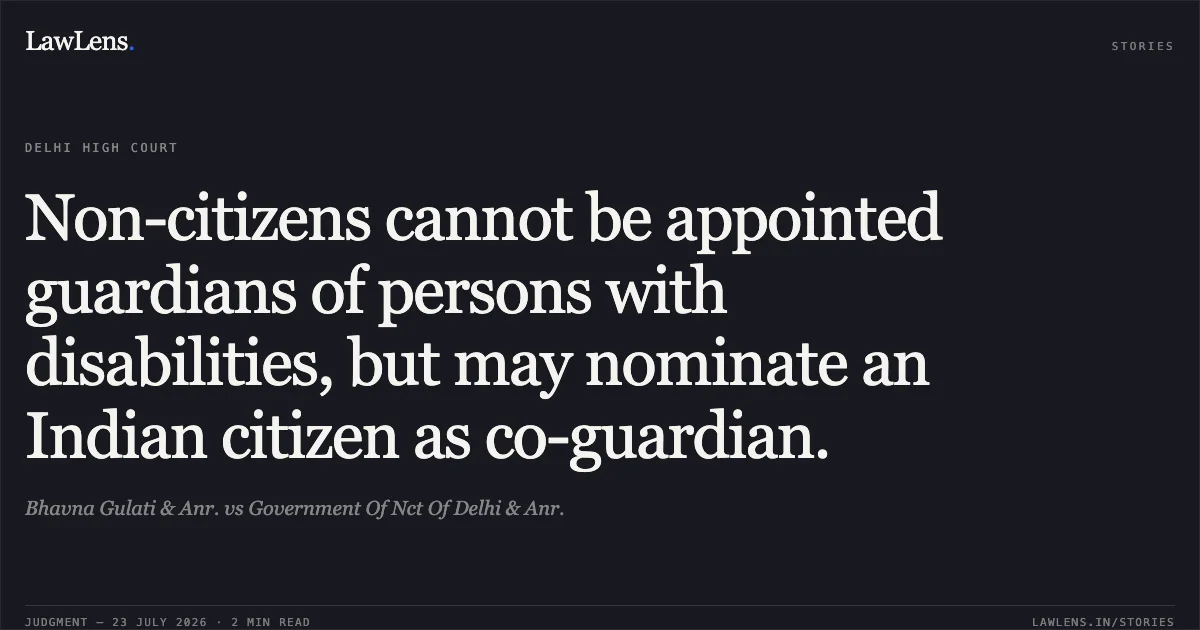
The Court affirmed the Single Judge’s finding that Rule 17(1)(iii)(a) creates an absolute bar against non-citizens acting as statutory guardians, noting that Appellant No. 1 is a citizen of New Zealand
Source reference: para. 11However, applying the parens patriae logic from Sunil Podar, the Court reasoned that the welfare of Appellant No. 2 remains paramount and cannot be left "in a lurch"
Source reference: para. 12The Court determined that while Appellant No. 1 cannot be the sole legal guardian, she may nominate an Indian citizen to serve as a statutory guardian
Source reference: para. 13This statutory guardian would then act alongside Appellant No. 1 to fulfill all legal/welfare obligations, ensuring the disabled person remains in the care of their family while satisfies the citizenship requirement of the Rules
Source reference: para. 14-15Holding
The Court upheld the Impugned Order but disposed of the appeal by granting liberty to Appellant No. 1 to nominate an Indian citizen for appointment as a statutory guardian through the Local Level Committee
The Committee is directed to evaluate the circumstances and facilitate this arrangement to ensure the welfare of Appellant No. 2
Source reference: para. 13-15The Court directed the Ministry of External Affairs and Ministry of Home Affairs to cooperate regarding Appellant No. 2’s visa issues
Source reference: para. 17The existing interim custody arrangement remains in force until modified by a competent authority
Source reference: para. 15Original Court PDF
Bhavna Gulati & Anr.vsGovernment Of Nct Of Delhi & Anr.
Click to open original judgment
Original judgment, available to read, download and summarize on LawLens.in


