Facts
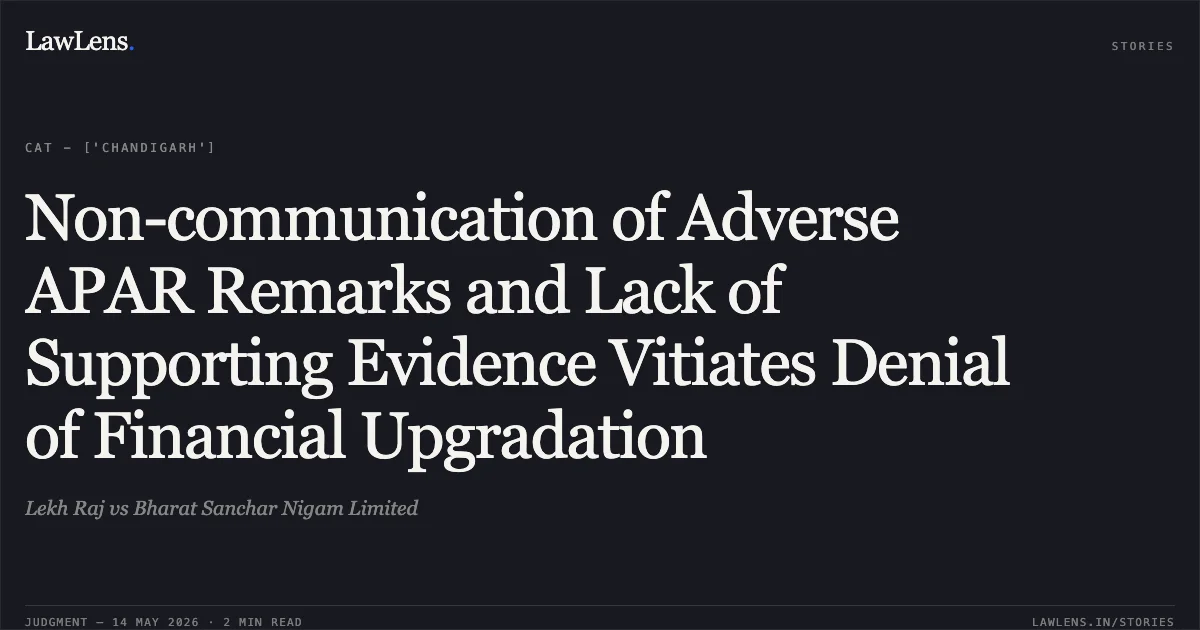
The applicant, a Junior Telecom Officer at BSNL, was denied financial upgradation from grade E-2 to E-3 (due in 2010) because of adverse remarks in his Annual Performance Appraisal Report (APAR) for 2008-09
Source reference: p. 3While the Reporting Officer had given positive remarks, the Reviewing Authority recorded that the applicant was "unable to guide as team leader" and "unable to extract work from staff"
Source reference: p. 12These remarks were never formally communicated to the applicant
Source reference: p. 4BSNL rejected his representations as time-barred, claiming he had signed a pre-printed certificate in 2009 stating he "agreed and accepted" the remarks
Source reference: p. 6-7The applicant contended he only received the full APAR via an RTI request in 2017 and was never issued warnings or memos regarding his performance during the period
Source reference: p. 5Issues
1. Whether the respondents were required to communicate the entire APAR, including adverse remarks, to the applicant to allow for a representation
Source reference: p. 112. Whether the Reviewing Authority's remarks were legally sustainable absent any prior notice or evidence of work deficiency
Source reference: p. 113. Whether a pre-printed "agreement certificate" signed by the employee constitutes a valid waiver of the right to represent against adverse entries
Source reference: p. 11Law Applied
The Tribunal primarily applied the principles established by the Hon'ble Supreme Court in Dev Dutt v. Union of India, which mandates that every entry in an ACR/APAR (whether fair, average, or good) must be communicated to the public servant to ensure transparency and fairness
Source reference: p. 4, 11It further relied on U.P. Jal Nigam v. Prabhat Chandra Jain, regarding the requirement to provide reasons for downgrading an officer
Source reference: p. 2State of U.P. v. Yamuna Shanker Misra, which stipulates that adverse remarks must be based on objective periodic inspections and the officer should be given an opportunity to improve through prior advisory/corrective notes
Source reference: p. 9, 12Reasoning
The Tribunal found that BSNL failed to follow the mandatory procedure for communicating APARs as established in Dev Dutt and subsequent DoPT instructions dated 14.05.2009
Source reference: p. 11-12The "agreement certificate" relied upon by BSNL was deemed invalid because it was a signed proforma that did not prove the applicant was actually shown the full adverse remarks or given a 15-day window to contest them as required by law
Source reference: p. 7, 10Furthermore, the Reviewing Authority’s remarks were found to be subjective opinions unsupported by any record of warnings, memos, or "Memo of Service" during the reporting period
Source reference: p. 9, 12Because the Reviewing Authority failed to provide objective reasons for effectively downgrading the Reporting Officer’s positive assessment, the remarks were held to be biased and non-est in the eyes of law
Source reference: p. 12Holding
The Tribunal allowed the O.A. and quashed the impugned orders dated 28.12.2016, 16.11.2013, and 31.12.2013
The court ordered the expunging of the adverse remarks from the 2008-09 APAR and directed the respondents to consider the applicant’s claim for financial upgradation from E-2 to E-3 from the date his juniors were upgraded, with all notional benefits, within 12 weeks
Source reference: p. 13Acts & Sections Cited
1 provisions across 1 statute referred to in this judgment. Each provision opens on LawLens.
Administrative Tribunals Act, 19851
Original Court PDF
Lekh RajvsBharat Sanchar Nigam Limited
Click to open original judgment
Original judgment, available to read, download and summarize on LawLens.in