Facts
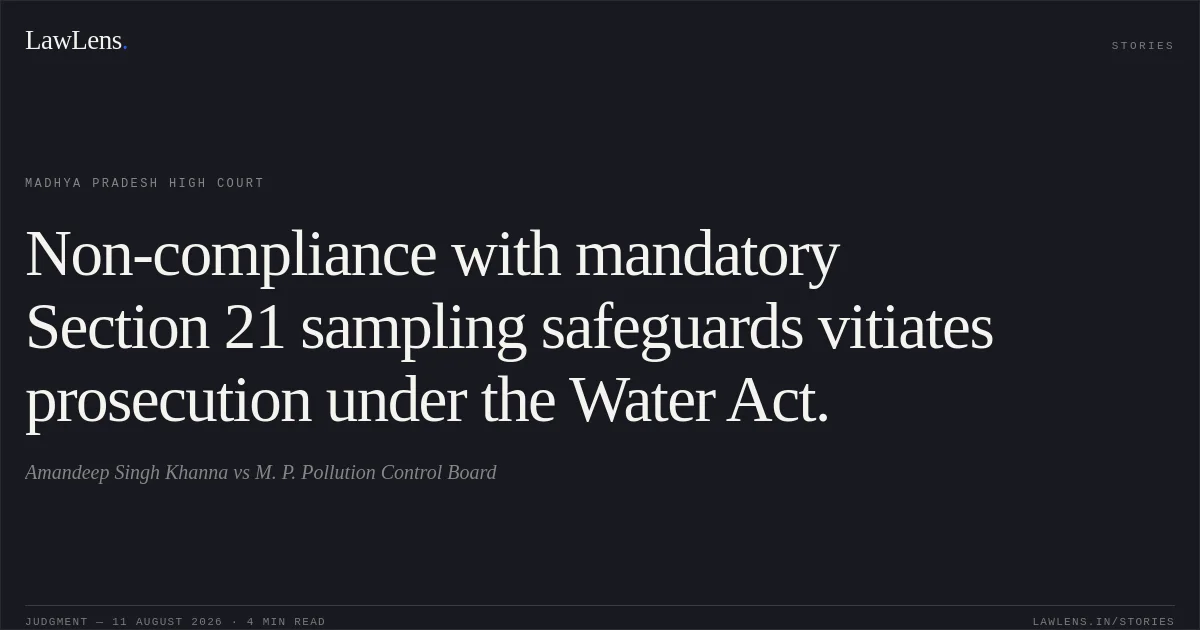
The applicants invoked Section 482 of the Code of Criminal Procedure, 1973, seeking quashing of Criminal Case No. UNCR 0000070/2019 pending before the J.M.F.C., Jabalpur, arising from proceedings concerning Sukhsagar Medical College Hospital, operated under the aegis of Gyanjeet Sewa Mission Trust.
Source reference: para. 2They alleged that the Madhya Pradesh Pollution Control Board had failed to comply with the mandatory procedure under Section 21 of the Water (Prevention and Control of Pollution) Act, 1974, particularly in relation to collection of samples, issuance of notice to the person in charge, and statutory safeguards governing analysis.
Source reference: paras. 2–3The individual applicants additionally contended that they were trustees/directors or persons associated with the institution but were not shown to be in charge of, or responsible for, its day-to-day affairs.
Source reference: paras. 4–5Reliance was placed on earlier orders of the High Court in M.Cr.C. Nos. 1700/2023 and 38592/2019, decided on 24 March 2026, where proceedings arising from the same statutory defect were quashed.
Source reference: para. 5The respondent opposed the petitions but did not dispute the applicability of the earlier decision concerning non-compliance with Section 21.
Source reference: para. 6Issues
Whether criminal proceedings founded upon samples collected in alleged non-compliance with the mandatory procedure prescribed under Section 21 of the Water Act could be permitted to continue?
Source reference: paras. 8–12Whether the High Court should exercise its inherent jurisdiction under Section 482 Cr.P.C. to quash the complaint where the defect in sampling and statutory compliance appeared from the prosecution documents themselves?
Source reference: paras. 9–12Whether judicial consistency required the applicants to receive the same relief granted in materially identical proceedings by the orders dated 24 March 2026?
Source reference: paras. 13–14Whether the individual applicants could be prosecuted merely by reason of their status as trustees/directors, without specific allegations that they were in charge of and responsible for the institution’s day-to-day affairs?
Source reference: paras. 4–5; issue not separately adjudicated in the final reasoningLaw Applied
The Court applied Section 21 of the Water (Prevention and Control of Pollution) Act, 1974, holding that its procedure for collection and handling of samples, including the safeguards available to the concerned person, is mandatory where the sample and analysis report form the basis of criminal prosecution.
Source reference: paras. 8, 11It applied Section 482 Cr.P.C., under which the High Court may intervene to prevent abuse of process and secure the ends of justice, including where the complaint and accompanying documents disclose a fundamental legal defect in the foundation of the prosecution.
Source reference: paras. 9–10The Court also relied on the principles of judicial consistency and discipline, following its earlier decisions in M.Cr.C. Nos. 1700/2023 and 38592/2019, decided on 24 March 2026, involving the same statutory issue and substantially identical circumstances.
Source reference: para. 13On individual liability, the applicants relied on S.M.S. Pharmaceuticals Ltd. v. Neeta Bhalla, (2005) 8 SCC 89, and National Small Industries Corporation Ltd. v. Harmeet Singh Paintal, (2010) 3 SCC 330, which require specific material showing that a director or trustee was in charge of and responsible for the conduct of the relevant affairs; the applicants also cited Harshendra Kumar D. v. Rebatilata Koley, (2011) 3 SCC 351, State of NCT of Delhi v. Rajiv Khurana, (2010) 11 SCC 469, State of Haryana v. Brij Lal Mittal, (1998) 5 SCC 343, and Pepsico India Holdings (P) Ltd. v. Food Inspector, (2011) 1 SCC 176.
Source reference: paras. 4–5Reasoning
The Court found that the prosecution documents did not satisfactorily establish compliance with the mandatory requirements of Section 21 at the stage of sample collection, including the statutory safeguards and notice requirements.
Source reference: para. 11Because the analysis report and the criminal complaint were founded upon that sample, the defect affected the very legal foundation of the prosecution rather than constituting a mere evidentiary irregularity.
Source reference: paras. 8, 11–12The Court held that it was not undertaking an impermissible appreciation of disputed evidence; the defect was apparent from the prosecution material itself and concerned compliance with a mandatory statutory procedure.
Source reference: para. 12Further, the respondent identified no distinguishing feature between the present cases and the earlier matters in which proceedings had been quashed for the same non-compliance.
Source reference: para. 13Applying judicial consistency, the Court held that similarly situated applicants could not be subjected to continuation of prosecution on an identical statutory defect.
Source reference: para. 13Accordingly, continuation of the complaint would amount to an abuse of process and warranted interference under Section 482 Cr.P.C.
Source reference: para. 14Holding
The Court answered the principal issues in favour of the applicants.
It held that the criminal complaint could not continue because the samples underlying the prosecution were collected without demonstrated compliance with the mandatory procedure under Section 21 of the Water Act.
Source reference: paras. 11–15M.Cr.C. Nos. 21375/2019 and 14325/2019 were allowed, and Criminal Case No. UNCR 0000070/2019 pending before the J.M.F.C., Jabalpur, together with all consequential proceedings insofar as they concerned the applicants, was quashed.
Source reference: para. 16The applicants were directed to stand discharged from the criminal proceedings; the Court clarified that the relief was principally based on the statutory non-compliance under Section 21 and the identical view previously taken in the connected cases.
Source reference: para. 16Acts & Sections Cited
2 provisions across 2 statutes referred to in this judgment. Each provision opens on LawLens.
Code of Criminal Procedure, 19731
Water (Prevention and Control of Pollution) Act, 19741
Original Court PDF
Amandeep Singh KhannavsM. P. Pollution Control Board
Click to open original judgment
Original judgment, available to read, download and summarize on LawLens.in