Facts
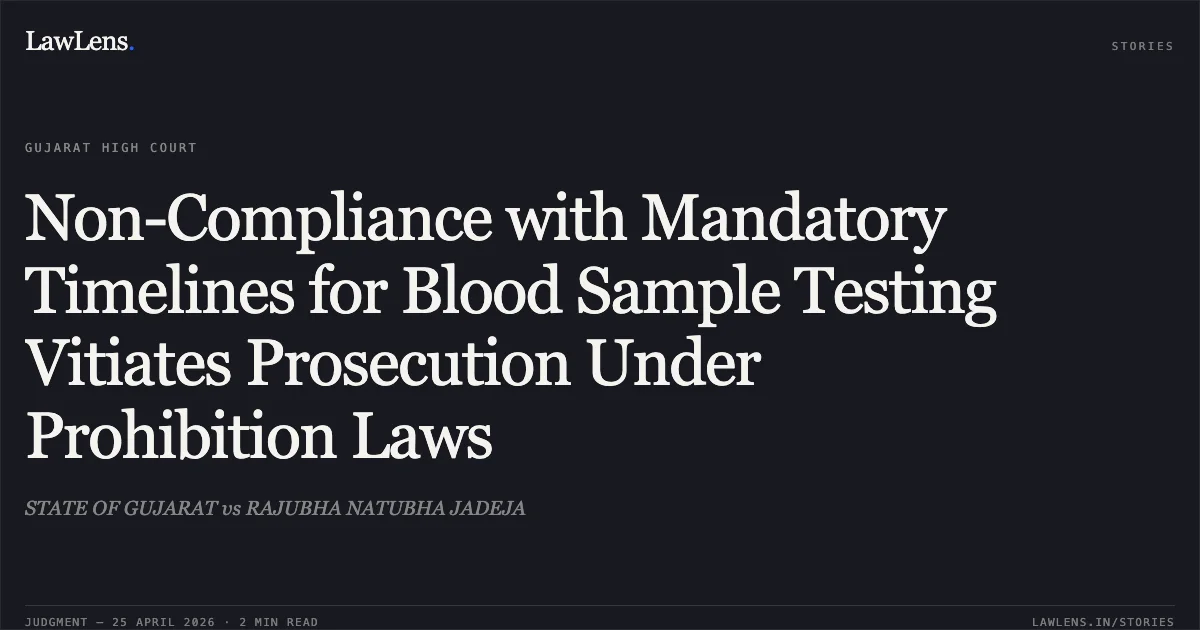
The State of Gujarat appealed a 31.01.2008 acquittal order passed by the JMFC, Junagadh.
Source reference: p. 1-2On 10.12.1999, the respondent, an FSL driver, was allegedly found intoxicated and unable to walk/talk properly at the FSL office.
Source reference: p. 1-2A complaint was filed under Sections 66(1)(B) and 85(1)(3) of the Bombay Prohibition Act, 1949.
Source reference: p. 1-2Blood samples were collected on 10.12.1999 but reached the FSL via Registered A.D. Post only on 17.12.1999.
Source reference: p. 6Due to the destruction of trial records, the High Court proceeded based on the 2008 trial court judgment.
Source reference: p. 5Issues
1. Whether the prosecution complied with the mandatory procedural requirements under the Bombay Prohibition (Medical Examination and Blood Test) Rules, 1959.
Source reference: p. 62. Whether the lack of a body panchnama and contradictions in witness testimony entitled the accused to the benefit of doubt.
Source reference: p. 5, 73. Whether there were "substantial and compelling reasons" to interfere with the trial court’s order of acquittal.
Source reference: p. 11Law Applied
Rule 4(2) of the Bombay Prohibition (Medical Examination and Blood Test) Rules, 1959, which mandates that blood samples must reach the testing officer within 7 days of collection.
Source reference: p. 6Fundamental principle of criminal jurisprudence regarding the "double presumption of innocence" in acquittal appeals, as established in Chandrappa v. State of Karnataka (2007).
Source reference: p. 10-11Rule of prudence from Ram Kumar v. State of Haryana (1995), stating that an appellate court should not disturb an acquittal if the trial court's view is reasonable and plausible.
Source reference: p. 9Reasoning
The High Court observed that the prosecution failed to meet the mandatory requirements of Rule 4(2) of the 1959 Rules because the blood sample, collected on 10.12.1999, reached the FSL on 17.12.1999—failing the "within 7 days" window if interpreted strictly or raising doubts about the integrity of the test results.
Source reference: p. 6The court noted significant procedural lapses: no panchnama was conducted at the FSL office where the accused was caught, and no entry regarding the telephonic message from the FSL was made in the station diary.
Source reference: p. 7The court reasoned that since the trial court's findings were based on material contradictions and a lack of direct evidence, they were not "perverse".
Source reference: p. 8Adhering to the principle that if two views are possible, the view favoring acquittal must be sustained, the Court found no justification to re-appreciate the evidence.
Source reference: p. 11-12Holding
The High Court dismissed the State's appeal and confirmed the judgment of acquittal, holding that the mandatory procedural non-compliance regarding the blood sample transit and the absence of a body panchnama rendered the prosecution's case doubtful.
Under the limited scope of Section 378 of the Cr.P.C., the court found no manifest illegality or perversity in the trial court's reasoning; the respondent's acquittal for offences under Sections 66(1)(B) and 85(1)(3) of the Bombay Prohibition Act was upheld.
Source reference: p. 13-14Acts & Sections Cited
2 provisions across 1 statute referred to in this judgment. Each provision opens on LawLens.
Code of Criminal Procedure, 19732
Original Court PDF
STATE OF GUJARATvsRAJUBHA NATUBHA JADEJA
Click to open original judgment
Original judgment, available to read, download and summarize on LawLens.in