Facts
The police intercepted a private vehicle (HR-51-BU-9902) during a routine check (Naka) on May 25, 2023. The petitioners, Ankit Pachwaria (driver) and Sarvagya Sharma (passenger), appeared frightened. A subsequent search of the vehicle yielded 328 grams of charas
Source reference: p. 2, para. 3The prosecution filed a charge sheet under Sections 20 and 29 of the NDPS Act. On March 24, 2026, the Special Judge-III, Mandi, framed charges against both petitioners
Source reference: p. 3, para. 4The petitioners challenged this order, alleging non-compliance with Section 42 of the NDPS Act, lack of independent evidence (CCTV), and procedural irregularities
Source reference: p. 3-4, para. 5Issues
1. Whether the Trial Court is required to record detailed reasons and conduct a threadbare analysis of evidence at the stage of framing charges
Source reference: p. 5, para. 10; p. 8, para. 162. Whether the alleged non-compliance with Section 42 of the NDPS Act (search and seizure) is a valid ground for discharge at the preliminary stage
Source reference: p. 15, para. 213. Whether the occupants of a private vehicle can be prima facie deemed to be in "conscious possession" of contraband recovered from that vehicle
Source reference: p. 8-9, para. 14-15Law Applied
The court applied Section 227 (discharge) and Section 228 (framing of charge) of the CrPC, emphasizing that only a prima facie case or "grave suspicion" is required to proceed, rather than proof beyond reasonable doubt
Source reference: p. 5-7It relied on Madan Lal v. State of H.P. (2003) to establish that occupants of a private vehicle are presumed to be in conscious possession of contraband
Source reference: p. 9, para. 14Regarding Section 42 of the NDPS Act, the court cited the Constitutional Bench in State of Punjab v. Baldev Singh (1999) and the Full Bench in State of H.P. v. Vidya Devi (1993), which clarify that Section 42 does not apply to "chance recovery"
Source reference: p. 16, para. 23Kanti Bhadra Shah v. State of W.B. (2000) was cited to establish that reasons must be recorded for discharge, but not necessarily for framing charges
Source reference: p. 11, para. 17Reasoning
The High Court observed that at the stage of framing charges, the Trial Court is not required to meticulously weigh evidence or consider the probability of conviction
Source reference: p. 5, para. 10Since the recovery happened during a routine Naka and not based on prior information, it constitutes a "chance recovery," exempting the police from the strict documentation requirements of Section 42 of the NDPS Act
Source reference: p. 16-17, para. 23-25The Court rejected the argument regarding missing CCTV footage, holding that a "defective investigation" is not a ground for discharge but a matter for trial
Source reference: p. 18, para. 28-31Applying the principle of conscious possession from Madan Lal, the Court found that the presence of both petitioners in the private vehicle where the drugs were found created sufficient suspicion to frame charges
Source reference: p. 10, para. 15Holding
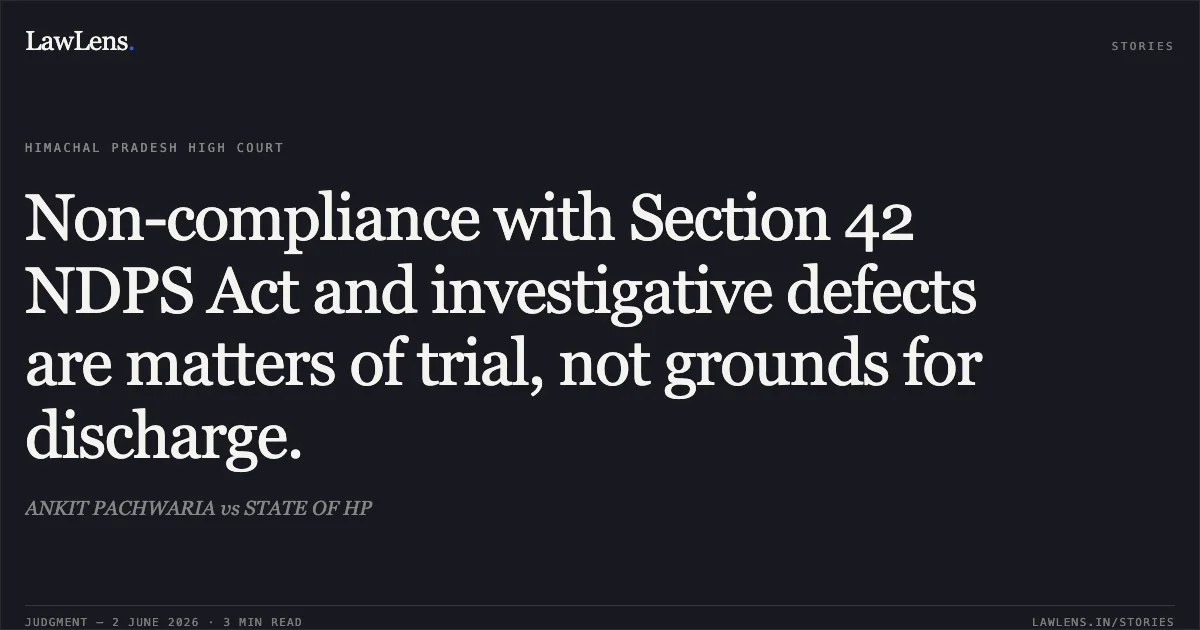
The High Court dismissed the revision petitions, holding that the Trial Court's order framing charges was legally sound
The Court answered that: (1) detailed reasons are not mandatory for framing charges as the act itself reflects a prima facie opinion [p. 15, para. 20]; (2) Section 42 compliance is a matter of trial and inapplicable to chance recoveries [p. 16, para. 22]; and (3) a prima facie case of conscious possession existed [p. 10, para. 15].
Source reference: p. 10, 15, 16The Trial Court's order was upheld, and the petitions were dismissed without affecting the merits of the upcoming trial
Source reference: p. 21, para. 39Acts & Sections Cited
27 provisions across 3 statutes referred to in this judgment. Each provision opens on LawLens.
Narcotic Drugs and Psychotropic Substances Act, 1985
Code of Criminal Procedure, 1973
Indian Penal Code, 18602
Original Court PDF
ANKIT PACHWARIAvsSTATE OF HP
Click to open original judgment
Original judgment, available to read, download and summarize on LawLens.in


