01Facts
The petitioners invoked Section 528 of the Bharatiya Nagarik Suraksha Sanhita, 2023, seeking quashing of FIR Crime No. 367/2017 registered at Police Station Porsa, District Morena, for offences under Sections 365, 323 and 34 of the IPC and Sections 11 and 13 of the Madhya Pradesh Dakaiti and Vyapaharan Prabhavit Kshetra Adhiniyam, on the basis of a compromise.
¶ 1The alleged victim, Shyam Singh Tomar, died on 24 May 2025; his wife, Nisha Devi, filed an affidavit consenting to the compromise, while his son, Mukesh Singh, also settled the dispute with the accused.
¶ 5 · ¶ 10The parties filed compromise applications supported by affidavits, and the Principal Registrar verified their identities, signatures, and the voluntary nature of the settlement.
¶ 2–3One accused, Raghu alias Raghvendra Tomar, was not impleaded because he was a minor at the time of the incident.
¶ 502Issues
i.Whether the High Court could quash the FIR and consequential criminal proceedings for non-compoundable offences on the basis of a voluntary compromise between the accused and the victim’s legal representatives?
¶ 1, 12–15ii.Whether the compromise, verified by the Principal Registrar and supported by the affidavits of the deceased victim’s wife and son, was sufficient to justify termination of the criminal proceedings?
¶ 3, 5, 10iii.Whether continuation of the prosecution would amount to an abuse of the process of law when the parties had amicably resolved their dispute?
¶ 13–1503Law Applied
The Court exercised its inherent jurisdiction under Section 528 of the BNSS, while referring to the corresponding power under Section 482 of the CrPC, to prevent abuse of the process of court and secure the ends of justice.
¶ 1, 13It relied on B.S. Joshi v. State of Haryana, Gian Singh v. State of Punjab, Jagdish Channa v. State of Haryana, Madan Mohan Abbot v. State of Punjab, Shiji v. Radhika, Narinder Singh v. State of Punjab, and Parbatbhai Ahir v. State of Gujarat, which recognise that criminal proceedings involving predominantly private or personal disputes may be quashed on the basis of a genuine compromise even where the offences are non-compoundable, provided that continuation of the prosecution would serve no useful purpose.
¶ 12The Court also considered the authorities cited by the petitioners, including Naushey Ali v. State of Uttar Pradesh and Vikas Gurjar v. State of Madhya Pradesh.
¶ 6Provisions in the judgment · 5 · Linked ones open on LawLens
Bharatiya Nagarik Suraksha Sanhita, 2023 Section 528
Indian Penal Code, 1860 Section 365Section 323Section 34
Code of Criminal Procedure, 1973 Section 482
04Reasoning
The Court found that the compromise was voluntary and free from threat, inducement, or coercion, as confirmed through the Principal Registrar’s verification.
¶ 3Although the original victim had died, his wife and son had expressly affirmed the settlement and raised no objection to quashing the proceedings.
¶ 5, 10Applying the Supreme Court’s principles on quashing criminal proceedings after settlement, the Court concluded that the dispute had been genuinely resolved and that continuation of the trial would be a futile exercise, causing unnecessary consumption of judicial resources and serving no meaningful purpose.
¶ 11–14The Court therefore held that its inherent jurisdiction could be invoked notwithstanding the non-compoundable character of the offences.
¶ 12–1405Holding
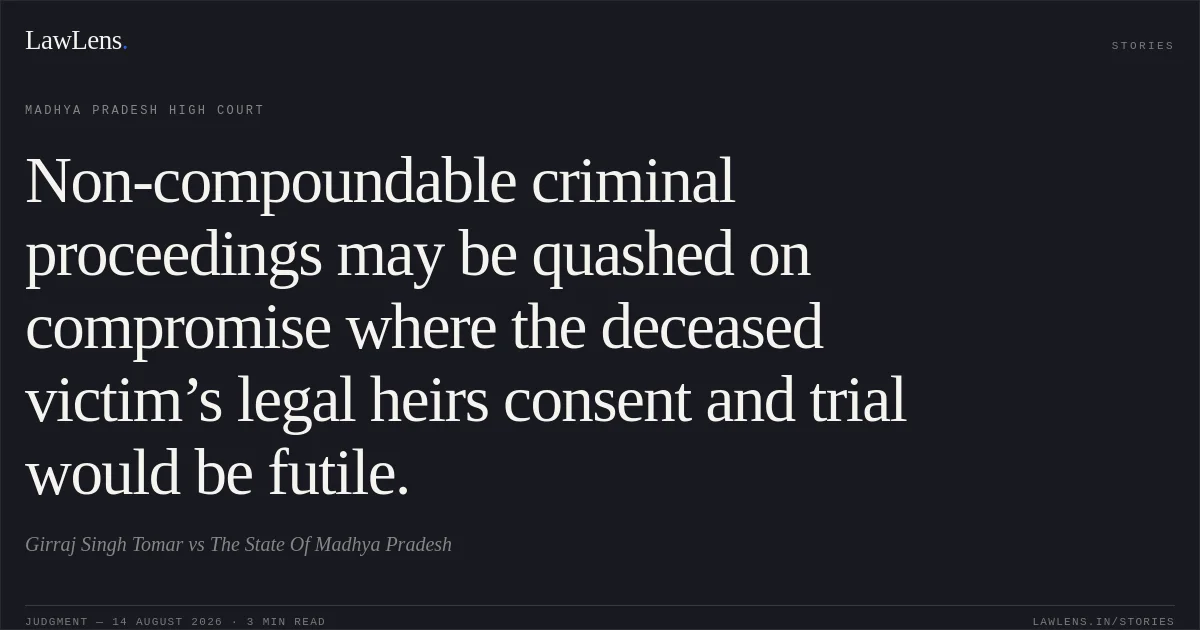
The High Court allowed the compromise applications and permitted the parties to compound the offences.
¶ 14It consequently quashed FIR Crime No. 367/2017 registered at Police Station Porsa, District Morena, under Sections 365, 323 and 34 of the IPC and Sections 11 and 13 of the MPDVPK Act, together with all consequential proceedings arising from it.
¶ 15The petition was accordingly allowed and disposed of.
¶ 16Original Court PDF
Girraj Singh TomarvsThe State Of Madhya Pradesh
Click to open original judgment
Original judgment, available to read, download and summarize on LawLens.in