Facts
The applicants filed a C-528 application (under Section 528 of the BNSS/482 Cr.P.C.) seeking to quash the charge-sheet and proceedings of Criminal Case No. 4713 of 2019.
Source reference: para. 4The case originated from an F.I.R. alleging offences under Sections 420 (cheating) and 406 (criminal breach of trust) of the I.P.C., and Sections 4/5 of the Prize Chits & Money Circulation Scheme (Banning) Act, 1978.
Source reference: para. 4-5During the pendency of the trial before the Chief Judicial Magistrate, Dehradun, the parties arrived at an amicable settlement with the help of respectable society members.
Source reference: para. 6The applicants paid a total of ₹4,00,000 to Respondent No. 2 (complaint)—comprising ₹1,00,000 previously paid in cash and ₹3,00,000 via a demand draft delivered in open court.
Source reference: para. 8Issues
1. Whether the High Court can exercise its inherent jurisdiction to quash criminal proceedings involving non-compoundable offences on the basis of a private settlement between parties.
Source reference: para. 122. Whether the continuation of proceedings in Case No. 4713 of 2019 would constitute an abuse of the process of law given the amicable resolution.
Source reference: para. 13Law Applied
Section 528 of the Bhartiya Nagarik Suraksha Sanhita (BNSS) (formerly Section 482 of the Cr.P.C.) regarding the inherent powers of the High Court to prevent abuse of the process of law.
Source reference: para. 12Landmark precedents of Gian Singh v. State of Punjab, Narinder Singh v. State of Punjab, and Parbatbhai Aahir v. State of Gujarat, which established that proceedings involving offences of a personal or private nature can be quashed even if the offences are non-compoundable, provided the ends of justice are served and the settlement is voluntary.
Source reference: para. 12Reasoning
The court observed that the dispute between the parties was essentially private in nature, arising from a personal discord.
Source reference: para. 11Upon interacting with the parties—specifically Respondent No. 2 via Video Conferencing—the court verified that the refund of the entire alleged amount was completed and the compromise was entered into voluntarily without coercion.
Source reference: para. 7The court applied the "personal nature" test from Gian Singh to determine that because the victim no longer wished to prosecute and a settlement had been reached, the likelihood of conviction was remote.
Source reference: para. 12-13The court reasoned that forcing the continuation of the trial would be a futile exercise and a waste of judicial time.
Source reference: para. 13Holding
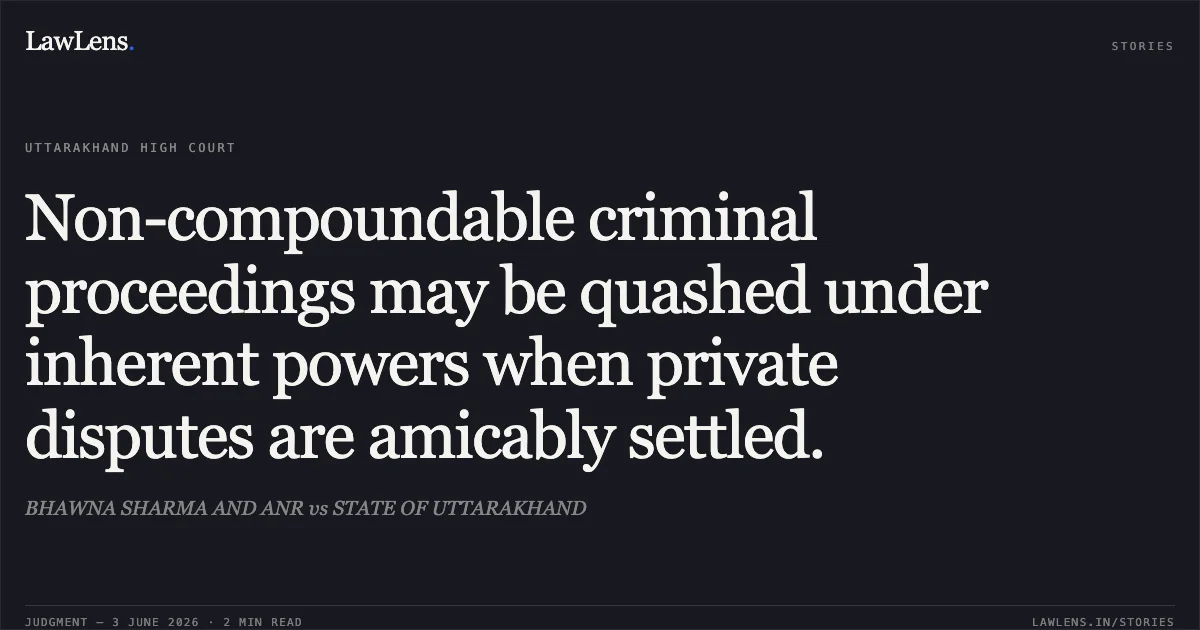
The court answered the issues in the affirmative, holding that the dispute was settled amicably and justice required the cessation of proceedings.
The Court allowed Compounding Application (I.A. No. 1 of 2026) and the main C-528 application; consequently, the charge-sheet, the summoning order dated 09.09.2019, and the entire proceedings of Criminal Case No. 4713 of 2019 pending before the CJM, Dehradun, were quashed.
Source reference: para. 14-15Acts & Sections Cited
6 provisions across 4 statutes referred to in this judgment. Each provision opens on LawLens.
Indian Penal Code, 18602
Code of Criminal Procedure, 19731
Bharatiya Nagarik Suraksha Sanhita, 20231
Original Court PDF
BHAWNA SHARMA AND ANRvsSTATE OF UTTARAKHAND
Click to open original judgment
Original judgment, available to read, download and summarize on LawLens.in


![Subsequent exoneration does not retrospectively invalidate a finalized promotion select list.. UNNIKRISHNAN M vs M/o Environment And Forests. CAT - ['Ernakulam']. LawLens](/stories/thumbnails/subsequent-exoneration-does-not-retrospectively-invalidate-a-finalized-promotion-select-li-ce80a0e84f2f4887857271e8b4341c42.webp)