Facts
The applicants sought to quash the charge-sheet, the cognizance/summoning order dated 10 April 2026, and the proceedings in Criminal Case No. 356 of 2026, arising from allegations of assault under Sections 115(2), 190, 191(3), 351(2) and 352 of the Bharatiya Nyaya Sanhita (BNS).
Source reference: para. 4After the charge-sheet was filed and cognizance taken, the parties submitted a joint application stating that they had amicably resolved their dispute.
Source reference: paras. 5–6The complainant and injured persons appeared before the Court, confirmed the settlement was voluntary, stated that they had sustained no serious injuries, and expressed that they did not wish to pursue the proceedings.
Source reference: para. 7The State opposed the application on the basis of the seriousness of the alleged offences, but did not dispute the settlement.
Source reference: para. 8Issues
Whether the High Court could quash proceedings for alleged non-compoundable offences under its inherent jurisdiction under Section 528 of the Bharatiya Nagarik Suraksha Sanhita (BNSS), on the basis of an amicable settlement.
Source reference: paras. 10–13Whether, in the circumstances of this personal dispute and the parties’ voluntary settlement, continuing the criminal proceedings would serve any useful purpose or advance the ends of justice.
Source reference: paras. 14–16Law Applied
Section 528 of the BNSS preserves the High Court’s inherent power to prevent abuse of the process of any court and to secure the ends of justice; that power may be exercised to quash proceedings for non-compoundable offences where the dispute is predominantly private or personal, subject to consideration of the offence’s nature and gravity.
Source reference: para. 10In Gian Singh v. State of Punjab, (2012) 10 SCC 303, the Supreme Court recognised that power in appropriate cases involving amicable resolution of private disputes, while requiring due regard to the nature and gravity of the offence.
Source reference: para. 11Narinder Singh v. State of Punjab, (2014) 6 SCC 466, requires consideration of the offence, the circumstances in which it was committed, and whether continuation would serve a useful purpose.
Source reference: para. 12Parbatbhai Aahir v. State of Gujarat, (2017) 9 SCC 641, reiterates that the decision must be guided by the nature of the offence and the facts and circumstances of the case.
Source reference: para. 13Reasoning
The Court found that the dispute arose from a personal altercation between neighbours and that the complainant and injured persons had confirmed the settlement in person.
Source reference: paras. 10, 14Their statements disclosed no coercion or undue influence, and they had sustained no serious injuries.
Source reference: paras. 7, 14Applying the principles governing the exercise of inherent jurisdiction, the Court concluded that the private nature of the dispute and the genuine settlement meant that continuation of the proceedings would serve no useful purpose and would not advance the ends of justice.
Source reference: paras. 14–16Holding
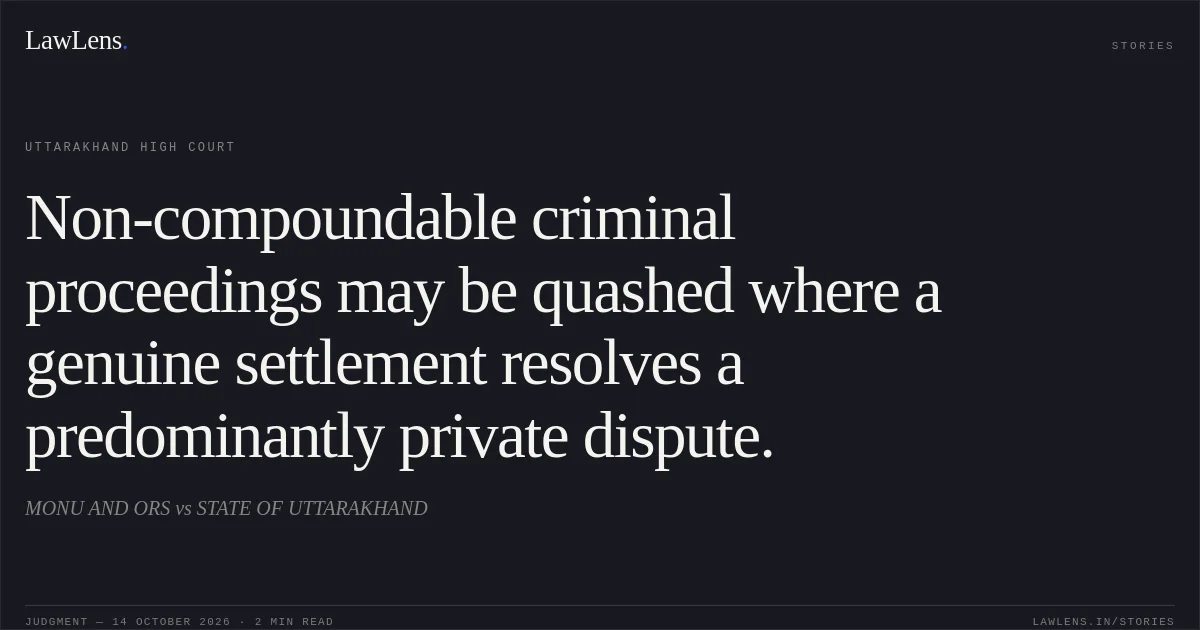
The Court held that the case warranted exercise of its inherent jurisdiction under Section 528 of the BNSS.
It allowed the joint compounding application and quashed the charge-sheet, the cognizance/summoning order dated 10 April 2026, the proceedings in Criminal Case No. 356 of 2026, and all criminal proceedings arising from them.
Source reference: paras. 17–19Acts & Sections Cited
6 provisions across 2 statutes referred to in this judgment. Each provision opens on LawLens.
Bharatiya Nyaya Sanhita, 20235
Bharatiya Nagarik Suraksha Sanhita, 20231
Original Court PDF
MONU AND ORSvsSTATE OF UTTARAKHAND
Click to open original judgment
Original judgment, available to read, download and summarize on LawLens.in


