Facts
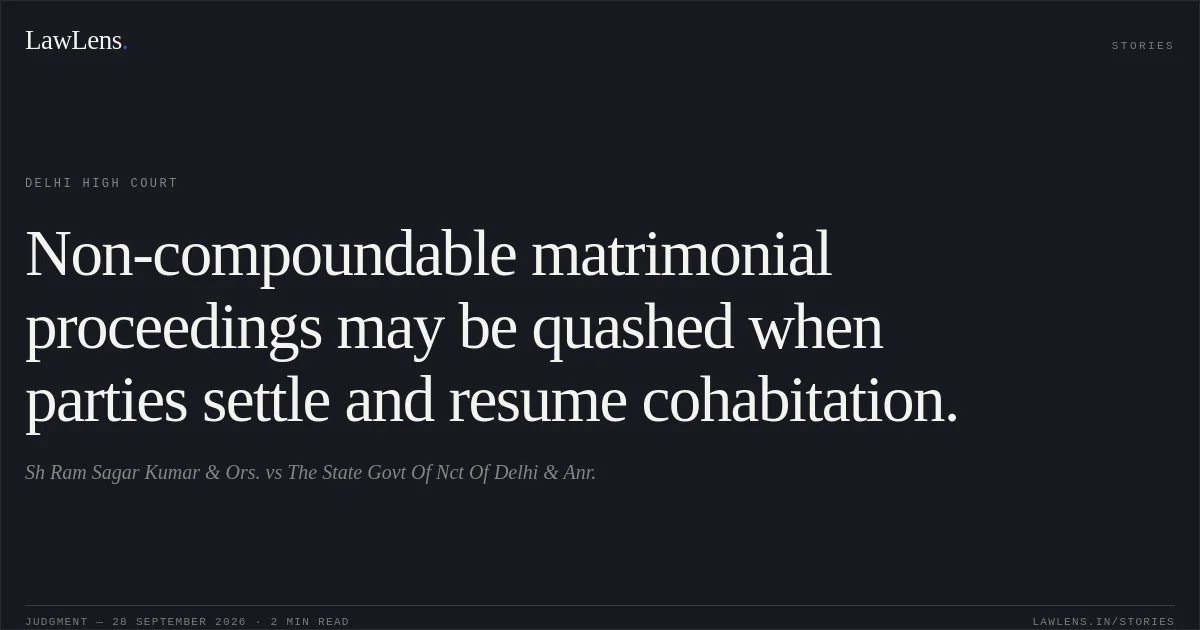
Respondent no. 2 married petitioner no. 1 in 2015.
Source reference: no citationIn 2022, she lodged an FIR against him and his family members under Sections 498A, 406 and 34 IPC, alleging dowry-related cruelty, misappropriation of jewellery, and demands connected with payments for a car and land
Source reference: paras. 4.1–4.4, pp. 2–3After a chargesheet was filed, the parties entered into a settlement before the Delhi Mediation Centre on 17 December 2025.
Source reference: paras. 2, 5–6, pp. 2–3They agreed to resume living together, and respondent no. 2 agreed to cooperate in quashing the FIR
Source reference: paras. 2, 5–6, pp. 2–3The petitioners sought quashing under Section 528 BNSS; respondent no. 2 confirmed that she was living peacefully with petitioner no. 1 and did not wish to pursue the case
Source reference: paras. 1, 8–10, pp. 1, 3Issues
1. Whether the High Court should exercise its inherent jurisdiction under Section 528 BNSS to quash the FIR and consequential proceedings under Sections 498A, 406 and 34 IPC on the basis of the parties’ settlement
Source reference: paras. 1, 12–19, pp. 1, 3–72. Whether the matrimonial nature of the dispute, the parties’ voluntary settlement, and their reconciliation warranted quashing despite Section 498A IPC being non-compoundable
Source reference: paras. 12–19, pp. 3–7Law Applied
Section 528 BNSS, corresponding to Section 482 CrPC, empowers the High Court to quash criminal proceedings to secure the ends of justice or prevent abuse of process, including in appropriate cases involving non-compoundable offences; this power is distinct from the statutory power to compound offences
Source reference: paras. 1, 13, 15, pp. 1, 4–6Section 406 IPC is compoundable, whereas Section 498A IPC is non-compoundable
Source reference: para. 12, p. 3Under Gian Singh v. State of Punjab, (2012) 10 SCC 303, and Narinder Singh v. State of Punjab, (2014) 6 SCC 466, proceedings arising predominantly from matrimonial or family disputes may be quashed after settlement where the nature and gravity of the offence, the likelihood of conviction, and the interests of justice support that course; serious offences affecting society are not to be quashed merely on compromise
Source reference: paras. 14–15, pp. 4–6The Court also referred to Deepak Kumar v. State (Govt. of NCT) of Delhi, 2024 SCC OnLine Del 1305, which requires consideration of the circumstances, gravity of the offence, and societal impact
Source reference: para. 16, p. 6Reasoning
The Court treated the case as a matrimonial dispute and considered that the parties had settled their differences and resumed living together peacefully.
Source reference: paras. 8–11, 17–18, pp. 3, 7Respondent no. 2 personally confirmed the settlement and her wish not to pursue the matter; the Court also recorded that the settlement was voluntary, and the State raised no objection to quashing
Source reference: paras. 8–11, 17–18, pp. 3, 7Applying the principles in Gian Singh and Narinder Singh, the Court concluded that, in these circumstances, continuing the proceedings was unwarranted and that quashing was consistent with the ends of justice
Source reference: paras. 14–18, pp. 4–7Holding
The Court allowed the petition and quashed FIR No. 448/2022, registered at PS Rajouri Garden under Sections 498A, 406 and 34 IPC, together with all consequential proceedings.
The parties remain bound by the settlement deed dated 17 December 2025; the petition and pending applications were disposed of accordingly
Source reference: paras. 19–21, p. 7Acts & Sections Cited
5 provisions across 3 statutes referred to in this judgment. Each provision opens on LawLens.
Bharatiya Nagarik Suraksha Sanhita, 20231
Code of Criminal Procedure, 19732
Indian Penal Code, 18602
Original Court PDF
Sh Ram Sagar Kumar & Ors.vsThe State Govt Of Nct Of Delhi & Anr.
Click to open original judgment
Original judgment, available to read, download and summarize on LawLens.in