Facts
An FIR was registered after an IGL gas pipeline caught fire during shifting or maintenance work, causing burn injuries that resulted in the deaths of two workers.
Source reference: paras. 1, 6.1–6.5The petitioners were, respectively, an IGL Assistant Manager, the proprietor of the contractor supplying manpower and equipment, and a third-party inspection engineer; the investigation concluded that their duties included ensuring safety at the site.
Source reference: paras. 1, 6.1–6.5A chargesheet was filed under Sections 285/304A/34 IPC, and the case was pending before the Trial Court at the stage of arguments on charge.
Source reference: paras. 4–5The deceased workers’ legal heirs settled their claims with the petitioners, received the agreed compensation, and supported quashing the FIR.
Source reference: paras. 7–17The petition sought quashing under Section 528 BNSS.
Source reference: para. 1Issues
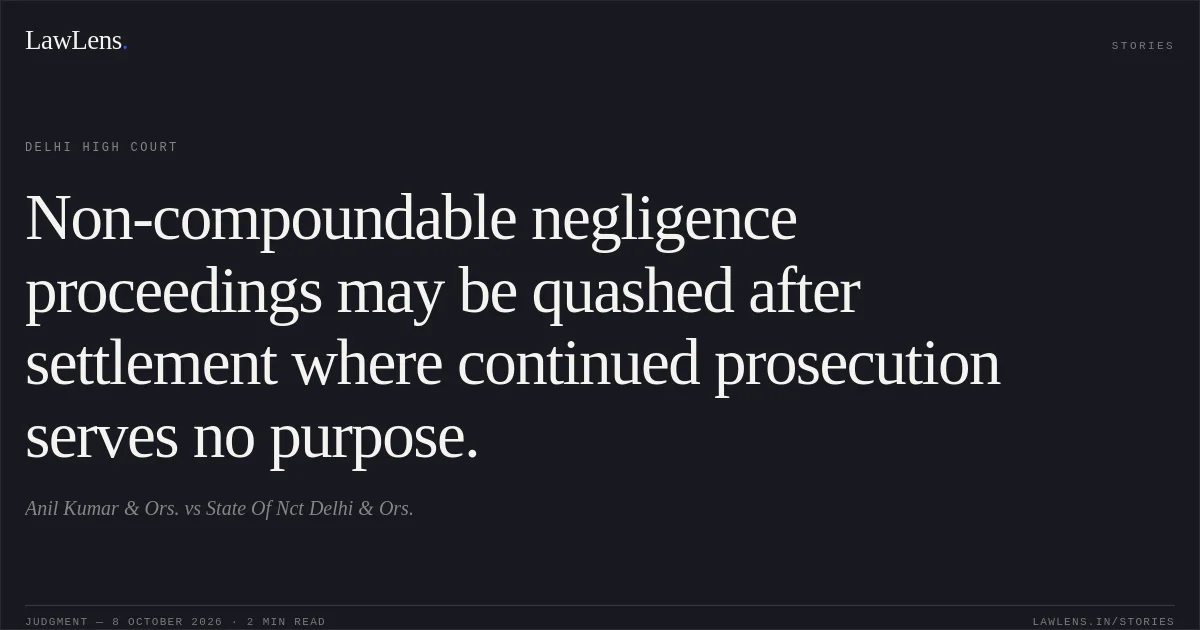
1. Whether the High Court could quash proceedings for non-compoundable offences under Sections 285/304A/34 IPC on the basis of a settlement with the deceased workers’ legal heirs.
Source reference: paras. 18–212. Whether, in the circumstances of this case, continuation of the prosecution would serve a useful purpose or instead warrant quashing to secure the ends of justice.
Source reference: paras. 22–25Law Applied
Section 528 of the BNSS, corresponding to Section 482 CrPC, preserves the High Court’s inherent power to prevent abuse of the process of a court or secure the ends of justice; that power is distinct from statutory compounding and may extend to non-compoundable offences.
Source reference: paras. 1, 19, 21Under Gian Singh v. State of Punjab, (2012) 10 SCC 303, and Parbatbhai Aahir v. State of Gujarat, (2017) 9 SCC 641, the High Court must assess the nature and gravity of the offence, the circumstances of settlement, the likelihood of conviction, and the public interest; serious offences affecting society ordinarily should not be quashed merely because the parties have settled.
Source reference: paras. 20–21Reasoning
The Court noted that the offences were non-compoundable, but found that all petitioners and the deceased workers’ legal heirs had entered into a settlement, the agreed compensation had been paid, and the legal heirs unequivocally did not wish to pursue the prosecution.
Source reference: paras. 18, 22–23It also observed that the incident appeared to have resulted from an accidental fire in the IGL pipeline.
Source reference: para. 24In these circumstances, the Court concluded that further proceedings would serve no fruitful purpose and would waste judicial time and resources.
Source reference: para. 25Holding
The Court allowed the petition and quashed FIR No. 220/2024, registered at PS Burari under Sections 285/337/304A IPC, and all consequential proceedings.
It directed the petitioners to pay Rs. 30,000 as costs to the Delhi High Court Bar Association within two weeks and to file proof of payment with the Court and the Investigating Officer.
Source reference: paras. 27–28The petition and pending applications were disposed of.
Source reference: para. 29Acts & Sections Cited
6 provisions across 3 statutes referred to in this judgment. Each provision opens on LawLens.
Bharatiya Nagarik Suraksha Sanhita, 20231
Code of Criminal Procedure, 19732
Indian Penal Code, 18603
Original Court PDF
Anil Kumar & Ors.vsState Of Nct Delhi & Ors.
Click to open original judgment
Original judgment, available to read, download and summarize on LawLens.in