Facts
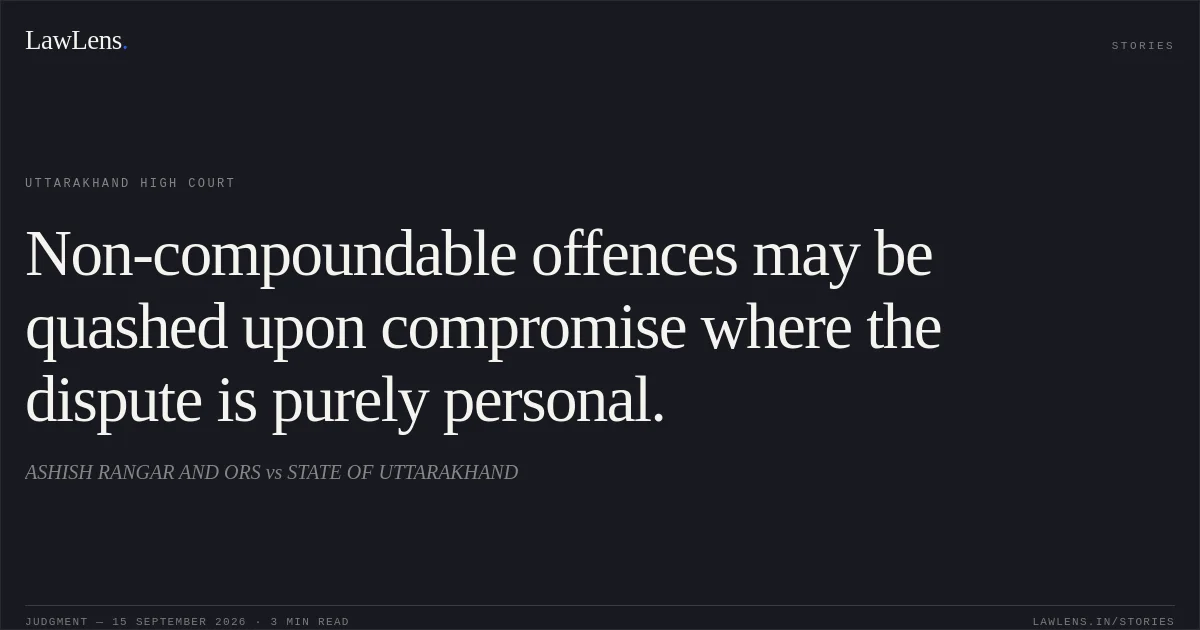
The applicants invoked Section 528 of the Bharatiya Nagarik Suraksha Sanhita, 2023, seeking quashing of the charge-sheet and summoning order dated 4 February 2026 passed by the ACJM/Vth Additional Civil Judge (Senior Division), Dehradun, in Criminal Case No. 2297 of 2026 arising from Case Crime No. 186 of 2025 under Sections 117(1), 191(2), 351(2) and 352 of the Bharatiya Nyaya Sanhita, 2023.
Source reference: para. 1The applicants, the informant/respondent no. 3, and the injured person appeared through video conferencing and were identified by their respective counsel.
Source reference: para. 4The parties filed a compounding application, affidavits and a compromise memo, stating that the dispute had been amicably resolved and that the informant and injured person did not wish to prosecute the applicants further.
Source reference: paras. 5–7Although two of the offences were non-compoundable, the State expressed no objection to the application in view of the personal nature of the dispute and the settlement between the parties.
Source reference: para. 8Issues
Whether the High Court could exercise its jurisdiction under Section 528 of the Bharatiya Nagarik Suraksha Sanhita, 2023 to permit compounding/quash criminal proceedings involving non-compoundable offences where the dispute was personal and had been amicably settled.
Source reference: paras. 1, 8–11Whether the charge-sheet and summoning order arising from the settled dispute ought to be quashed to secure the ends of justice.
Source reference: paras. 10–12Law Applied
The Court exercised its inherent jurisdiction under Section 528 of the Bharatiya Nagarik Suraksha Sanhita, 2023 to prevent the abuse of process and secure the ends of justice.
Source reference: para. 1It relied on Gian Singh v. State of Punjab, 2012 (10) SCC 303; Dimpey Gujral v. Union Territory, Chandigarh, (2013) 11 SCC 497; B.S. Joshi v. State of Haryana, (2003) 4 SCC 675; and Nikhil Merchant v. CBI, (2008) 9 SCC 677, for the principle that criminal proceedings involving non-compoundable offences may be quashed by the High Court when the dispute is predominantly private or personal, the parties have genuinely settled their differences, and continuation of the prosecution would serve no useful purpose.
Source reference: para. 9The underlying offences were Sections 117(1), 191(2), 351(2) and 352 of the Bharatiya Nyaya Sanhita, 2023.
Source reference: paras. 1, 11–12Reasoning
The Court verified the settlement by interacting with the informant and the injured person, who confirmed that they did not wish to pursue the prosecution, consistent with their affidavits and the compromise memo.
Source reference: paras. 5–7It noted that the dispute was personal in nature, that the parties had voluntarily resolved it, and that the State had no objection despite the non-compoundable character of two offences.
Source reference: para. 8Applying the principles in the cited Supreme Court authorities, the Court held that requiring the parties to undergo a criminal trial in these circumstances would be a futile exercise and that quashing the proceedings would better serve the ends of justice.
Source reference: paras. 9–11Holding
The Court allowed the compounding application and quashed the charge-sheet and the summoning order dated 4 February 2026 in Criminal Case No. 2297 of 2026 arising out of Case Crime No. 186 of 2025 under Sections 117(1), 191(2), 351(2) and 352 of the Bharatiya Nyaya Sanhita, 2023.
Criminal Misc. Application No. 1292 of 2026 was accordingly disposed of, and the compounding application and compromise memo were directed to form part of the order.
Source reference: paras. 13–14Acts & Sections Cited
5 provisions across 2 statutes referred to in this judgment. Each provision opens on LawLens.
Bharatiya Nagarik Suraksha Sanhita, 20231
Bharatiya Nyaya Sanhita, 20234
Original Court PDF
ASHISH RANGAR AND ORSvsSTATE OF UTTARAKHAND
Click to open original judgment
Original judgment, available to read, download and summarize on LawLens.in