Facts
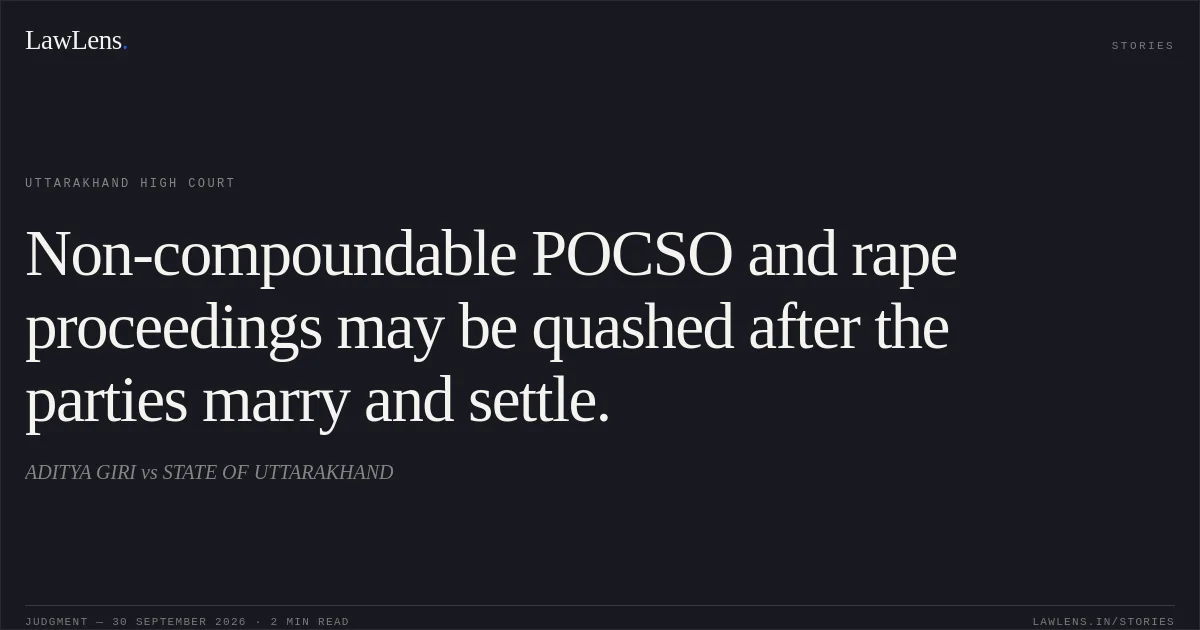
The applicant sought quashing of the charge-sheet, cognizance order and proceedings in Special Sessions Trial No. 99 of 2022, arising from offences under Sections 363, 366A and 376 IPC and Sections 3/4 of the POCSO Act.
Source reference: para. 2, para. 11The victim appeared before the Court and stated that she had married the applicant, was living happily with him and did not wish to prosecute him. Her father also supported the settlement and stated that he no longer wished to pursue the case; affidavits and the marriage certificate were placed on record.
Source reference: para. 3–6The State submitted that the alleged offences were non-compoundable, while not disputing that the parties had married.
Source reference: para. 7Issues
Whether the criminal proceedings for the alleged non-compoundable offences should be quashed under Section 482 CrPC in light of the parties’ marriage and settlement.
Source reference: para. 7–10Whether, in the circumstances, continuation of the trial would serve any useful purpose.
Source reference: para. 8, para. 10Law Applied
The Court relied on its inherent jurisdiction under Section 482 CrPC to quash criminal proceedings, notwithstanding that the offences charged under Sections 363, 366A and 376 IPC and Sections 3/4 of the POCSO Act are non-compoundable.
Source reference: para. 2, para. 7, para. 10–11It referred to Gian Singh v. State of Punjab, (2012) 10 SCC 303; Dimpey Gujral v. Union Territory, Chandigarh, (2013) 11 SCC 497; B.S. Joshi v. State of Haryana, (2003) 4 SCC 675; and Nikhil Merchant v. CBI, (2008) 9 SCC 677, as authorities concerning quashing of non-compoundable offences.
Source reference: para. 9It also relied on Ayyub Malik v. State of Uttarakhand, 2026 SCC OnLine SC 637, in which the Supreme Court quashed proceedings in light of the parties’ marital relationship and circumstances.
Source reference: para. 8Reasoning
The Court considered the victim’s statement and affidavit, the marriage certificate, the father’s support for the settlement, and the parties’ assertion that they were living together happily and had settled the dispute voluntarily.
Source reference: para. 4–6Although the offences were non-compoundable, the Court treated the application as one warranting quashing in exercise of its inherent jurisdiction, relying particularly on Ayyub Malik. It concluded that continuing the trial would serve no useful purpose and could disrupt the parties’ married life.
Source reference: para. 8–10Holding
The Court allowed the compounding application and quashed the charge-sheet, cognizance order and all subsequent proceedings in Special Sessions Trial No. 99 of 2022 against the applicant.
The Section 482 application was disposed of, and any pending applications were also disposed of.
Source reference: para. 12–13Acts & Sections Cited
8 provisions across 3 statutes referred to in this judgment. Each provision opens on LawLens.
Code of Criminal Procedure, 19731
Indian Penal Code, 18603
Original Court PDF
ADITYA GIRIvsSTATE OF UTTARAKHAND
Click to open original judgment
Original judgment, available to read, download and summarize on LawLens.in