Facts
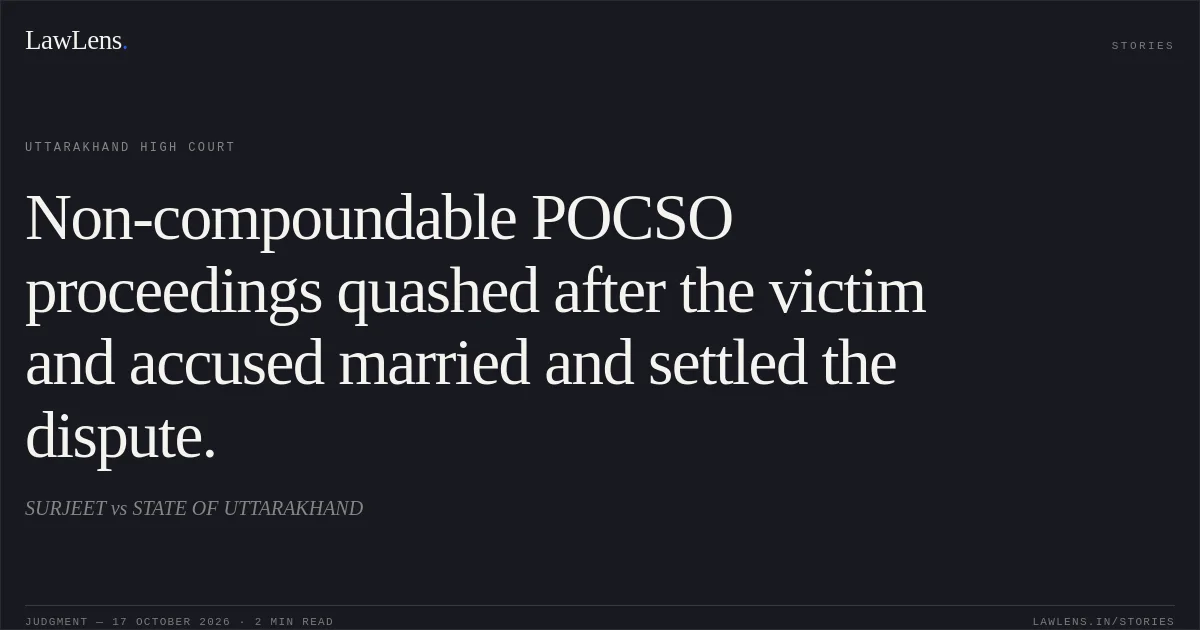
The applicant sought to quash the chargesheet, cognizance/summoning order dated 26 June 2024, and consequential proceedings in a case alleging offences under Sections 363, 366-A and 376 IPC and Sections 5(B)/6 of the POCSO Act.
Source reference: para. 4The complainant, the victim’s father, had alleged that his minor daughter was enticed away and abducted; the applicant acknowledged that she was 16 at the time of the alleged incident.
Source reference: paras. 5–6The applicant stated that they had been in a relationship, later married after she attained majority, and were living together.
Source reference: para. 7The complainant and victim supported a joint application to settle the matter; the victim told the Court that the settlement was voluntary and that she did not wish to pursue the proceedings.
Source reference: paras. 8–9The State opposed quashing on the basis that the alleged offences were serious and non-compoundable.
Source reference: para. 10Issues
Whether the High Court could exercise its inherent jurisdiction to quash proceedings for non-compoundable offences, including POCSO offences, on the basis of a settlement between the parties.
Source reference: paras. 14–15Whether, in the circumstances of this case, continuation of the prosecution would be an abuse of process or contrary to the ends of justice.
Source reference: paras. 16–17Law Applied
The Court relied on its inherent powers under Section 528 of the Bharatiya Nagarik Suraksha Sanhita, 2023 (and referred to Section 482 CrPC), which may be exercised to quash criminal proceedings to prevent abuse of process or secure the ends of justice, including in appropriate cases involving non-compoundable offences.
Source reference: paras. 14–15It applied Gian Singh v. State of Punjab, (2012) 10 SCC 303, on quashing proceedings where a dispute is overwhelmingly personal and the settlement serves the ends of justice; Narinder Singh v. State of Punjab, (2014) 6 SCC 466, on assessing whether continuation would be futile and contrary to justice; and Parbatbhai Aahir v. State of Gujarat, (2017) 9 SCC 641, on the breadth of the inherent power and the need to consider the nature of the offence and circumstances of the case.
Source reference: para. 15Reasoning
The Court treated the dispute as arising from a personal relationship and noted that the applicant and victim had married after attaining majority and were living together.
Source reference: para. 12It accepted the complainant’s and victim’s statements that the compromise was voluntary and free from coercion.
Source reference: para. 13Although the State emphasised the serious, non-compoundable nature of the alleged offences, the Court considered the parties’ settlement and the victim’s wish not to continue the case, and concluded that further proceedings would serve no fruitful purpose and adversely affect their matrimonial life.
Source reference: paras. 10, 16–17Holding
The Court held that this was a fit case to exercise its inherent powers to secure the ends of justice and prevent abuse of process.
It allowed the joint compounding application and quashed the chargesheet, the cognizance/summoning order dated 26 June 2024, and the consequential proceedings in Special Sessions Trial No. 87 of 2024 arising from Case Crime No. 0080 of 2024; the application was allowed and pending applications were disposed of.
Source reference: paras. 18–21Acts & Sections Cited
6 provisions across 4 statutes referred to in this judgment. Each provision opens on LawLens.
Indian Penal Code, 18602
Code of Criminal Procedure, 19731
Bharatiya Nagarik Suraksha Sanhita, 20231
Original Court PDF
SURJEETvsSTATE OF UTTARAKHAND
Click to open original judgment
Original judgment, available to read, download and summarize on LawLens.in