Facts
The petitioners, Accused Nos. 1–8, sought to quash proceedings in C.C. No. 743/2026 before the II JMFC, Belagavi, arising from Crime No. 233/2024 of Malmaruti Police Station.
Source reference: p.3The prosecution concerned alleged offences under Sections 189(2), 191(2), 115(2), 126(2), 74, 352, 351(2) and 190 of the Bharatiya Nyaya Sanhita, 2023
Source reference: p.3During the petition, the petitioners and the de facto complainant filed a joint application and affidavits stating that they had amicably settled the dispute voluntarily and without coercion
Source reference: p.3–15The State and the complainant’s counsel did not oppose quashing on the basis of the settlement
Source reference: p.15Issues
Whether the High Court could quash the criminal proceedings for the alleged non-compoundable offences under its inherent jurisdiction, notwithstanding the settlement between the parties
Source reference: p.15–16Whether, in the circumstances of the case, continuing the prosecution would amount to an abuse of process or would be unnecessary to secure the ends of justice
Source reference: p.21–22Law Applied
The Court invoked Section 482 of the Code of Criminal Procedure, read with Section 528 of the Bharatiya Nagarik Suraksha Sanhita, 2023, as the basis for exercising inherent jurisdiction to quash proceedings, including in cases involving non-compoundable offences
Source reference: p.3, p.15–16It distinguished that power from statutory compounding under Section 320 CrPC and relied on Narinder Singh & Ors. v. State of Punjab & Anr., (2014) 6 SCC 466, which holds that the High Court may quash non-compoundable offences following settlement where doing so serves the ends of justice or prevents abuse of process.
Source reference: p.16–21The power must be exercised cautiously, with attention to the nature and gravity of the offences, the likelihood of conviction, and the stage of proceedings
Source reference: p.16–21Reasoning
The Court considered the dispute to have arisen between the complainant and the accused and found that the parties had settled it with the intervention of family elders, without compulsion or coercion
Source reference: p.15, p.21It noted that the accused persons’ roles were not clearly established and that the complainant had not stated a clear direct nexus between them and the alleged offences; it therefore considered the prospect of conviction remote
Source reference: p.21–22Applying the principles in Narinder Singh, the Court concluded that continuing the prosecution after the settlement would be unnecessary and would amount to an abuse of process
Source reference: p.16–21Holding
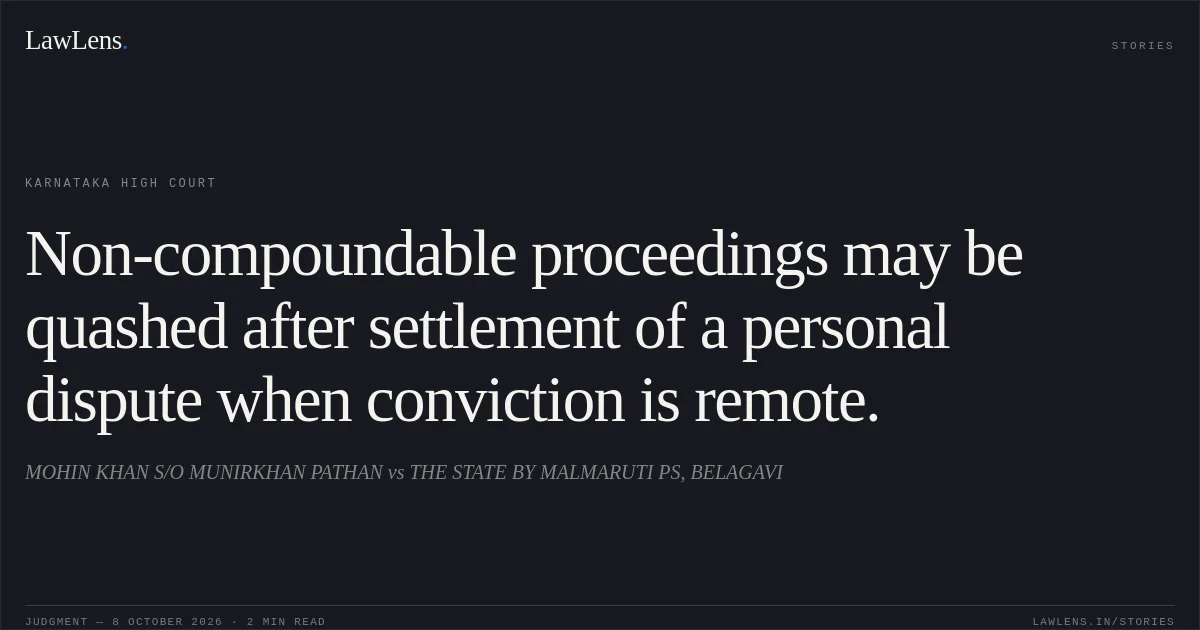
The Court accepted the compromise and allowed the criminal petition.
It quashed the proceedings in C.C. No. 743/2026, arising from Crime No. 233/2024 and pending before the II JMFC, Belagavi, for the offences charged under the BNS; I.A. No. 2/2026 was allowed accordingly
Source reference: p.22–23Acts & Sections Cited
16 provisions across 4 statutes referred to in this judgment. Each provision opens on LawLens.
Code of Criminal Procedure, 19732
Bharatiya Nyaya Sanhita, 20238
Bharatiya Nagarik Suraksha Sanhita, 20232
Indian Penal Code, 18604
Original Court PDF
MOHIN KHAN S/O MUNIRKHAN PATHANvsTHE STATE BY MALMARUTI PS, BELAGAVI
Click to open original judgment
Original judgment, available to read, download and summarize on LawLens.in