Facts
The petitioner challenged FIR No. 0209 of 2026, registered at Police Station Haldwani under Sections 305(a), 331(2) and 317(2) of the Bharatiya Nyaya Sanhita, 2023 (BNS), following an alleged theft from the informant’s premises.
Source reference: p.1The petitioner and informant filed a joint application and affidavits stating that they had amicably settled the dispute; the informant stated she no longer wished to prosecute and had no objection to quashing the FIR.
Source reference: pp.1–2The State submitted that Section 317(2) was compoundable, whereas Sections 305(a) and 331(2) were non-compoundable.
Source reference: p.2Issues
1. Whether the High Court could quash an FIR involving non-compoundable offences on the basis of a settlement between the petitioner and the informant.
Source reference: pp.2–32. Whether, in light of the settlement and the circumstances presented, continuation of the criminal proceedings would be contrary to the interests of justice.
Source reference: pp.3–4Law Applied
The Court relied on B.S. Joshi v. State of Haryana, (2003) 4 SCC 675, for the principle that Section 320 CrPC does not bar the High Court from quashing proceedings where necessary to secure the ends of justice.
Source reference: p.2It also applied Gian Singh v. State of Punjab, (2013) 1 SCC (Cri) 160, which holds that the High Court’s power to quash under its inherent jurisdiction is distinct from statutory compounding and may be exercised, depending on the facts, where a settlement makes conviction remote or bleak and continuing the proceedings would cause injustice or amount to an abuse of process.
Source reference: pp.2–3The Court stated that its extraordinary power under Article 226 of the Constitution is not limited by Section 320 CrPC.
Source reference: p.3Reasoning
The Court accepted that the parties had settled the matter and considered the informant’s statement that she did not wish to pursue the case.
Source reference: p.2It also noted the petitioner’s submission that he suffered from a disorder and the informant’s acknowledgment of his mental disorder.
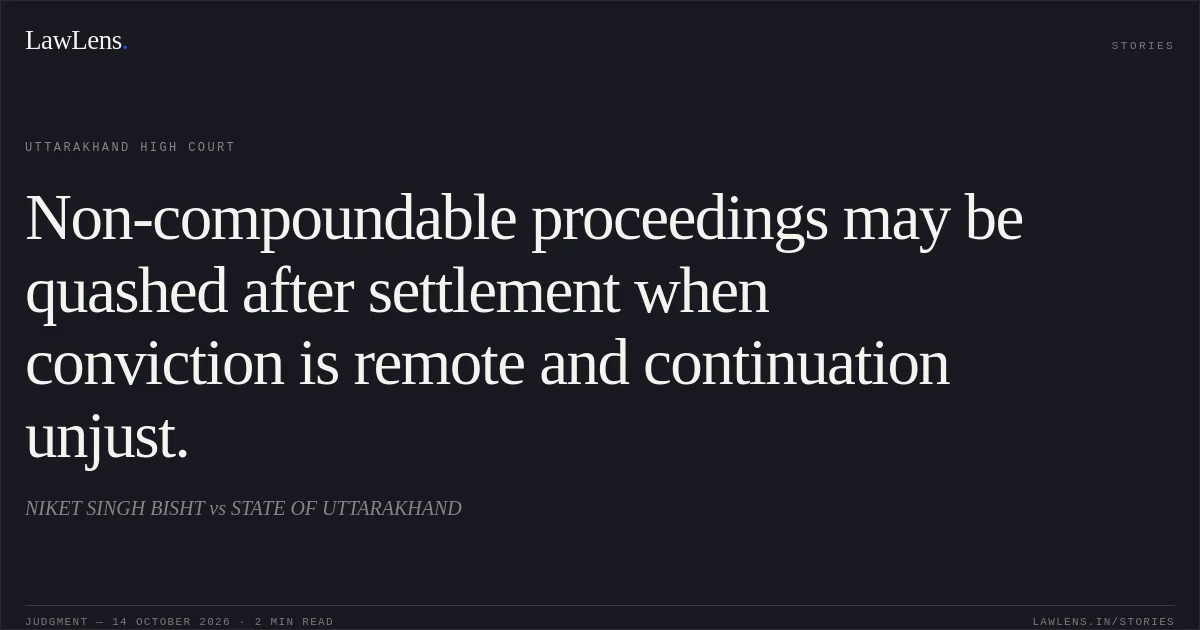
Source reference: p.2Applying Gian Singh, the Court concluded that the settlement left only a remote or bleak possibility of conviction and that continuing the proceedings would be unfair or contrary to the interests of justice.
Source reference: pp.3–4It therefore treated the case as appropriate for quashing notwithstanding that Sections 305(a) and 331(2) were non-compoundable.
Source reference: pp.2–4Holding
The Court allowed the joint compounding application, accepted the compromise, and quashed FIR No. 0209 of 2026 under Sections 305(a), 331(2) and 317(2) BNS.
It directed that all subsequent proceedings arising from the FIR would consequently come to an end and allowed the writ petition.
Source reference: p.4Acts & Sections Cited
4 provisions across 2 statutes referred to in this judgment. Each provision opens on LawLens.
Bharatiya Nyaya Sanhita, 20233
Code of Criminal Procedure, 19731
Original Court PDF
NIKET SINGH BISHTvsSTATE OF UTTARAKHAND
Click to open original judgment
Original judgment, available to read, download and summarize on LawLens.in


