Facts
The petitioner, Surendra Tiwary, was an accused in Bhagwanpur P.S. Case No. 70 of 2022, arising from allegations of an altercation and assault involving the petitioner and other accused persons, including an allegation under Section 307 of the Indian Penal Code (“IPC”).
Source reference: p. 2, para. 3The case was pending as Sessions Trial No. 282 of 2023 before the IXth Additional District and Sessions Judge, Kaimur at Bhabua.
Source reference: p. 1, para. 2The petitioner’s discharge petition was dismissed by order dated 16 January 2024, which he challenged before the High Court.
Source reference: p. 1, para. 2The parties were agnates and claimed that the dispute arose from a bona fide land-related disagreement.
Source reference: p. 2, para. 4The petitioner asserted that the injuries were simple and that the parties had subsequently amicably settled the dispute.
Source reference: p. 2, para. 4Opposite Party No. 2 filed a counter-affidavit confirming the settlement and stating that he no longer wished to pursue the prosecution.
Source reference: p. 2, para. 5The parties also agreed that the petitioner would withdraw Bhagwanpur P.S. Case No. 71 of 2022, instituted against opposite party no. 2.
Source reference: p. 2, para. 5Issues
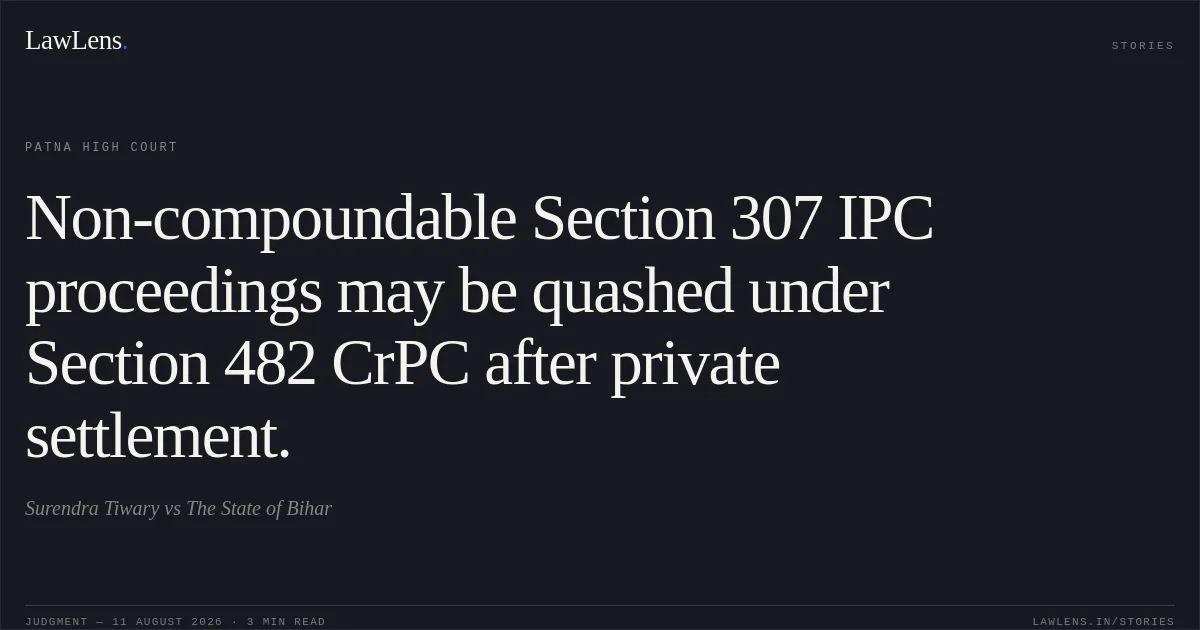
Whether the High Court should exercise its inherent jurisdiction under Section 482 of the Code of Criminal Procedure, 1973 (“CrPC”) to quash the criminal proceedings arising from an offence under Section 307 IPC on the basis of an amicable settlement between the parties.
Source reference: pp. 3–5, paras. 6–8Whether continuation of the prosecution, in light of the compromise, the parties’ close relationship, and the circumstances of the dispute, would serve any useful purpose.
Source reference: p. 6, para. 9Whether the order dated 16 January 2024 dismissing the petitioner’s discharge petition should be quashed.
Source reference: p. 6, para. 10Law Applied
The Court applied Section 482 CrPC, which preserves the High Court’s inherent power to prevent abuse of the process of court and secure the ends of justice, even in respect of non-compoundable offences under Section 320 CrPC.
Source reference: pp. 3–5, paras. 7–8It considered Section 307 IPC, observing that although the offence is non-compoundable, proceedings may be quashed in appropriate cases where the dispute is predominantly private or civil in character and the compromise does not implicate significant public policy concerns.
Source reference: p. 3, para. 6Relying on State of Madhya Pradesh v. Laxmi Narayan, (2019) 5 SCC 688, and Ramgopal v. State of Madhya Pradesh, (2022) 14 SCC 531, the Court held that the power under Section 482 CrPC may be exercised beyond the statutory limits of Section 320 CrPC, but cautiously, having regard to the nature and gravity of the offence, its impact on society, and the antecedents and conduct of the accused.
Source reference: pp. 3–5, paras. 7–8The Court also referred to Narinder Singh v. State of Punjab, (2014) 6 SCC 466, for the caution applicable to quashing proceedings on the basis of compromise.
Source reference: p. 5, para. 8Reasoning
The Court found that the dispute arose from a petty altercation between closely related agnates in the context of a land dispute and that the injured persons had suffered only simple injuries.
Source reference: pp. 2–3, paras. 4–6Although Section 307 IPC had been invoked and was non-compoundable, the Court held that the circumstances did not disclose an element of public policy or a prosecution involving the kind of heinous, socially harmful conduct for which compromise-based quashing would be inappropriate.
Source reference: p. 3, para. 6; pp. 3–5, paras. 7–8The compromise was specifically confirmed by opposite party no. 2 through a counter-affidavit, and the parties’ joint submissions demonstrated that their relations had been restored.
Source reference: pp. 2–3, paras. 5–6Applying the principles in Laxmi Narayan and Ramgopal, the Court concluded that continuing the prosecution would serve no useful purpose and would merely perpetuate bitterness and acrimony between the parties.
Source reference: p. 6, para. 9Holding
The High Court answered the issues in favour of the petitioner and exercised its inherent jurisdiction under Section 482 CrPC.
It quashed the order dated 16 January 2024 passed by the IXth Additional District and Sessions Judge, Kaimur at Bhabua, in Sessions Trial No. 282 of 2023, arising out of Bhagwanpur P.S. Case No. 70 of 2022.
Source reference: p. 6, para. 10The criminal proceedings were consequently terminated on the basis of the parties’ compromise, and the application was allowed.
Source reference: p. 6, para. 10; concluding orderActs & Sections Cited
3 provisions across 2 statutes referred to in this judgment. Each provision opens on LawLens.
Indian Penal Code, 18601
Code of Criminal Procedure, 19732
Original Court PDF
Surendra TiwaryvsThe State of Bihar
Click to open original judgment
Original judgment, available to read, download and summarize on LawLens.in