Facts
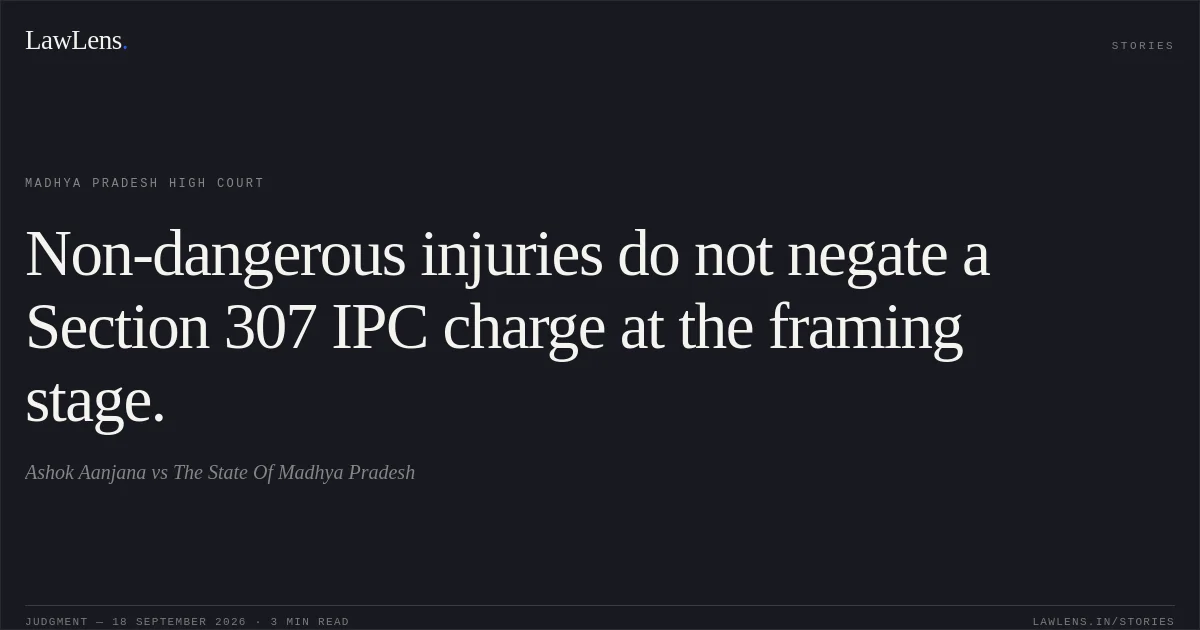
The petitioners filed a criminal revision under Section 438 read with Section 442 of the Bharatiya Nagarik Suraksha Sanhita, 2023, corresponding to Sections 397 and 401 of the Code of Criminal Procedure, 1973, challenging the order dated 18 February 2025 passed by the Second Additional Sessions Judge, Dr. Ambedkar Nagar, District Indore, in Sessions Trial No. 28/2024.
Source reference: p.2, para.1The prosecution alleged that, on 13 September 2023, during a Jan Aashirwaad Yatra at Gram Nayapura Charodiya, an altercation took place between the complainant’s group and the petitioners’ group. Petitioner No. 1 allegedly struck the complainant on the head with a sword, while Petitioner No. 2 allegedly caused injury with an iron rod; other co-accused persons allegedly assaulted members of the complainant’s party with rods and sticks.
Source reference: pp.2–3, paras.3–4The Trial Court framed charges against Petitioner No. 1 under Sections 294, 307/34, 324/34 and 506 Part II of the IPC and Section 25(1-B)(b) of the Arms Act, and against Petitioner No. 2 under Sections 294, 307/34, 324/34 and 506 Part II of the IPC.
Source reference: p.2, para.2The petitioners’ discharge application had earlier been dismissed on 28 November 2024.
Source reference: p.3, para.5Issues
1. Whether the material on record disclosed a prima facie case warranting framing of charges under Section 307 read with Section 34 of the IPC and the other charged provisions.
Source reference: p.5, paras.11–142. Whether the alleged counter-case, the petitioners’ claim that the complainant’s party was the aggressor, the alleged heat-of-the-moment incident, and the medical opinion that the injury was not dangerous to life justified quashing the charges at the stage of revision.
Source reference: pp.5–6, paras.13–153. Whether the Trial Court’s order framing charges suffered from perversity, illegality, jurisdictional error, or resulted in a gross miscarriage of justice.
Source reference: pp.4–6, paras.11, 15–16Law Applied
The Court applied Sections 397 and 401 of the Cr.P.C., read with Sections 438 and 442 of the BNSS, concerning revisional jurisdiction, and held that such jurisdiction is not equivalent to appellate jurisdiction and does not ordinarily permit re-appreciation of evidence or a mini-trial at the stage of framing charges.
Source reference: p.2, para.1; p.4, para.11The Court considered Sections 294, 307/34, 324/34 and 506 Part II of the IPC, together with Section 25(1-B)(b) of the Arms Act; for Section 307, the relevant question at the charge stage was whether the material prima facie suggested the requisite intention or knowledge to commit culpable homicide amounting to an attempt to murder, rather than whether the injury was ultimately dangerous to life.
Source reference: pp.2, 5, paras.2, 12–14The governing principle is that, while framing charges, the Court must assess whether the prosecution material discloses sufficient grounds to proceed, without conclusively determining disputed facts or evaluating the evidence as it would after trial.
Source reference: p.5, para.14The Court also referred to State of Haryana v. Bhajan Lal, 1992 AIR 604, relied upon by the petitioners, in the context of quashing proceedings to prevent a gross miscarriage of justice.
Source reference: p.4, para.8Reasoning
The Court found that the prosecution specifically alleged the use of a sword and an iron rod and attributed assaults to the petitioners, thereby disclosing serious allegations sufficient to justify proceeding under Section 307 read with Section 34 of the IPC.
Source reference: p.5, para.12The petitioners’ arguments regarding the identity of the aggressor, the counter-case, the circumstances of the altercation, and the precise evidentiary significance of the medical opinion were treated as disputed questions of fact requiring examination at trial.
Source reference: p.5, para.13The opinion that the complainant’s injury was “grievous but not dangerous to life” was not considered determinative at the charge stage, since the evidentiary value of that opinion and the petitioners’ intention or knowledge had to be tested through evidence.
Source reference: p.5, para.14As the Trial Court had considered the charge-sheet material and its order disclosed neither perversity nor jurisdictional error, the revisional Court declined to interfere.
Source reference: p.6, paras.15–16Holding
The High Court held that sufficient prima facie material existed to proceed against the petitioners and that the disputed factual issues could not be adjudicated in revision or through a mini-trial at the stage of framing charges.
The criminal revision was dismissed, and the order dated 18 February 2025 framing charges in Sessions Trial No. 28/2024 was affirmed.
Source reference: p.6, para.17The Trial Court was directed to proceed with the trial in accordance with law and without being influenced by the observations made in the revisional order.
Source reference: p.6, para.17Acts & Sections Cited
10 provisions across 4 statutes referred to in this judgment. Each provision opens on LawLens.
Bharatiya Nagarik Suraksha Sanhita, 20232
Code of Criminal Procedure, 19732
Indian Penal Code, 18605
Arms Act, 19591
Original Court PDF
Ashok AanjanavsThe State Of Madhya Pradesh
Click to open original judgment
Original judgment, available to read, download and summarize on LawLens.in