Facts
The petitioner represents 361 slum dwellers whose hutments on Western Railway land were demolished for the Surat-Udhna-Jalgaon Third Railway Line Project
Source reference: p. 3Following previous litigation in WP(PIL) 222 of 2014 and subsequent appeals to the Supreme Court, the railway land was cleared, and eligible dwellers were to be rehabilitated under the Pradhan Mantri Awas Yojana (PMAY)
Source reference: p. 8-9The Supreme Court had previously directed that applications be accepted without the initial ₹20,000/- deposit, but stipulated that once found eligible, applicants must pay the deposit within three months to proceed with allotment
Source reference: p. 14Out of 2,450 claims, 1,901 were found eligible, including the 361 individuals represented here
Source reference: p. 11-12The petitioners failed to deposit the mandatory ₹20,000/- despite multiple extensions granted until May 2023
Source reference: p. 12They filed this PIL in 2026 seeking a direction to allow them to pay the deposit now and be considered for allotment or alternative schemes like JnURM
Source reference: p. 2Issues
1. Whether the petitioners are entitled to seek a revival of the allotment process and a relaxation of the deposit condition after failing to meet the court-sanctioned timelines
Source reference: p. 14 / para. 17-182. Whether the court should exercise its writ jurisdiction to grant humanitarian relief against the established terms of a rehabilitation scheme after a significant delay
Source reference: p. 15 / para. 22-23Law Applied
The Court applied the principles of rehabilitation under the Pradhan Mantri Awas Yojana (PMAY) and the specific directions issued by the Supreme Court in SLP (C) Diary No. 19714/2021.
Source reference: no citationThe legal rule established by the Apex Court in its interim order dated 18.02.2022 was that while the initial deposit is not a pre-condition for filing an application, it is a mandatory requirement once eligibility is determined
Source reference: p. 14The doctrine of laches/delay was relevant, as the court noted the petition was filed after a gap of three years without sufficient explanation
Source reference: p. 15Reasoning
The High Court reasoned that the petitioners were already granted significant procedural indulgence by both the High Court and the Supreme Court. Specifically, the Supreme Court had relaxed the initial deposit rule but explicitly maintained that the deposit must be made within three months of eligibility notification
Source reference: p. 14The petitioners admitted to receiving notice and requesting extensions, which were granted but still went unfulfilled
Source reference: p. 12The Court found no substance in the argument that the condition was "onerous," as the Supreme Court had already held that all prescribed terms and conditions of the scheme must be met
Source reference: p. 15The Court observed that the petitioners sat on their rights for three years before filing this petition. Granting relief at this late stage would disrupt the scheme and open "floodgates" for others who ignored mandatory conditions, potentially blocking housing meant for other needy, compliant citizens
Source reference: p. 15Holding
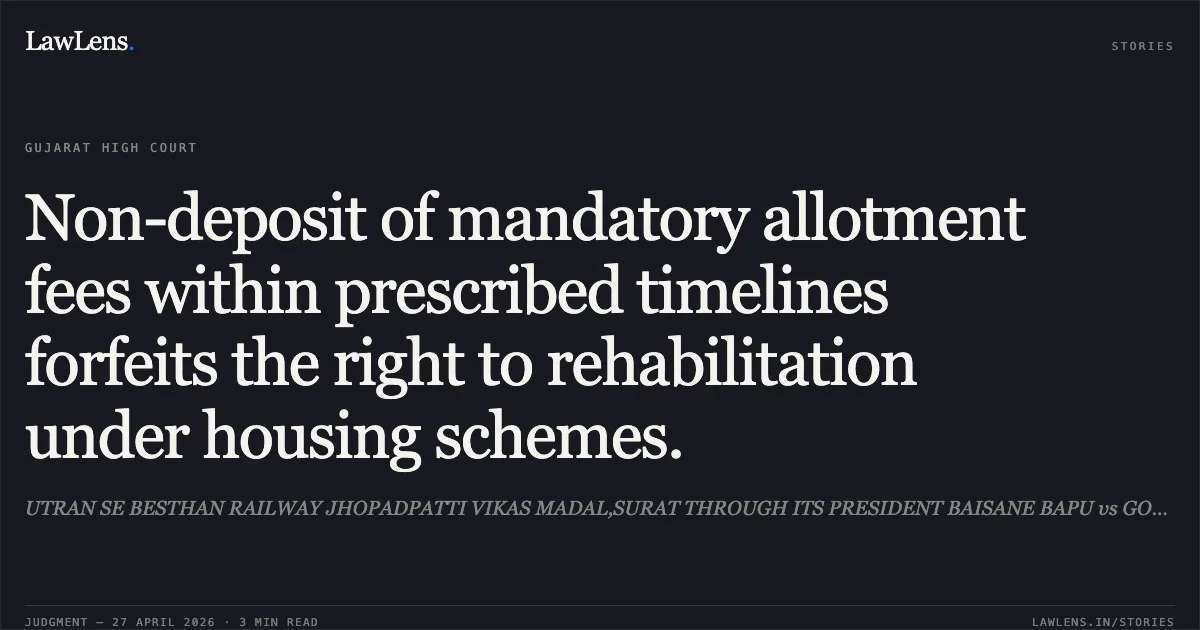
The Court dismissed the petition, holding that there was no justification to relax the mandatory deposit conditions or revive the allotment process after such a delay
The court answered the issues in the negative, stating that the allotment for rehabilitation under PMAY was strictly subject to the fulfillment of prescribed conditions as per the Apex Court's directions, and no humanitarian grounds justified a deviation where the applicants had failed to adhere to timelines. All requested reliefs were denied.
Source reference: p. 15-16Acts & Sections Cited
4 provisions across 4 statutes referred to in this judgment. Linked provisions open on LawLens.
Public Premises (Eviction Of Unauthorised Occupants) Act, 19711
Pradhan Mantri Awas Yojana1
Chief Minister Awas Yojana1
Jawaharlal Nehru University Act, 19661
Original Court PDF
UTRAN SE BESTHAN RAILWAY JHOPADPATTI VIKAS MADAL,SURAT THROUGH ITS PRESIDENT BAISANE BAPUvsGOVERNMENT OF INDIA THROUGH THE SECRETARY MINISTRY OF HOUSING AND URBAN POVERTY ALLEVIATION
Click to open original judgment
Original judgment, available to read, download and summarize on LawLens.in


![Subsequent exoneration does not retrospectively invalidate a finalized promotion select list.. UNNIKRISHNAN M vs M/o Environment And Forests. CAT - ['Ernakulam']. LawLens](/stories/thumbnails/subsequent-exoneration-does-not-retrospectively-invalidate-a-finalized-promotion-select-li-ce80a0e84f2f4887857271e8b4341c42.webp)