Facts
The Respondent (original Petitioner) was appointed as an Assistant Teacher (Science-CBZ) by a private aided institution on 24.12.2022 following a public advertisement.
Source reference: para 4.2When the management submitted a proposal for approval of her appointment and admission to salary grant, the Deputy Director of Public Instructions (DDPI) issued an endorsement on 15.06.2023 rejecting the proposal.
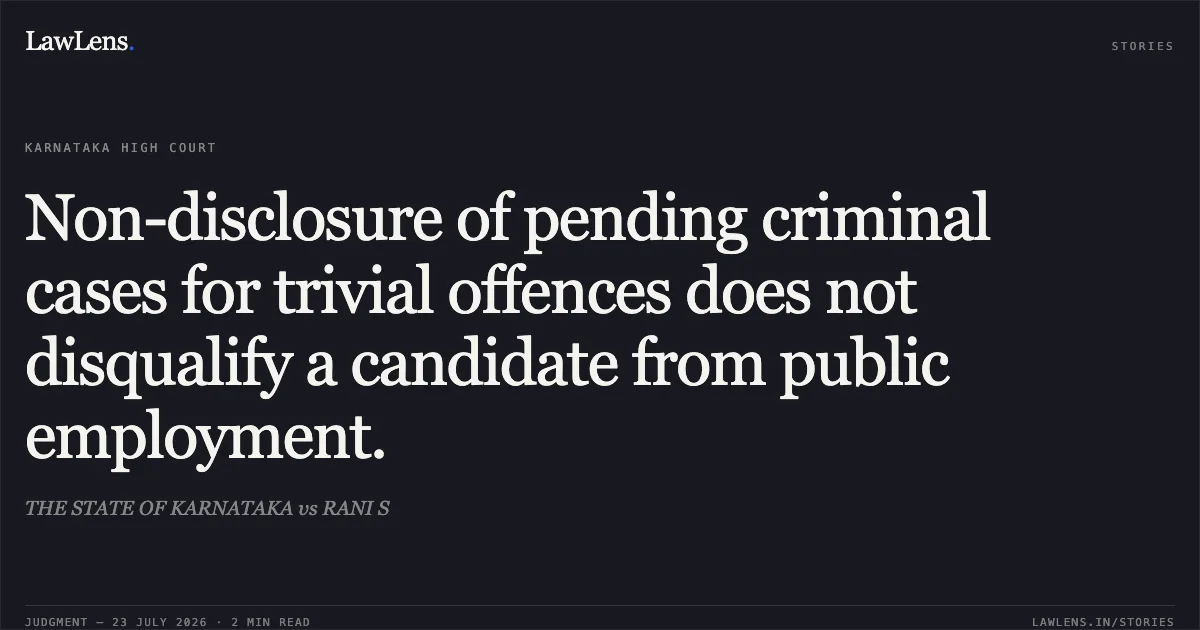
Source reference: para 4.4The rejection was based on a pending criminal case (C.C. No. 1895/2021) for trivial IPC offences (Sections 323, 324, 504, 506) involving a family feud, where the Respondent was accused of "exhorting" others.
Source reference: para 4.8A Single Judge of the High Court quashed the endorsement and directed approval of the appointment.
Source reference: para 2The State appealed this order, arguing that non-disclosure and "undesirable character" disqualified her under Rule 10 of the KCS (General Recruitment) Rules, 1977.
Source reference: para 4.6, 6Issues
1. Whether the pendency of a criminal case involving trivial offences and the alleged non-disclosure thereof constitutes a valid ground to deny approval of an appointment and salary grant.
Source reference: para 11, 162. Whether the character of the candidate can be deemed "undesirable" solely based on a pending charge sheet where the allegations do not involve moral turpitude.
Source reference: para 10, 14Law Applied
Rule 10 of the Karnataka Civil Services (General Recruitment) Rules, 1977, noting it requires verification of qualifications and character certificates but does not expressly mandate disqualification for pending cases.
Source reference: para 4.9, 4.10The Supreme Court’s decision in Avtar Singh v. Union of India (2016), which established that for trivial offences, the employer should not take a mechanical approach to non-disclosure.
Source reference: para 12, 13State of West Bengal v. Mitul Kumar Jana (2023), affirming that cases not involving moral turpitude or heinous crimes should not automatically result in termination or denial of appointment.
Source reference: para 12Reasoning
The Court observed that the criminal allegations against the Respondent were trivial, arising from a family feud, and lacked elements of moral turpitude.
Source reference: para 11Regarding the State's claim of "suppression," the Court found that the original job advertisement did not provide a specific format or column requiring the disclosure of pending criminal cases; thus, per Avtar Singh (para 38.10), a candidate cannot be penalized for not disclosing information that was never specifically asked for.
Source reference: para 14, 16The Court distinguished the State's cited precedent, State of U.P. v. Dinesh Kumar, noting it involved heinous crimes (including POCSO Act charges), whereas the present case involved simple "exhortation" in a family dispute.
Source reference: para 10, 11The Court concluded that until conviction, the candidate is presumed innocent and the mere filing of a charge sheet in a trivial matter does not demonstrate "adverse character."
Source reference: para 4.9, 17Holding
The Division Bench dismissed the Writ Appeal, confirming the Single Judge's order and held that the endorsement rejecting the Respondent’s appointment was unsustainable in law.
The Court directed the State-Appellants to take effective steps to approve the Respondent's appointment and admit her to salary grant within two months and dropped the contempt petition (CCC No. 732/2025).
Source reference: para 17, 19Acts & Sections Cited
2 provisions across 2 statutes referred to in this judgment. Each provision opens on LawLens.
KARNATAKA HIGH COURT ACT, 19611
Protection of Children from Sexual Offences Act, 20121
Original Court PDF
THE STATE OF KARNATAKAvsRANI S
Click to open original judgment
Original judgment, available to read, download and summarize on LawLens.in


![Subsequent exoneration does not retrospectively invalidate a finalized promotion select list.. UNNIKRISHNAN M vs M/o Environment And Forests. CAT - ['Ernakulam']. LawLens](/stories/thumbnails/subsequent-exoneration-does-not-retrospectively-invalidate-a-finalized-promotion-select-li-ce80a0e84f2f4887857271e8b4341c42.webp)