Facts
The prosecution originated from a complaint by Dharamvir Kumar alleging that on 25.11.2007, the appellants—armed with pistols—threatened his bataidar (sharecropper), Krishna Chaudhary, subjected them to caste-based insults, and forcibly stripped the bataidar.
Source reference: p. 3-4It was further alleged that the appellants assaulted the informant and snatched personal property, including a watch, a golden chain, and a shawl.
Source reference: p. 3-4After a trial in the Court of the Ist Addl. Distt. and Sessions Judge cum Special Judge, Sheikhpura, the appellants were convicted under Sections 147, 148, 323, 504, 379 of the IPC, Section 27 of the Arms Act, and Section 3(1)(x) of the SC/ST Act.
Source reference: p. 2The appellants challenged this conviction on grounds of material contradictions, absence of medical evidence, and non-examination of the Investigating Officer (IO).
Source reference: p. 5Issues
1. Whether the prosecution established the charges of rioting, assault, and theft beyond a reasonable doubt in light of material contradictions and absence of physical evidence?
Source reference: p. 5-72. Whether the absence of the Investigating Officer’s (IO) testimony and medical evidence caused significant prejudice to the defense?
Source reference: p. 5, 8-93. Whether the conviction under Section 3(1)(x) of the SC/ST Act is sustainable without proof of intentional insult in public view addressed to the caste identity?
Source reference: p. 8Law Applied
The court applied Section 379 IPC requiring proof of dishonest intention and identification of stolen property.
Source reference: p. 7It relied on the principle that to sustain a conviction under Section 3(1)(x) of the SC/ST Act, there must be intentional insult denigrating a caste in a "public view", citing Keshaw Mahto @ Keshaw Kumar Mahto v. State of Bihar.
Source reference: p. 8Regarding procedural lapses, the court applied the principles from Ravishwar Manjhi v. State of Jharkhand, which mandates that the examination of the IO is vital if his absence denies the defense the opportunity to confront witnesses with contradictions or causes significant prejudice.
Source reference: p. 9The "Benefit of Doubt" doctrine was applied as the overarching principle.
Source reference: p. 8Reasoning
The High Court found the trial court's judgment legally and factually infirm due to a cumulative breakdown of evidence. First, the court noted severe contradictions in the timing of the occurrence (9:00 AM vs. 12:00 Noon) and description of weapons.
Source reference: p. 6-7Second, the "hostile" nature of PW1 (the only independent witness) meant the prosecution version lacked corroboration.
Source reference: p. 6Third, the absence of an injury report or medical testimony rendered the conviction under Section 323 IPC baseless.
Source reference: p. 7-8Fourth, the court observed that the essential ingredients of Section 379 IPC (theft) and Section 27 of the Arms Act were not proven as no weapons or stolen items were recovered or seized.
Source reference: p. 7Crucially, the non-examination of the IO was deemed fatal to the prosecution's case as it prevented the defense from checking contradictions in witness statements.
Source reference: p. 8-9Regarding the SC/ST Act, the court found no evidence that the insults were made in a "public view" with the specific intent to humiliate based on caste.
Source reference: p. 8Holding
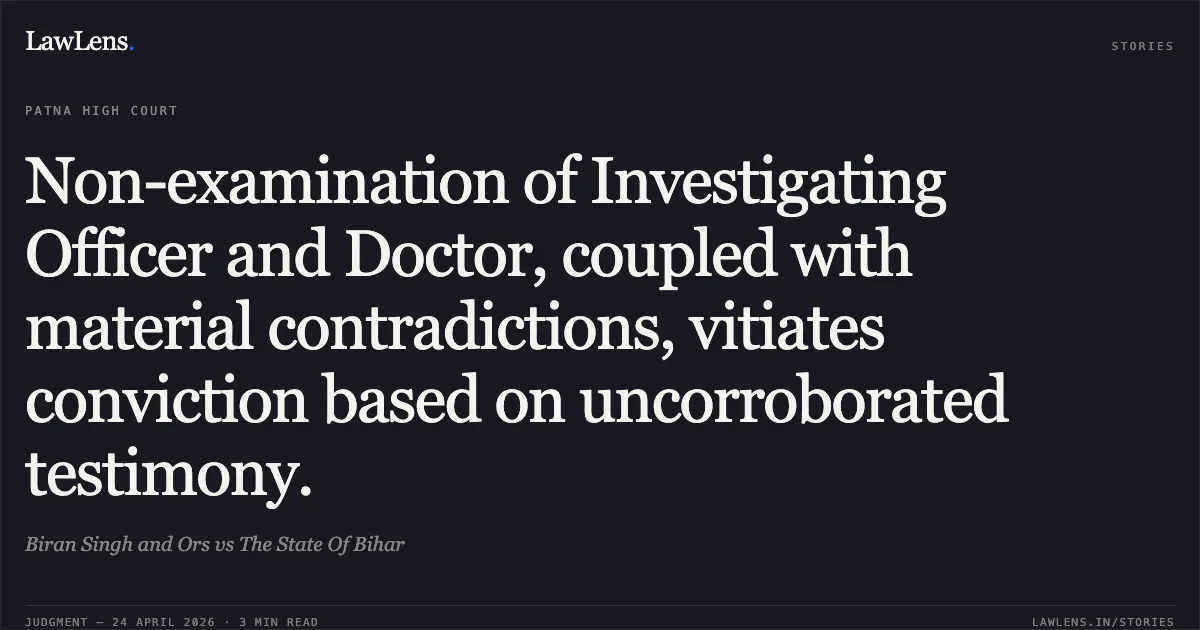
The Court answered the issues in favour of the appellants, holding that the prosecution failed to prove the charges beyond reasonable doubt.
The court set aside the judgment of conviction and sentence dated 15.1.2016. All appellants were acquitted of all charges and discharged from the liabilities of their bail bonds. The appeal filed by Maheshwar Singh was declared abated due to his death during the pendency of the appeal.
Source reference: p. 2, 9Acts & Sections Cited
9 provisions across 3 statutes referred to in this judgment. Each provision opens on LawLens.
Indian Penal Code, 18606
Arms Act, 19591
Original Court PDF
Biran Singh and OrsvsThe State Of Bihar
Click to open original judgment
Original judgment, available to read, download and summarize on LawLens.in


![Subsequent exoneration does not retrospectively invalidate a finalized promotion select list.. UNNIKRISHNAN M vs M/o Environment And Forests. CAT - ['Ernakulam']. LawLens](/stories/thumbnails/subsequent-exoneration-does-not-retrospectively-invalidate-a-finalized-promotion-select-li-ce80a0e84f2f4887857271e8b4341c42.webp)