01Facts
The appellant was arrested on July 13, 2025, for alleged involvement in a cyber-fraud conspiracy involving mule accounts and forged KYC documents.
¶ 3-6The CBI filed a chargesheet on September 2, 2025, under the Bharatiya Nyaya Sanhita (BNS) and Information Technology Act, within the sixty-day statutory period.
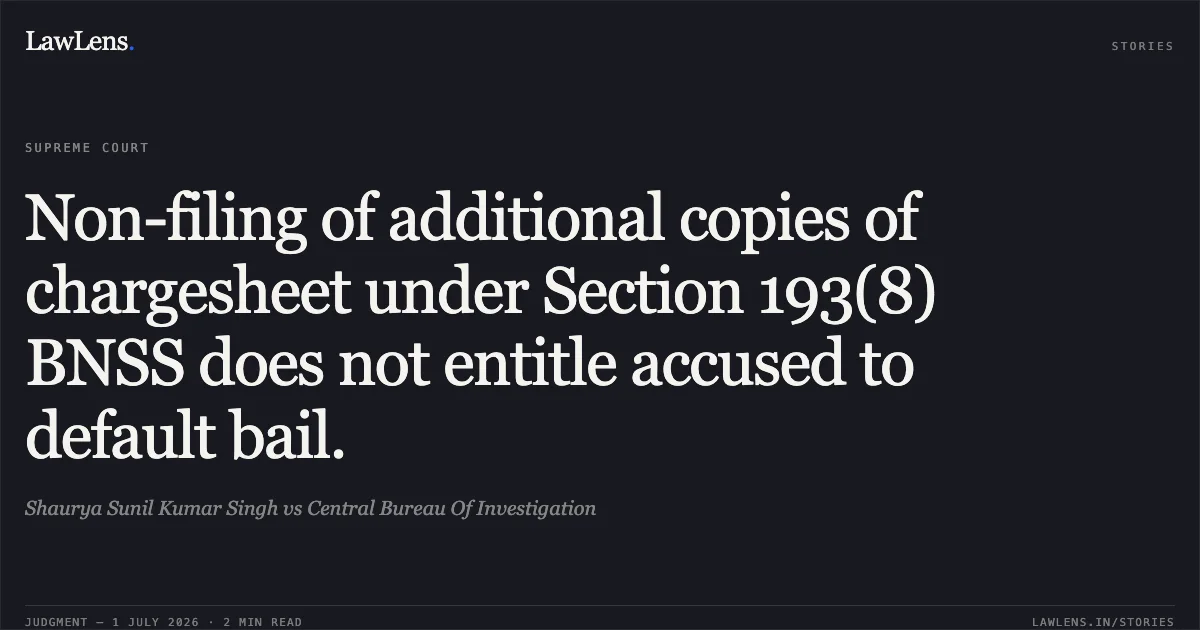
¶ 8The appellant moved for default bail on September 17, 2025, arguing that the investigating agency failed to file and supply additional copies of the chargesheet and documents as required under Section 193(8) of the Bharatiya Nagarik Suraksha Sanhita (BNSS).
¶ 9The Special Judge and the Bombay High Court concurrently dismissed the application, leading to this appeal.
¶ 9, 1202Issues
i.1. Whether the filing of a chargesheet without the additional copies mandated by Section 193(8) of the BNSS entitles an accused to default bail under Section 187(3) of the BNSS.
¶ 1503Law Applied
The Court applied Section 187(3) of the BNSS (corresponding to Section 167(2) CrPC), which provides for default bail if a chargesheet is not filed within the prescribed sixty or ninety-day period.
¶ 16The Court interpreted Section 193(8) of the BNSS (new provision) regarding the submission of additional copies for the accused.
¶ 17The Court relied on Judgebir Singh v. NIA and CBI v. Kapil Wadhawan to establish that the right to default bail is extinguished once a chargesheet in the form prescribed is filed.
¶ 21, 22The Court applied the principle from CBI v. R.S. Pai and Narendra Kumar Amin v. CBI that procedural requirements for supporting documents are directory rather than mandatory.
¶ 24, 25Provisions in the judgment · 29 · Linked ones open on LawLens
Bharatiya Nyaya Sanhita, 2023 12 provisions
Section 61Section 318Section 319Section 336Section 340Section 64Section 65Section 66Section 67Section 68Section 70Section 71Bharatiya Nagarik Suraksha Sanhita, 2023 Section 173Section 180Section 183Section 187Section 190Section 193Section 230
Prevention of Corruption Act, 1988 Section 7
Information Technology Act, 2000 Section 66
Code of Criminal Procedure, 1973 Section 154Section 161Section 164Section 167Section 170Section 173Section 207
Indian Penal Code, 1860 Section 376
04Reasoning
The Court observed that Section 187(3) of the BNSS is substantially identical to Section 167(2) of the CrPC, intended to prevent laxity in investigation.
¶ 19-20The Court reasoned that the right to default bail is a conditional right that ceases once the police report is filed in its proper form under Section 193(3).
¶ 21-23While Section 193(8) of the BNSS introduced a requirement for the police to file additional copies for the accused, the Court held that non-compliance with this specific administrative requirement does not vitiate the chargesheet itself.
¶ 23Drawing a parallel to the "directory" nature of Section 173(5) CrPC (now Section 193(6) BNSS), the Court concluded that procedural omissions—such as failing to provide extra copies or missing documents—cannot be interpreted to revive an indefeasible right to bail once the core investigation is complete and the report is before the Magistrate.
¶ 24-2705Holding
The Court dismissed the appeal, holding that the appellant was not entitled to default bail.
¶ 29The Court ruled that as the chargesheet was filed within the statutory period on September 2, 2025, and complied with the form required under Section 193(3) of the BNSS, the right to default bail was extinguished. The non-filing of extra copies under Section 193(8) is a procedural irregularity and not a ground for default bail.
¶ 26, 27The Court clarified that the appellant’s separate application for regular bail must be considered on its own merits.
¶ 28Original Court PDF
Shaurya Sunil Kumar SinghvsCentral Bureau Of Investigation
Click to open original judgment
Original judgment, available to read, download and summarize on LawLens.in