Facts
The respondent had acquired the suit land through a court-executed conveyance pursuant to a decree for specific performance.
Source reference: p. 2–9The parties later entered into three agreements for its sale to the appellant for ₹20 lakhs.
Source reference: p. 2–9The appellant paid ₹9 lakhs in total; the respondent agreed to complete the sale after obtaining relevant documents and permissions.
Source reference: p. 2–9When the respondent did not execute the sale deed, the appellant sued for specific performance.
Source reference: p. 2–9The trial court refused specific performance because the respondent’s name had not been mutated in the land records, but ordered repayment of ₹9 lakhs with 6% interest.
Source reference: p. 2–9The first appellate court affirmed that decision.
Source reference: p. 2–9The appellant brought this second appeal.
Source reference: p. 2–9Issues
1. Whether a vendor who holds a court-executed conveyance may be treated as lacking clear title to enter into an agreement for sale because the property has not been mutated in the vendor’s name.
Source reference: p. 8–92. Whether specific performance may be refused solely because the property has not been mutated in the vendor’s name, absent a demonstrated legal bar to transfer.
Source reference: p. 8–93. Whether the courts below failed to account for orders in prior writ proceedings concerning mutation.
Source reference: p. 94. Whether repayment of the advance, rather than specific performance, was an adequate alternative remedy in the circumstances.
Source reference: p. 9Law Applied
The Court considered Sections 10, 11, 14 and 16 of the Specific Relief Act, 1963.
Source reference: p. 10–12Under Section 10, specific performance is enforceable subject to the statutory restrictions; Sections 14 and 16 respectively identify contracts that cannot be specifically enforced and personal bars to relief, including the plaintiff’s failure to prove performance or readiness and willingness.
Source reference: p. 10–12Section 11 concerns contracts connected with trusts.
Source reference: p. 10–12The Court treated mutation as a revenue-record matter, not itself a document of title, and reasoned that absence of mutation does not defeat title established by a valid conveyance.
Source reference: p. 10–12It also considered the lower appellate court’s reference to the discretionary power under Section 20.
Source reference: p. 10–12Reasoning
The respondent’s title arose from a conveyance executed through the court’s process, and the decree underlying it had not been challenged.
Source reference: p. 13–16The mutation application was refused because the former holders were not the recorded tenants; that refusal did not invalidate the conveyance.
Source reference: p. 13–16The respondent identified no statutory provision requiring mutation or sale permission before transfer, and no order restraining the sale.
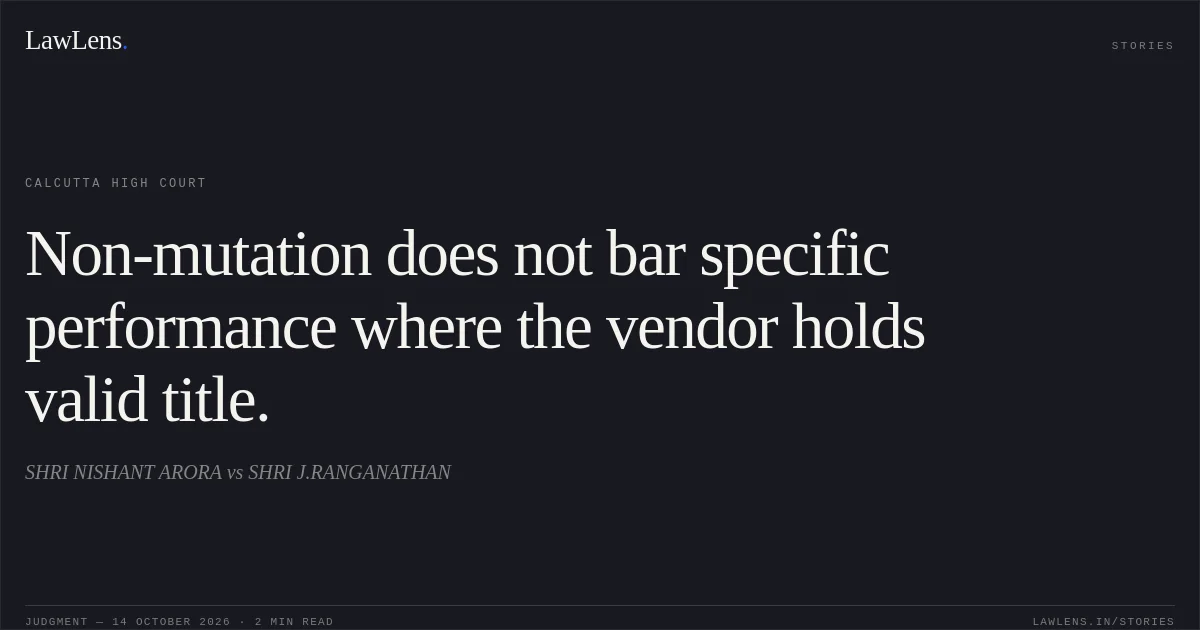
Source reference: p. 13–16The Court therefore found that non-mutation alone did not establish a legal impediment to performance, and that the respondent could not rely on it to avoid the sale agreement.
Source reference: p. 13–16It also found no demonstrated bar under Sections 11, 14 or 16.
Source reference: p. 13–16The Court did not decide the question concerning prior writ orders on mutation, as the appellant had produced no supporting document.
Source reference: p. 13–16Holding
The second appeal was allowed.
The judgments and decrees below were set aside, and the appellant was granted specific performance.
Source reference: p. 16–17The appellant was directed to pay the balance consideration within three weeks; upon payment, the respondent was directed to execute and register the sale deed forthwith.
Source reference: p. 16–17If the respondent defaulted, the appellant could execute the decree.
Source reference: p. 16–17Acts & Sections Cited
6 provisions across 1 statute referred to in this judgment. Each provision opens on LawLens.
Specific Relief Act, 19636
Original Court PDF
SHRI NISHANT ARORAvsSHRI J.RANGANATHAN
Click to open original judgment
Original judgment, available to read, download and summarize on LawLens.in


