Facts
The Petitioner, a company specializing in LED streetlighting, challenged a Notice Inviting Tender (NIT) issued by the Respondent (EESL) for the replacement and maintenance of over 7 lakh streetlights across three packages in Andhra Pradesh.
Source reference: p. 2-3The Petitioner contended that the base rate of Rs. 133 per light fixed by EESL was arbitrary and commercially unworkable, citing previous market assessments where rates ranged from Rs. 184 to Rs. 610.
Source reference: p. 3-4The Petitioner did not participate in the pre-bid meeting or submit bids for Packages 1 and 2, but filed this writ petition just before the deadline for Package 3.
Source reference: p. 6-7The Respondent raised preliminary objections regarding territorial jurisdiction and the Petitioner’s locus standi, noting that Packages 1 and 2 had already been successfully awarded at the contested rate.
Source reference: p. 5-6Issues
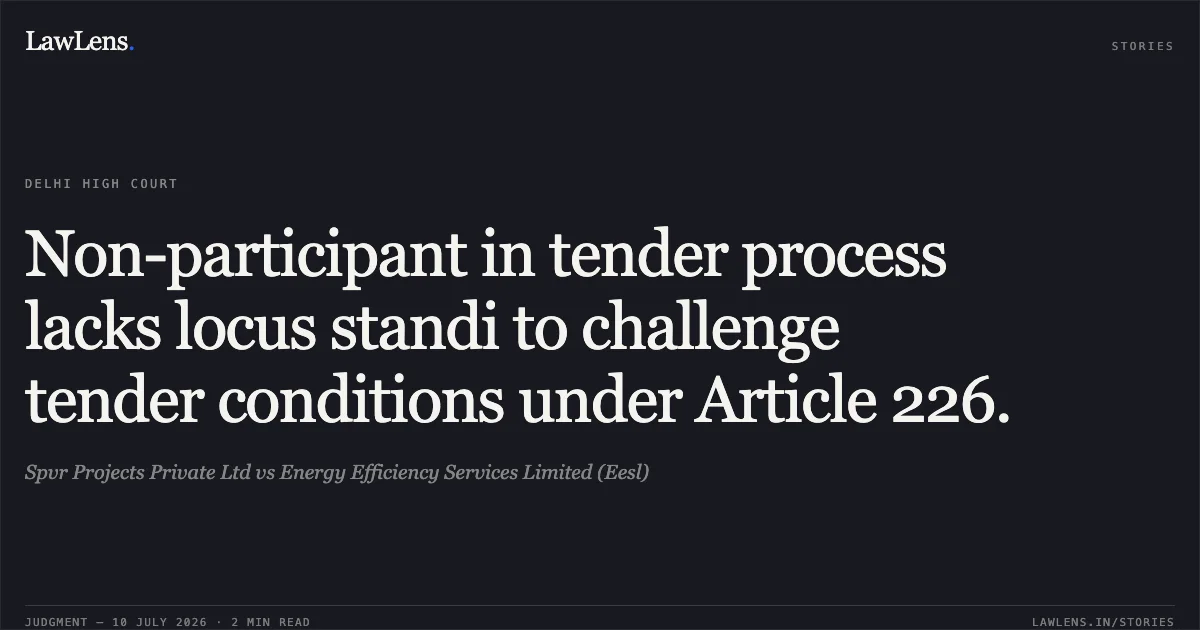
1. Whether a party that has not participated in the bidding process has the locus standi to challenge the terms of a tender under Article 226 of the Constitution.
Source reference: p. 82. Whether the base price of Rs. 133 fixed by the Respondent was arbitrary or commercially unfeasible.
Source reference: p. 7Law Applied
The court applied the principle that only entities participating in a bidding process may challenge tender conditions, as the objective of such processes is to ensure competition and transparency for those genuinely interested.
Source reference: p. 8The court relied heavily on the precedent National Highways Authority of India v. Gwalior-Jhansi Expressway Limited, which established that a right to grievance regarding tender terms only arises if a party participates in the process; non-bidders cannot whittle down the rights of eligible bidders.
Source reference: p. 8-9The court also cited Gaurav Enterprises v. GTB Hospital & Anr. and Brijesh Kumar v. Union of India to affirm that a challenge by a non-participant, especially at a belated stage, is not maintainable.
Source reference: p. 8-9Reasoning
The Court observed that the Petitioner admitted to not participating in the pre-bid meetings or the bidding for Packages 1 and 2.
Source reference: p. 6-7It found the timing of the petition—filed on the eve of the Package 3 bid submission—suspicious and lacking bona fides, suggesting an intent to interdict the process rather than facilitate competition.
Source reference: p. 7The Court refused to conduct a "roving enquiry" into the commercial feasibility of the Rs. 133 rate, noting that other bidders had already accepted this rate for Packages 1 and 2, thereby proving its prima facie viability.
Source reference: p. 6, 7By applying the National Highways Authority doctrine, the Court reasoned that since the Petitioner stayed away from the process, it acquired no legal right to challenge the technical or financial stipulations of the tender.
Source reference: p. 7-9Holding
The Court answered the first issue in the negative, holding that the Petitioner lacked locus standi because it was a non-bidder.
Consequently, it declined to rule on the merits of the second issue regarding price feasibility.
Source reference: p. 10The writ petition and pending applications were dismissed, while the question of territorial jurisdiction was left open.
Source reference: p. 9-10Original Court PDF
Spvr Projects Private LtdvsEnergy Efficiency Services Limited (Eesl)
Click to open original judgment
Original judgment, available to read, download and summarize on LawLens.in