Facts
The respondents, who were beneficiaries under a registered Will dated 3 January 2017 but were not its executors, petitioned for probate and related relief concerning schedule ‘A’ and ‘B’ properties.
Source reference: p. 3–4, 9–10, 17–18The Probate Court allowed the petition in their favour on 26 September 2023; no respondents had been arrayed in that proceeding, and citation had been issued by publication.
Source reference: p. 3–4, 9–10, 17–18The appellants, claiming rights in the properties and not having participated in the probate proceeding, filed Misc. No. 190/2023 to set aside the grant and sought condonation of a 21-day delay.
Source reference: p. 4–6, 13–15The Probate Court converted that proceeding into O.S. No. 5/2024, conducted a trial, and dismissed it as not maintainable.
Source reference: p. 4–6, 13–15The appellants appealed under Section 299 of the Indian Succession Act, 1925.
Source reference: p. 2Issues
1. Whether the order dated 26 September 2023 granting probate called for interference.
Source reference: p. 122. Whether the subsequent order in Misc. No. 190/2023, converted into O.S. No. 5/2024, called for interference.
Source reference: p. 12Law Applied
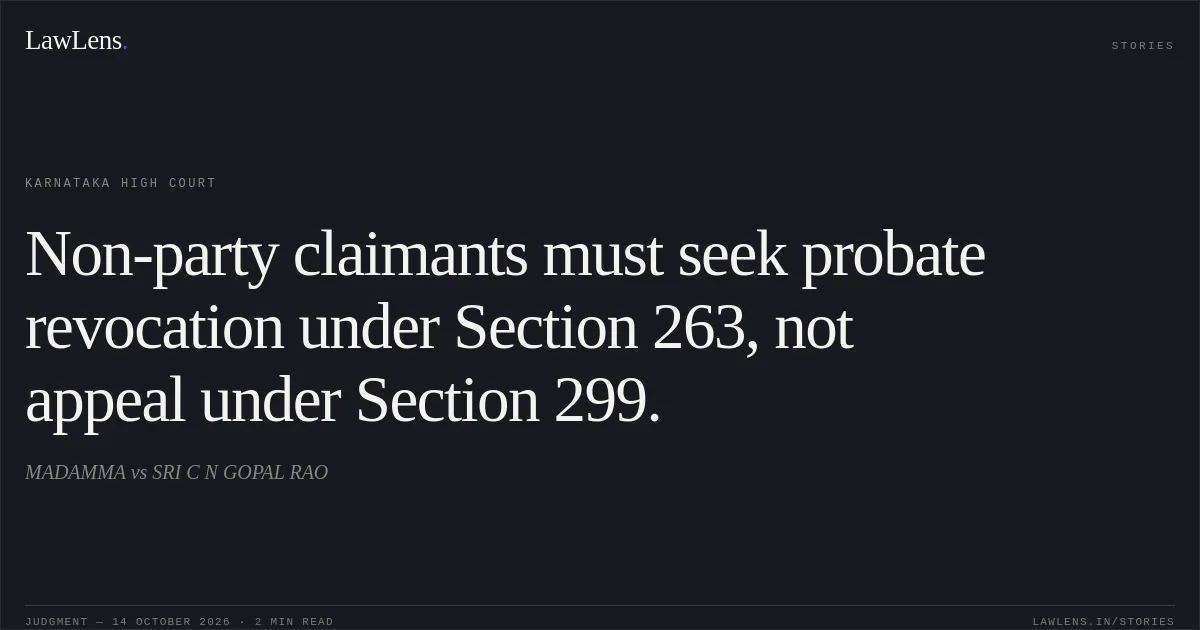
Section 263 of the Indian Succession Act, 1925 permits revocation or annulment of a grant of probate for “just cause”; a person claiming an interest who was not impleaded may seek that remedy before the court that made the grant.
Source reference: p. 19–21Section 299 provides for an appeal from orders made by a District Judge under the Act, but a rival claimant seeking revocation of a probate grant must pursue the Section 263 remedy before the Probate Court.
Source reference: p. 19–21The Court relied on Swaminathan & Ors. v. Alankamony (Dead) Through LRs., Civil Appeal Nos. 798–799 of 2013, decided 9 March 2022, for the proposition that non-party rival claimants may seek revocation under Section 263 upon showing just cause.
Source reference: p. 20It also held that probate is ordinarily sought by an executor named in the Will; beneficiaries who are not executors may, where legally appropriate, seek letters of administration.
Source reference: p. 17–18, 22Reasoning
The appellants’ claim that they had not been joined in the probate proceeding raised a rival claim that the Probate Court was required to consider under the Act, rather than convert their miscellaneous petition into a civil suit and dismiss it as not maintainable.
Source reference: p. 14–19The Court found that this course was procedurally erroneous and that the 21-day delay, or the appellants’ initial choice of procedure, did not justify dismissing their claim without consideration on its merits.
Source reference: p. 19It further observed that the respondents were beneficiaries, not executors, and that the appropriate form of relief could therefore require consideration of letters of administration rather than probate.
Source reference: p. 17–18, 22Holding
The appeal was allowed.
The Court set aside both the 26 September 2023 probate order and the 19 August 2025 order in Misc. No. 190/2023/O.S. No. 5/2024, restored Misc. No. 190/2023, and remitted it to the Probate Court for reconsideration in accordance with law after giving both sides an opportunity to be heard.
Source reference: p. 23–24The appellants were permitted to amend their application to seek revocation under Section 263, and the respondents were permitted to seek appropriate amendment, including letters of administration if legally permissible.
Source reference: p. 24–25The Court expressed no opinion on the merits.
Source reference: p. 24–25Acts & Sections Cited
4 provisions across 2 statutes referred to in this judgment. Each provision opens on LawLens.
Indian Succession Act, 19253
Limitation Act, 19631
Original Court PDF
MADAMMAvsSRI C N GOPAL RAO
Click to open original judgment
Original judgment, available to read, download and summarize on LawLens.in


