Facts
The prosecution alleged that the appellant, who was staying near the victim’s home, took the victim—then aged about seven years and seven months—to a deserted house on several occasions and sexually assaulted her.
Source reference: paras 6–9The victim’s date of birth was supported by school records, and the defence did not seriously dispute her age.
Source reference: paras 6–9The trial court convicted the appellant under Sections 376AB IPC and 6 of the POCSO Act, and Section 3(2)(v) of the SC/ST (POA) Act; it acquitted him under Section 366 IPC.
Source reference: paras 2–5On appeal, the High Court considered whether the evidence proved penetrative sexual assault and whether the convictions could otherwise be sustained.
Source reference: paras 10–12Issues
1. Whether the victim’s testimony and medical evidence proved penetrative sexual assault under Section 375 IPC and Section 3 of the POCSO Act, supporting conviction under Section 376AB IPC and Section 6 of the POCSO Act
Source reference: paras 18–23, 262. Whether the evidence, even if insufficient to prove penetration, established aggravated sexual assault under Sections 9(l) and 9(m) of the POCSO Act, punishable under Section 10
Source reference: para 243. Whether the conviction under Section 3(2)(v) of the SC/ST (POA) Act could be sustained in light of the offence ultimately proved
Source reference: paras 25–27Law Applied
Section 375 IPC and Section 3 of the POCSO Act define rape and penetrative sexual assault, respectively, by reference to specified forms of penetration; Section 376AB IPC and Section 6 of the POCSO Act prescribe punishment for the relevant aggravated offences.
Source reference: paras 12–13Sections 9 and 10 of the POCSO Act provide for aggravated sexual assault and its punishment.
Source reference: para 24Section 354 IPC addresses assault or criminal force with intent to outrage a woman’s modesty.
Source reference: para 27Section 3(2)(v) of the SC/ST (POA) Act was considered in connection with the punishment prescribed for the proved offence.
Source reference: paras 25–27The trial court had also relied on Section 29 of the POCSO Act, which provides for a presumption in prosecutions for specified POCSO offences, and on Ganeshan v. State, concerning reliance on a credible victim’s testimony.
Source reference: para 19Reasoning
The High Court found that the victim described being taken to a deserted house, having her clothing removed, and the accused pressing her private part with his hand; her evidence did not establish penetration.
Source reference: para 18The medical evidence recorded no external injuries, an intact hymen, no signs suggestive of struggle, and no evidence of recent sexual intercourse; the doctor also stated that discharge could arise from causes other than sexual intercourse.
Source reference: paras 20–23The Court therefore held that penetrative sexual assault was not proved and that the evidence was also insufficient to establish an attempt to commit rape.
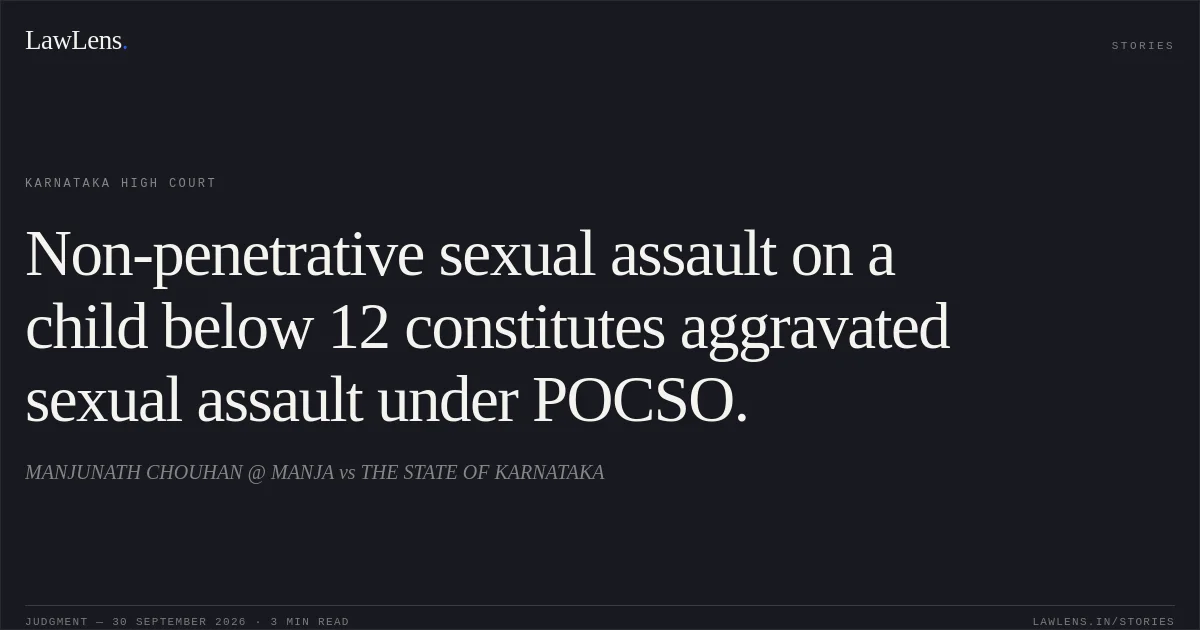
Source reference: para 26It nevertheless found, on the cumulative evidence, that the conduct amounted to aggravated sexual assault on a child below 12 years under Sections 9(l) and 9(m) of the POCSO Act.
Source reference: para 24Because the convictions for penetration-based offences were not sustainable, and the offence ultimately proved did not support the trial court’s basis for applying Section 3(2)(v) of the SC/ST (POA) Act, that conviction was also set aside.
Source reference: paras 25–27Holding
The appeal was partly allowed.
The High Court set aside the convictions under Sections 376AB IPC and 6 of the POCSO Act and Section 3(2)(v) of the SC/ST (POA) Act, and convicted the appellant under Sections 9(l) and 9(m), punishable under Section 10, of the POCSO Act.
Source reference: para 29(ii)–(iii)It sentenced him to five years’ rigorous imprisonment and a fine of ₹1,00,000, with one year’s simple imprisonment in default; the fine, if deposited, was to be paid to the victim as compensation within 30 days.
Source reference: para 29(iii)–(v)The trial court’s separate victim-compensation award was left undisturbed.
Source reference: para 29(iii)–(v)Acts & Sections Cited
17 provisions across 5 statutes referred to in this judgment. Each provision opens on LawLens.
Code of Criminal Procedure, 19731
Indian Penal Code, 18605
Protection of Children from Sexual Offences Act, 2012
Scheduled Castes and the Scheduled Tribes (Prevention of Atrocities) Act, 19891
General Clauses Act, 18971
Original Court PDF
MANJUNATH CHOUHAN @ MANJAvsTHE STATE OF KARNATAKA
Click to open original judgment
Original judgment, available to read, download and summarize on LawLens.in