Facts
The Appellant (Durgapur Steel Plant) issued an advertisement in 2007 for the recruitment of Plant Attendants
Source reference: para. 3A selection process involving a written examination (outsourced to an independent agency) and interviews was conducted, leading to the appointment of 194 candidates
Source reference: paras. 3-4The Respondents, unsuccessful candidates, filed writ petitions in 2009 seeking disclosure of their marks and challenging the transparency of the process
Source reference: para. 5The Central Administrative Tribunal (Tribunal) directed the Appellants to appoint the Respondents, citing the non-production/destruction of examination records and lack of evidence that the Respondents had failed
Source reference: paras. 6-7The Calcutta High Court affirmed this direction in 2019
Source reference: para. 8The Appellants challenged these orders before the Supreme Court, contending that records were destroyed in the normal course of business and that qualifications for the post had since been revised
Source reference: para. 9Issues
1. Whether a candidate acquires an indefeasible right to appointment merely by participating in a selection process or through the non-production of recruitment records by the employer.
Source reference: para. 13-142. Whether the destruction of examination records by an independent agency justifies a mandatory direction for appointment and drawing an adverse inference against the employer.
Source reference: para. 15Law Applied
The State and its instrumentalities must adhere to comparative merit in recruitment under Article 14 of the Constitution
Source reference: para. 13A candidate in a select list does not acquire an indefeasible right to appointment
Source reference: para. 13, note 2Unless recruitment rules or advertisements specifically mandate the preservation or publication of marks for all candidates, the employer is not legally bound to produce them after the process is finalized
Source reference: para. 14-15Reasoning
The Court reasoned that the Tribunal erred in drawing an adverse inference from the non-production of records, as the examination was conducted by an independent agency and there was no statutory requirement to preserve records indefinitely
Source reference: para. 15The Court found the Appellants' explanation for the unavailability of records to be bona fide
Source reference: para. 15The Respondents failed to prove they had actually passed the written examination; the mere absence of a "fail" result does not equate to a "pass"
Source reference: para. 14The Respondents had initially sought disclosure of marks rather than appointment, and since the eligibility qualifications for the post were revised in 2008, a retrospective appointment was no longer feasible
Source reference: para. 16Holding
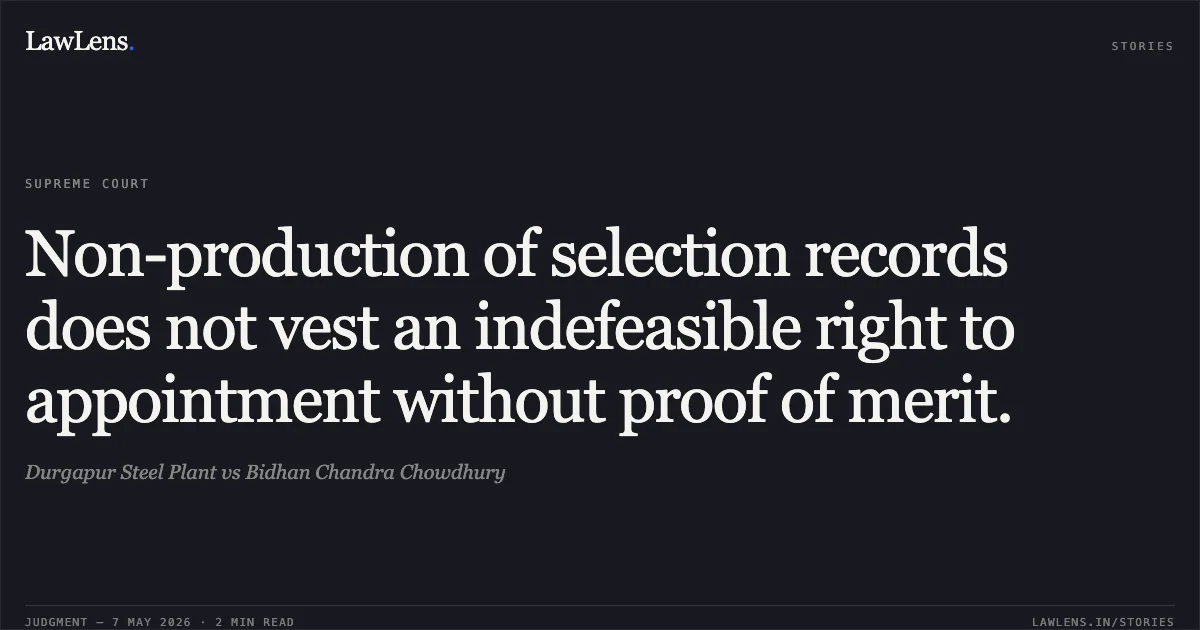
No right to appointment exists without evidence of passing the selection process
The Supreme Court allowed the appeals and set aside the orders of the Tribunal and the High Court directing the appointment of the Respondents
Source reference: para. 18-19In the peculiar facts of the case, directed the Appellants to pay Respondent No. 1 a sum of ₹5,00,000/- as a matter of equity
Source reference: para. 17Original Court PDF
Durgapur Steel PlantvsBidhan Chandra Chowdhury
Click to open original judgment
Original judgment, available to read, download and summarize on LawLens.in