Facts
On 28 April 2022, Abhishek Mishra travelled from Anand Vihar to Bapudham (Motihari), Bihar, on Train No. 12558, allegedly after purchasing a valid journey ticket. He allegedly fell from the moving train near Mundhapanday, Moradabad, due to heavy rush and passenger push-and-pull, sustained grievous injuries, and later died at District Hospital, Moradabad.
Source reference: p. 2, para. 2His legal representatives filed a claim before the Railway Claims Tribunal. The Tribunal dismissed the claim, relying principally on the non-recovery of the journey ticket, the DRM Report, and the absence of railway records or eyewitness evidence establishing an “untoward incident”.
Source reference: p. 2, para. 3The claimants appealed under Section 23 of the Railway Claims Tribunal Act, 1987.
Source reference: p. 2, para. 1The High Court separately condoned a delay of 175 days in filing the appeal, considering the appellants’ economic circumstances and the beneficial nature of the legislation.
Source reference: pp. 1–2, paras. 1–6Issues
1. Whether the deceased was a bona fide passenger at the time of the incident, despite the non-recovery of the journey ticket and uncertainty regarding its source of purchase?
Source reference: p. 3, para. 72. Whether the deceased’s fall from the train constituted an “untoward incident” under the Railways Act, 1989, notwithstanding the absence of a railway report, eyewitness, or information to the Guard or Station Master?
Source reference: p. 5, paras. 11–123. Whether the appellants were entitled to compensation under the statutory railway accident-compensation scheme?
Source reference: pp. 5–6, paras. 13–15Law Applied
The Court exercised appellate jurisdiction under Section 23 of the Railway Claims Tribunal Act, 1987.
Source reference: p. 2, para. 1Under Sections 123(c) and 124-A of the Railways Act, 1989, an accidental fall from a train may constitute an “untoward incident” giving rise to statutory compensation, subject to the exceptions in the proviso to Section 124-A.
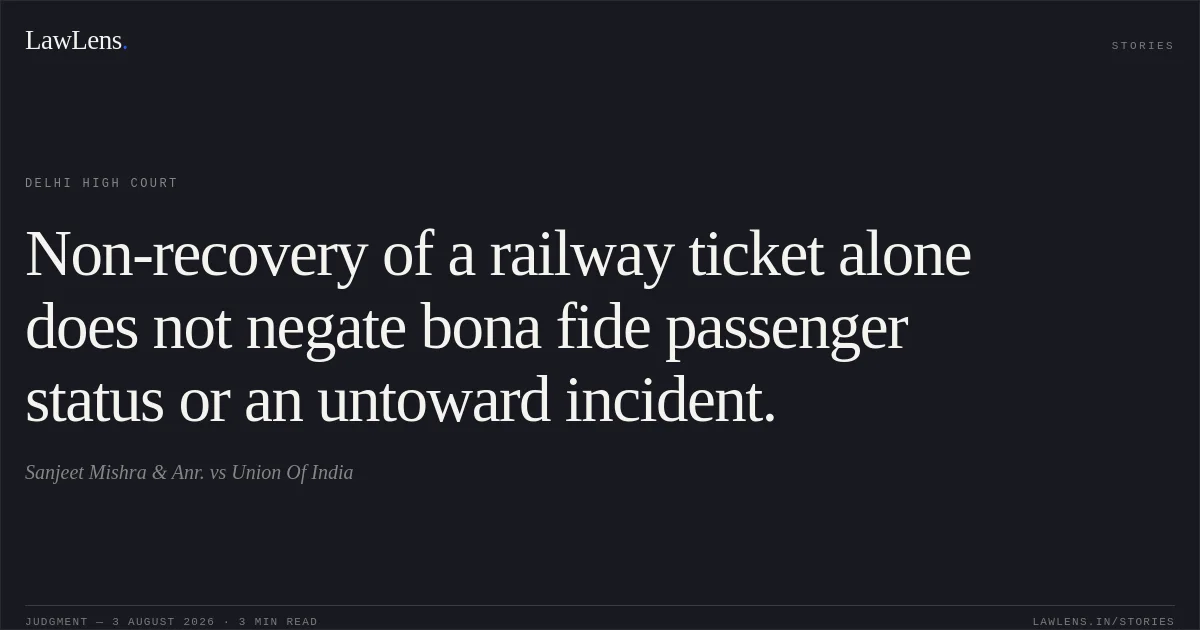
Source reference: pp. 3, 5, paras. 9, 11, 14Relying on Union of India v. Rina Devi, (2019) 3 SCC 572, the Court held that the claimant’s initial burden of establishing bona fide passenger status may be discharged through affidavit and consistent evidence, and that mere non-recovery of a ticket does not by itself negate such status; the burden then shifts to the Railway Administration to rebut the claim by cogent evidence.
Source reference: p. 4, para. 9The Court also relied on Lata v. Union of India, 2026 SCC OnLine SC 1350, which reiterated this burden-shifting principle.
Source reference: p. 4, para. 9In relation to delay, the Court followed Mohsina v. Union of India, 2017 SCC OnLine Del 10003, and Reshma v. Union of India, FAO 25/2022, adopting a liberal approach in view of the beneficial nature of the legislation.
Source reference: pp. 1–2, paras. 3–5Reasoning
The Court found that the appellants had consistently pleaded that the deceased purchased a valid ticket and that it was lost in the accident.
Source reference: p. 3, para. 8Their evidence was supported by the testimony of the deceased’s brother, who stated that he accompanied the deceased to Anand Vihar Railway Station, witnessed the purchase of the ticket, and saw him board the train.
Source reference: p. 3, para. 8Applying Rina Devi and Lata, the Court held that this evidence discharged the initial burden and that the Railway Administration failed to establish that the deceased was travelling without authority.
Source reference: p. 4, para. 9The fact that the alleged vendor, Gupta Communication, was not an authorised railway ticket vendor created doubt regarding the ticket’s source but did not conclusively prove ticketless travel.
Source reference: p. 4, para. 10On the second issue, the DRM Report, police investigation, DD entries, and contemporaneous medical records showed that the deceased was found injured near the railway track after apparently falling from a train.
Source reference: p. 5, para. 13The absence of an eyewitness, railway report, or information to the Guard or Station Master was held insufficient to disprove the occurrence.
Source reference: p. 5, para. 13Once bona fide passenger status was established, the burden shifted to the Railway Administration to prove an exception under the proviso to Section 124-A, which it failed to do.
Source reference: p. 5, para. 14Holding
The High Court allowed the appeal and set aside the Tribunal’s judgment.
It held that the deceased was a bona fide passenger and that his accidental fall from the train constituted an “untoward incident” under the Railways Act, 1989.
Source reference: pp. 4–6, paras. 10, 14–16The matter was remanded to the Railway Claims Tribunal to assess the compensation payable in accordance with law and to direct disbursement by the concerned authorities within two months of receiving the order.
Source reference: p. 6, paras. 15–17The matter was directed to be listed before the Tribunal on 21 August 2026.
Source reference: p. 6, paras. 15–17Original Court PDF
Sanjeet Mishra & Anr.vsUnion Of India
Click to open original judgment
Original judgment, available to read, download and summarize on LawLens.in