Facts
Kalicharan Majhi was travelling by train from Madhukunda to Adra on 14 September 2014 when he fell from the running train between Madhukunda and Muradih, sustained injuries and died later that night.
Source reference: pp. 1–4His widow and other claimants sought compensation under the Railways Act, 1989.
Source reference: pp. 1–4The Railway Claims Tribunal awarded ₹4 lakh, with interest at 6% per annum from the filing of the claim until the award and 9% thereafter until payment.
Source reference: pp. 1–4The Union of India appealed, challenging the findings on the untoward incident and the deceased’s status as a bona fide passenger; the claimants filed a cross-objection seeking enhanced compensation.
Source reference: pp. 1–4Issues
Whether the evidence established that the deceased died in an “untoward incident” within the meaning of the Railways Act, 1989.
Source reference: pp. 5–8Whether the deceased was a bona fide passenger despite the absence of a recovered ticket.
Source reference: pp. 6–8Whether the compensation awarded by the Tribunal should be enhanced in light of the applicable compensation provisions and principles.
Source reference: p. 9Law Applied
Section 124A of the Railways Act, 1989 imposes no-fault liability for death or injury resulting from an untoward incident, subject to the statutory exceptions; “untoward incident” is defined in Section 123(c)(2).
Source reference: pp. 5–6Under Union of India v. Rina Devi, mere absence of a ticket does not negate a claim that the deceased was a bona fide passenger: the claimant bears an initial burden, which may be discharged by an affidavit of relevant facts, after which the burden shifts to the Railways to establish otherwise.
Source reference: pp. 6–8The Court also referred to Union of India v. Prabhakaran Vijaya Kumar, Union of India v. Dilip, Manju Agarwal v. Union of India and Anamika Halder v. Union of India in considering the untoward-incident claim, the ticket issue and compensation.
Source reference: pp. 5–8The Court treated the legislation as beneficial and applied the principle that compensation cannot be denied absent an applicable statutory exception.
Source reference: p. 6Reasoning
The widow’s evidence was supported by the police and railway reports, the hospital injury report recording a fall from a train, and the post-mortem materials.
Source reference: pp. 5–8The Court therefore found that the deceased died from a fall from the running train and rejected the Railway’s challenge based on the absence of direct eyewitness testimony or notice to the Railway Authority.
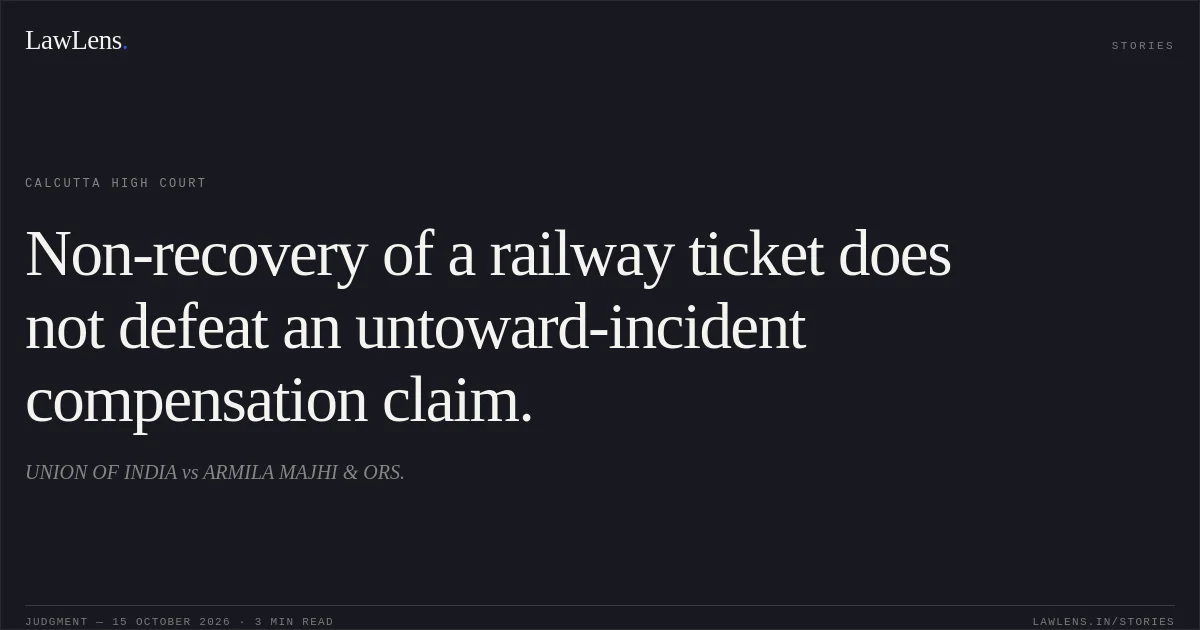
Source reference: pp. 5–8On bona fide passenger status, the Court applied Rina Devi: non-recovery of a ticket, without more, was insufficient to defeat the claim, and the surrounding evidence supported the claimants’ case.
Source reference: pp. 6–8It further held that the deceased’s alleged negligence did not bar recovery under Section 124A, absent an applicable statutory exception.
Source reference: p. 6In view of the amendment concerning compensation and the beneficial nature of the legislation, the Court considered enhancement appropriate.
Source reference: p. 9Holding
The Court upheld the finding that the death resulted from an untoward incident and that the deceased was a bona fide passenger.
It disposed of the appeal and cross-objection by modifying the award: the claimants were held entitled to ₹4 lakh with 6% annual interest from the date of filing the claim until judgment, or ₹8 lakh, whichever was higher.
Source reference: p. 9The Union of India was directed to deposit the amount, less any amount already deposited, with the Registrar General within eight weeks of communication of the order; the claimants could withdraw it upon completing the required formalities.
Source reference: p. 9Acts & Sections Cited
1 provisions across 1 statute referred to in this judgment. Each provision opens on LawLens.
Railways Act, 19891
Original Court PDF
UNION OF INDIAvsARMILA MAJHI & ORS.
Click to open original judgment
Original judgment, available to read, download and summarize on LawLens.in