01Facts
On 10 August 2018, Naman Maheshkumar Parmar allegedly travelled from Nadiad to Mehsana via Ahmedabad in Train No. 69115 Vadodara–Ahmedabad MEMU with a valid journey ticket. Due to overcrowding, a jerk and the pushing of passengers, he allegedly fell from the running train between Barejadi-Nandej and Geratpur stations. After sustaining injuries, he remained on the track and was subsequently run over by Train No. 12009 Shatabdi Express and died. His ticket and personal articles were not recovered.
¶ 1–2.5 · pp. 1–4The deceased’s parents filed a claim before the Railway Claims Tribunal, Ahmedabad. The Tribunal dismissed the claim, holding that the deceased was not proved to be a bona fide passenger and that the occurrence appeared to be suicidal. The claimants challenged that decision under Section 23 of the Railway Claims Tribunal Act, 1987.
¶ 1–2.5 · pp. 1–402Issues
i.Whether the deceased was a bona fide passenger despite the non-recovery of his railway journey ticket.
¶ 13–17 · pp. 9–12ii.Whether the deceased’s death resulted from an “untoward incident” under Section 123(c)(2) of the Railways Act, 1989, or was attributable to suicide.
¶ 8–11, 22–25 · pp. 6–9, 14–17iii.Whether the delayed DRM report and the respondent’s written statement based upon it could be relied upon to defeat the claim.
¶ 18–21 · pp. 12–14iv.Whether the claimants were entitled to statutory compensation under the Railways Act, 1989.
¶ 2.3, 21, 26 · pp. 3, 13, 17–1803Law Applied
The Court applied Section 23 of the Railway Claims Tribunal Act, 1987 concerning appeals to the High Court; Sections 123(c)(2) and 124A of the Railways Act, 1989, under which an accidental fall from a passenger train constitutes an “untoward incident” and compensation is payable irrespective of negligence, subject to the statutory exceptions; and Section 123(b) concerning dependants.
¶ 1, 2.3, 21Under the principles stated in Rajni v. Union of India and Lata v. Union of India, a claimant’s affidavit may discharge the initial burden of proving bona fide passenger status, and mere non-recovery of a ticket does not negate that status.
¶ 15–17 · pp. 10–12The Court also relied on Rules 4 and 6 of the Railway Passengers (Manner of Investigation of Untoward Incidents) Rules, 2020, requiring prompt reporting and completion of investigation within sixty days, and on the principle in Kalandi Charan Sahoo v. General Manager, South-East Central Railways that compensation may be awarded where the incident is established and the Railway’s mandated inquiry is not properly conducted.
¶ 19, 21, 23The Court further followed Vani Hirendbhai Modi v. Union of India in treating a delayed DRM report, and a written statement founded solely upon it, as unreliable.
¶ 18–20Provisions in the judgment · 4 · Linked ones open on LawLens
Railway Claims Tribunal Act, 1987 Section 23Section 16
Railways Act, 1989 Section 123
Code of Criminal Procedure, 1973 Section 174
04Reasoning
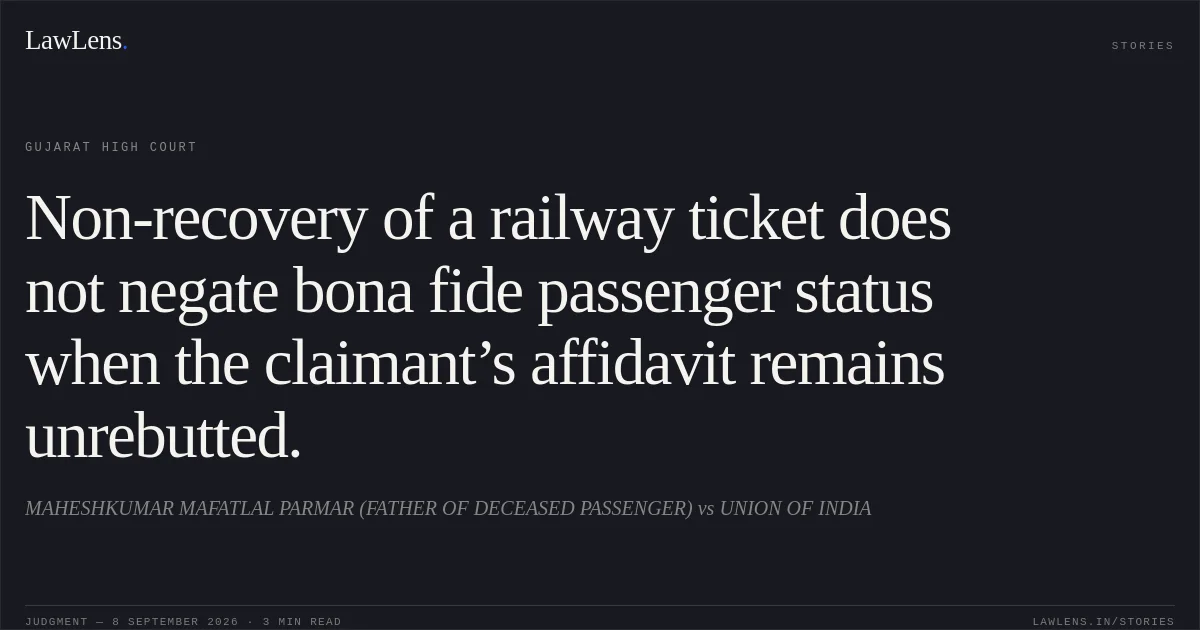
The Court held that the father’s affidavit specifically asserting that the deceased possessed a valid journey ticket discharged the initial burden of establishing bona fide passenger status. Since the Railways produced no evidence rebutting that assertion, and the ticket could have been lost during the accident, its non-recovery was insufficient to defeat the claim.
¶ 13–17On the nature of the occurrence, the contemporaneous railway records described the incident as a “run over,” while the inquest panchnama recorded the cause of death as a train accident and did not indicate suicide.
¶ 22–25The driver’s evidence that the deceased was sitting on the track did not establish an intention to commit suicide.
¶ 22–25The Court therefore rejected the later suicide theory, particularly because it emerged only through a DRM report prepared approximately five years after the incident, contrary to the prescribed investigative timeline. Since the written statement substantially reproduced that delayed report, it was also considered unreliable.
¶ 18–25The occurrence consequently fell within the scope of an untoward incident attracting no-fault statutory compensation under Section 124A of the Railways Act.
05Holding
The appeal was allowed and the Railway Claims Tribunal’s judgment dismissing the claim was set aside.
¶ 26 · pp. 17–18The Court held that the deceased was a bona fide passenger and that his death resulted from an untoward incident, not a proved act of suicide.
¶ 26 · pp. 17–18The claimants were awarded ₹8,00,000, together with interest at 9% per annum from 10 August 2018 until realization.
¶ 26 · pp. 17–18The Union of India was directed to deposit the amount with the Railway Claims Tribunal within six weeks of receiving the judgment, after which the Tribunal was directed to disburse the compensation and accrued interest to the claimants through RTGS/NEFT following due verification.
¶ 26 · pp. 17–18Original Court PDF
MAHESHKUMAR MAFATLAL PARMAR (FATHER OF DECEASED PASSENGER)vsUNION OF INDIA
Click to open original judgment
Original judgment, available to read, download and summarize on LawLens.in