Facts
The appellants, widow and children of deceased Ramesh, challenged the Railway Claims Tribunal’s order dated 4 April 2022 dismissing their claim for compensation under the Railways Act, 1989.
Source reference: para. 1The claimants alleged that, on 2 November 2015, Ramesh purchased a journey ticket at Kurukshetra and boarded a train for Jind/Barsola, where his wife was staying. He did not reach his destination, and his dead body was subsequently found near the railway track between Kurukshetra and Thanesar.
Source reference: para. 2Police proceedings under Section 174 Cr.P.C. were initiated. The post-mortem report recorded multiple traumatic injuries and opined that death resulted from haemorrhage and shock; the possibility of injuries caused by a railway accident could not be ruled out.
Source reference: para. 3; pp. 1, 5The claimants relied on the testimony of the widow and the deceased’s brother, while the Railways principally relied on the non-recovery of any ticket and disputed that Ramesh was a bona fide passenger or that the death resulted from an untoward incident. The Tribunal dismissed the claim, leading to the present appeal.
Source reference: para. 4; p. 2Issues
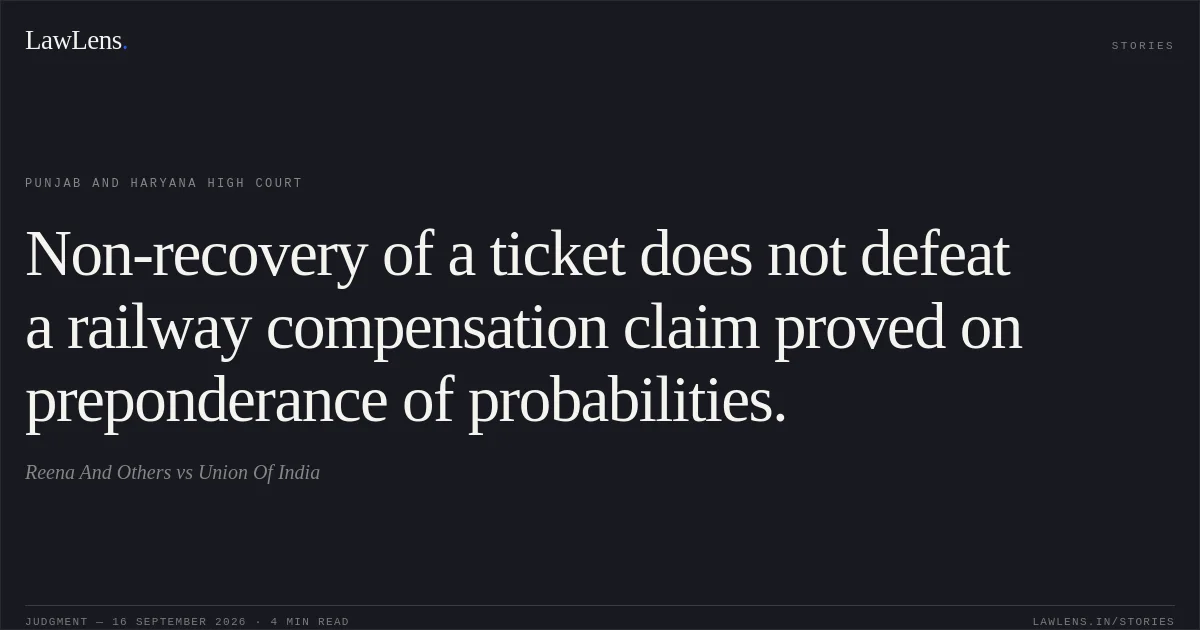
Whether the absence or non-recovery of a journey ticket conclusively disproved that the deceased was a bona fide railway passenger.
Source reference: paras. 8, 12–14; pp. 3–4Whether, on a preponderance of probabilities, the deceased died as a result of an accidental fall from a train constituting an “untoward incident” under Section 123(c)(2) of the Railways Act, 1989.
Source reference: paras. 8, 19–21; pp. 3, 6–7Whether the appellants were entitled to compensation under Section 124-A of the Railways Act, and if so, what amount and interest were payable.
Source reference: paras. 21–22; pp. 7–8Law Applied
Section 123(c)(2) of the Railways Act, 1989 includes the accidental falling of a passenger from a train within the expression “untoward incident,” while Section 124-A imposes strict/no-fault liability on the Railway Administration, subject to the statutory exceptions in its proviso.
Source reference: para. 8; p. 3In Union of India v. Prabhakaran Vijaya Kumar, (2008) 9 SCC 527, the Supreme Court held that the compensation provisions of the Railways Act are beneficial and must receive a liberal and purposive interpretation.
Source reference: para. 9Union of India v. Rina Devi, (2019) 3 SCC 572, establishes that non-recovery of a ticket does not, by itself, negate bona fide passenger status; the claimant bears an initial burden which may be discharged through relevant facts and surrounding circumstances, after which the matter is assessed on the evidence as a whole.
Source reference: paras. 10, 12–13; pp. 3–4The Court also relied on Rajni and another v. Union of India and another, 2025 INSC 1201, for the principles that Railway Claims Tribunal proceedings are not criminal trials, the applicable standard is preponderance of probabilities, and technical procedural deficiencies should not defeat a legitimate welfare claim.
Source reference: para. 11; pp. 3–4Under Rina Devi and Radha Yadav, (2019) 3 SCC 410, the compensation applicable on the date of the accident carries reasonable interest, but the claimant is entitled to the higher amount where the statutory compensation prevailing on the date of the award exceeds the accident-date amount.
Source reference: para. 22; pp. 7–8Reasoning
The High Court held that the Tribunal adopted an excessively technical approach by treating the absence of a ticket as conclusive. The testimony of the widow and the deceased’s brother established, in substance, that Ramesh had left to travel by train and had been seen off at Kurukshetra; discrepancies in their statements were not considered material, particularly because the evidence was recorded several years after the incident.
Source reference: para. 14; p. 4The Court considered this evidence alongside the documentary record: the deceased failed to reach his destination, his body was found beside the railway track, police proceedings treated the occurrence as an accidental railway incident, the post-mortem disclosed extensive ante-mortem traumatic injuries, and the site plan showed injuries compatible with a fall on an iron angle near the track.
Source reference: paras. 16–18; pp. 5–6There was no evidence of suicide, self-inflicted injury, intoxication, criminal act, natural death, or any other exception under the proviso to Section 124-A.
Source reference: para. 16; p. 5The absence of an eyewitness to the exact fall was not decisive because railway accidents ordinarily occur without available eyewitnesses; insisting on direct evidence would frustrate the statutory scheme.
Source reference: para. 19; p. 6Viewed cumulatively, the circumstances established on a balance of probabilities that Ramesh was travelling by train and suffered an accidental fall resulting in death.
Source reference: para. 20; pp. 6–7Holding
The appeal was allowed. The Court held that Ramesh’s death resulted from an “untoward incident” under Section 123(c)(2), attracting the Railways’ statutory liability under Section 124-A.
The appellants were held entitled to compensation of Rs. 4,00,000 together with simple interest at 9% per annum from 2 November 2015 until actual payment, or Rs. 8,00,000, whichever was higher, applying the law concerning the enhanced statutory compensation.
Source reference: para. 22; pp. 7–8The respondents were directed to release the compensation within eight weeks of receiving a certified copy of the order, with apportionment among the appellants according to their entitlement as determined by the Tribunal or applicable rules. Pending miscellaneous applications, if any, were disposed of.
Source reference: p. 8Acts & Sections Cited
2 provisions across 2 statutes referred to in this judgment. Each provision opens on LawLens.
Railways Act, 19891
Code of Criminal Procedure, 19731
Original Court PDF
Reena And OthersvsUnion Of India
Click to open original judgment
Original judgment, available to read, download and summarize on LawLens.in