Facts
The applicant is the widow of Late D. Gopal, who served as a Skilled Farm Worker (Temporary Status) at the Central Sericultural Germplasm Resources Centre under the Central Silk Board.
Source reference: para. 3Having joined as a casual laborer in 1989, Gopal was conferred Temporary Status (TS) effective from 19.03.2005, a date modified by the Hon’ble High Court of Karnataka.
Source reference: para. 3, 12He died in harness on 18.05.2023 after 34 years of total service, including eight years with temporary status, without being regularized.
Source reference: para. 3-4The applicant’s requests for family pension under the CCS (Pension) Rules and compassionate appointment were rejected by the Board.
Source reference: no citationThe Respondents contended that the deceased was not a permanent employee, was not engaged against a sanctioned post, and was covered under the Employees' Provident Fund (EPF) Scheme rather than the statutory pension rules.
Source reference: para. 3, 5Issues
1. Whether a widow of an employee granted Temporary Status effective after 01.01.2004 is entitled to family pension under the CCS (Pension) Rules, 1972.
Source reference: para. 152. Whether the dependents of a deceased employee who held Temporary Status but was never regularized against a sanctioned post are eligible for compassionate appointment.
Source reference: para. 6, 18Law Applied
The Tribunal primarily applied the CCS (Pension) Rules, 1972, which regulate retirement benefits only for Central Government employees appointed before January 1, 2004.
Source reference: para. 15DoPT OM dated 10.09.1993 regarding the "Grant of Temporary Status and Regularisation of Casual Labourer" Scheme, noting that an employee is treated on par with Group ‘D’ only after three years of service subsequent to the grant of TS.
Source reference: para. 15The Tribunal relied on the precedent of Umesh Nagpal v. State of Haryana, establishing that compassionate appointment is intended to tide over sudden financial crises and is generally reserved for regular employees.
Source reference: para. 18It distinguished the applicant’s cited precedents (e.g., Munni Devi and Jagbiri Devi) because those cases involved employees who attained Temporary Status prior to the 01.01.2004 cutoff.
Source reference: para. 13-14Reasoning
The Tribunal analyzed the timing of the grant of Temporary Status to determine eligibility for the Old Pension Scheme.
Source reference: no citationWhile the applicant relied on several judgments where TS employees received pensions, the Tribunal observed a critical factual distinction: in all cited cases, TS was conferred before 01.01.2004.
Source reference: para. 13In the present case, the High Court of Karnataka had fixed the deceased's TS effective date as 19.03.2005.
Source reference: para. 12Consequently, even though the deceased was entitled to benefits on par with Group ‘D’ employees, he fell outside the temporal scope of the CCS (Pension) Rules, 1972.
Source reference: para. 15Regarding compassionate appointment, the Tribunal noted that because the deceased was never regularized nor occupied a sanctioned post, the legal requirements for such an appointment were not met.
Source reference: para. 6, 18The Tribunal acknowledged that a separate Writ Petition (WP No. 325/2020) seeking the deceased’s regularization was still pending before the High Court.
Source reference: para. 19Holding
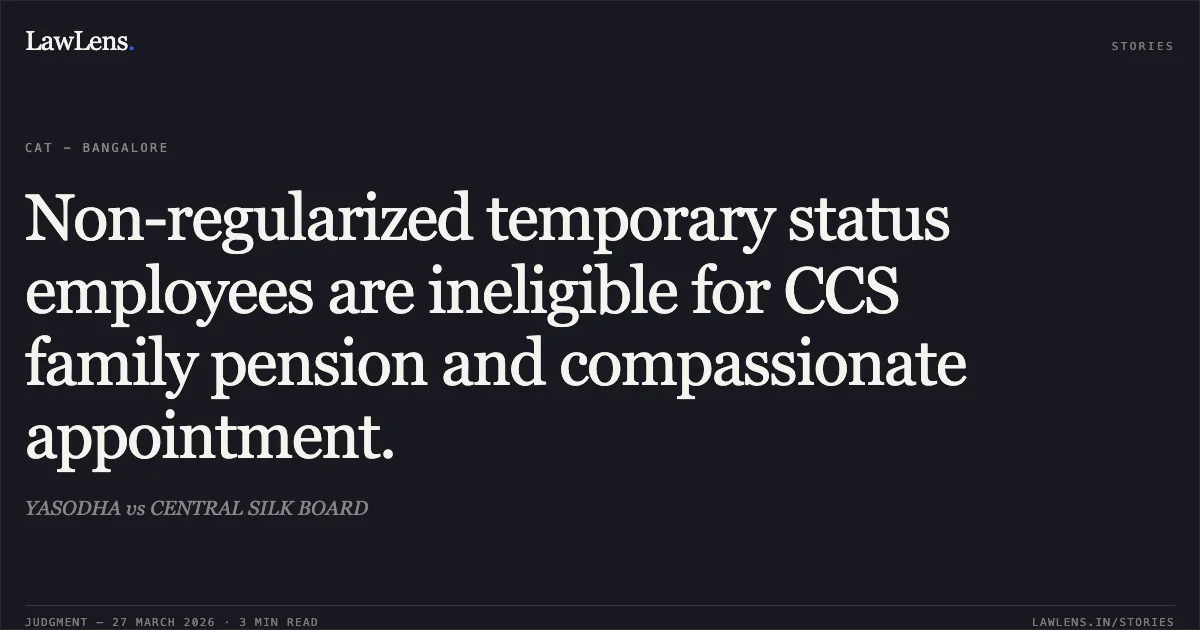
The Tribunal held that the applicant is not entitled to family pension under the CCS (Pension) Rules, 1972, nor to compassionate appointment, as the deceased's Temporary Status commenced after the 2004 cutoff and he was never regularized.
The OAs were disposed of, with the caveat that the findings are subject to the final result of the pending regularization proceedings in Writ Petition No. 325/2020 before the Hon’ble High Court of Karnataka.
Source reference: para. 20Original Court PDF
YASODHAvsCENTRAL SILK BOARD
Click to open original judgment
Original judgment, available to read, download and summarize on LawLens.in


