Facts
The petitioner, who was suffering from a kidney ailment, sought approval for a kidney transplant from Umarani, a proposed donor who was not his “near relative” and was stated to be his friend and employee.
Source reference: para. 1–4The Tahsildar rejected the request in proceedings dated 31 August 2026, principally because the donor and recipient were not near relatives.
Source reference: para. 1–4The petitioner challenged that report and sought consideration of his representation dated 26 August 2026 under the Transplantation of Human Organs and Tissues Act, 1994 (“the Act”).
Source reference: para. 1–4Issues
Whether a proposed donor’s failure to qualify as a “near relative” under Section 2(i) of the Act is, by itself, a bar to donation.
Source reference: para. 5–6Whether the rejection could stand without consideration of the procedure and safeguards applicable under Section 9(3) of the Act and the Rules.
Source reference: para. 5, 9Law Applied
Section 2(i) of the Act defines “near relative”; however, the statutory scheme under Section 9(3) and the Rules permits consideration of a transplant proposal involving a donor who is not a near relative, subject to the competent Authorisation Committee’s satisfaction and the prescribed safeguards.
Source reference: para. 5–6Such a proposal requires scrutiny of the donation’s genuineness and voluntariness, the donor-recipient relationship, and the absence of commercial consideration; non-relative status alone is not an absolute disqualification.
Source reference: para. 6–7, 11The Court also relied on Sudha Mathesan and Balamani Sabapathi v. The Authorisation Committee (Transplantation), W.P. Nos. 13918, 13922, 13967 and 13969 of 2024, decided 30 May 2024, concerning the application of Section 9(3) and the relevant Rules.
Source reference: para. 8Reasoning
The Tahsildar’s report treated the donor’s non-relative status as a principal ground for rejection, without considering the statutory route for scrutiny of non-relative donations under Section 9(3).
Source reference: para. 4–6, 9The donor’s employment under the petitioner could warrant inquiry, but the report identified no specific supporting material establishing a commercial transaction or monetary consideration; that circumstance therefore could not operate as an automatic disqualification.
Source reference: para. 7The request required fresh consideration by the competent Authorisation Committee, with the prescribed inquiry and safeguards.
Source reference: para. 10–11Holding
The Court quashed the Tahsildar’s proceedings dated 31 August 2026 and directed the fifth respondent, the Central District Level Authorization Committee, to reconsider the petitioner’s representation in accordance with Section 9(3), the Rules, and the cited precedent.
The Committee must conduct any necessary inquiry, consider the parties’ materials, afford the petitioner and proposed donor an opportunity to provide documents and credentials, and issue a reasoned order preferably within seven days of receiving the order.
Source reference: para. 11–12The Court expressed no view on whether the transplant should ultimately be approved.
Source reference: para. 13The writ petition was allowed to that extent, with no order as to costs.
Source reference: para. 14Acts & Sections Cited
2 provisions across 1 statute referred to in this judgment. Each provision opens on LawLens.
Original Court PDF
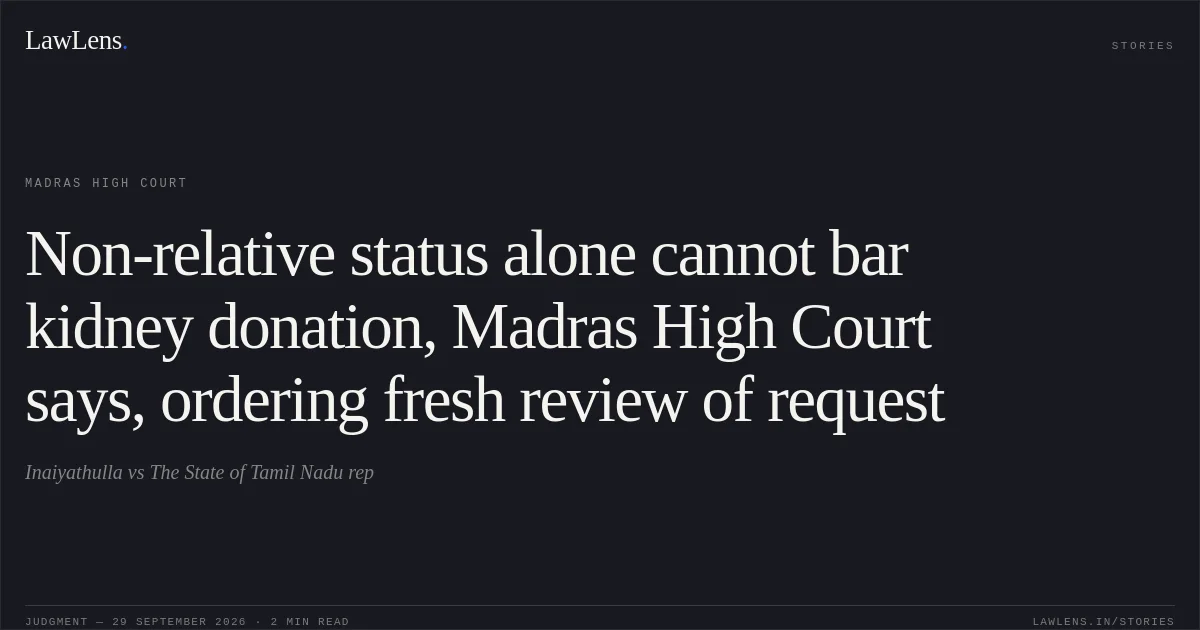
InaiyathullavsThe State of Tamil Nadu rep
Click to open original judgment
Original judgment, available to read, download and summarize on LawLens.in