Facts
The petitioner was engaged as an Upper Division Clerk by the respondents under successive session-based appointments. She claimed that her services continued from 28 April 2010 until 30 April 2013 and were orally terminated in violation of Section 25F of the Industrial Disputes Act, 1947 (“ID Act”). She further claimed to have worked for more than 240 days in the relevant period and sought reinstatement with back wages.
Source reference: para. 2The respondents contended that she was appointed only for fixed periods—05 July 2010 to 30 April 2011, 05 July 2011 to 30 April 2012, and 05 July 2012 to 30 April 2013—and that her engagement ended upon expiry of the respective contracts.
Source reference: para. 3The Labour Court, in Case No. 72/I.D.Act/Ref./2013, rejected the claim on 06 November 2019, holding that the petitioner had been appointed for particular sessions and had no right to reinstatement or back wages. The petitioner challenged that award before the High Court under Article 226 of the Constitution.
Source reference: paras. 1, 6Issues
1. Whether the non-renewal or expiry of the petitioner’s fixed-term, session-based contract constituted “retrenchment” under Section 2(oo) of the ID Act, thereby attracting the requirements of Section 25F.
Source reference: paras. 2, 10–112. Whether the petitioner established that she had worked for 240 days in the relevant period so as to claim protection against termination and reinstatement.
Source reference: paras. 2, 4, 113. Whether the Labour Court’s award dismissing the petitioner’s claim warranted interference by the High Court.
Source reference: paras. 6, 9, 12Law Applied
The Court applied Section 10 of the ID Act, under which an industrial dispute may be referred to the Labour Court.
Source reference: para. 2It considered Section 2(oo) of the ID Act, defining “retrenchment,” together with Section 2(oo)(bb), which excludes termination resulting from the expiry or non-renewal of a fixed-term contract, or termination under a contractual stipulation, from the definition of retrenchment.
Source reference: para. 10The Court also considered Section 25F, which prescribes conditions precedent for retrenchment, including the requisite period of continuous service and notice or payment in lieu thereof.
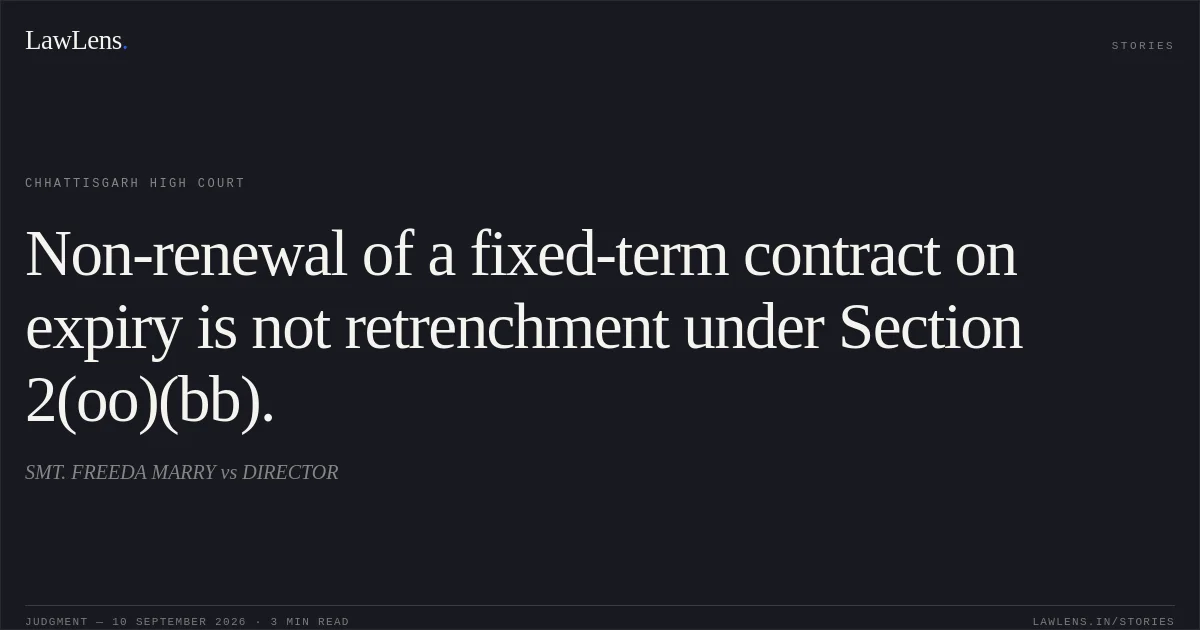
Source reference: para. 2The governing principle was that where a workman is appointed for a specified contractual or sessional period and the contract expires without renewal, such cessation is excluded from retrenchment under Section 2(oo)(bb), and the workman cannot claim reinstatement merely on the basis of completion of contractual service.
Source reference: para. 11Reasoning
The appointment orders produced by the petitioner showed that she was engaged on an ad hoc, fixed-term basis for successive academic sessions ending on 30 April of each year.
Source reference: para. 11The Court held that the respondents’ failure to renew the final contract after 30 April 2013 amounted to cessation upon expiry of the contractual term, rather than retrenchment by the employer.
Source reference: para. 11Consequently, Section 2(oo)(bb) excluded the termination from the scope of retrenchment, and the protections under Section 25F were not attracted.
Source reference: paras. 10–11In addition, although the petitioner asserted that she had worked for more than 240 days, the Court found that she had failed to establish this fact in the relevant period preceding the alleged termination.
Source reference: para. 11On that basis, the Labour Court’s conclusion that she was not entitled to reinstatement or back wages was found to be legally sustainable.
Source reference: paras. 6, 11–12Holding
The High Court answered the reference against the petitioner and upheld the Labour Court’s award dismissing her statement of claim.
It held that the expiry and non-renewal of her fixed-term contractual appointment fell within the exclusion under Section 2(oo)(bb) of the ID Act, and that she had also failed to prove 240 days of service in the relevant period.
Source reference: paras. 11–12The writ petition was accordingly dismissed, with no reinstatement or back wages granted.
Source reference: paras. 11–12Acts & Sections Cited
1 provisions across 1 statute referred to in this judgment. Each provision opens on LawLens.
Coir Industry Act, 19531
Original Court PDF
SMT. FREEDA MARRYvsDIRECTOR
Click to open original judgment
Original judgment, available to read, download and summarize on LawLens.in