Facts
The Petitioner, a Project Implementation Agency, was appointed by Respondent No. 1 (MoRD) under the Deen Dayal Upadhyaya Grameen Kaushalya Yojna to improve educational standards in Jammu and Kashmir
Source reference: para 4.1–4.2A Memorandum of Understanding (MoU) dated April 2, 2016, containing an arbitration clause, was executed only between the Petitioner and Respondent No. 2 (NIRD)
Source reference: para 1Although the MoU was signed in Hyderabad (and the project implemented in J&K), the stamp paper was generated in Delhi
Source reference: para 4.4Respondent No. 1 later transferred the project’s administration from Respondent No. 2 to Respondent No. 3
Source reference: para 4.7The Petitioner filed this petition under Section 11(6) of the Arbitration and Conciliation Act, 1996, seeking appointment of an arbitrator for unpaid dues, impleading Respondents 1 and 3 despite them being non-signatories to the MoU
Source reference: para 1, 5.1Issues
1. Whether the High Court of Delhi has territorial jurisdiction to entertain the petition given that the MoU was executed in Hyderabad and the project was in J&K
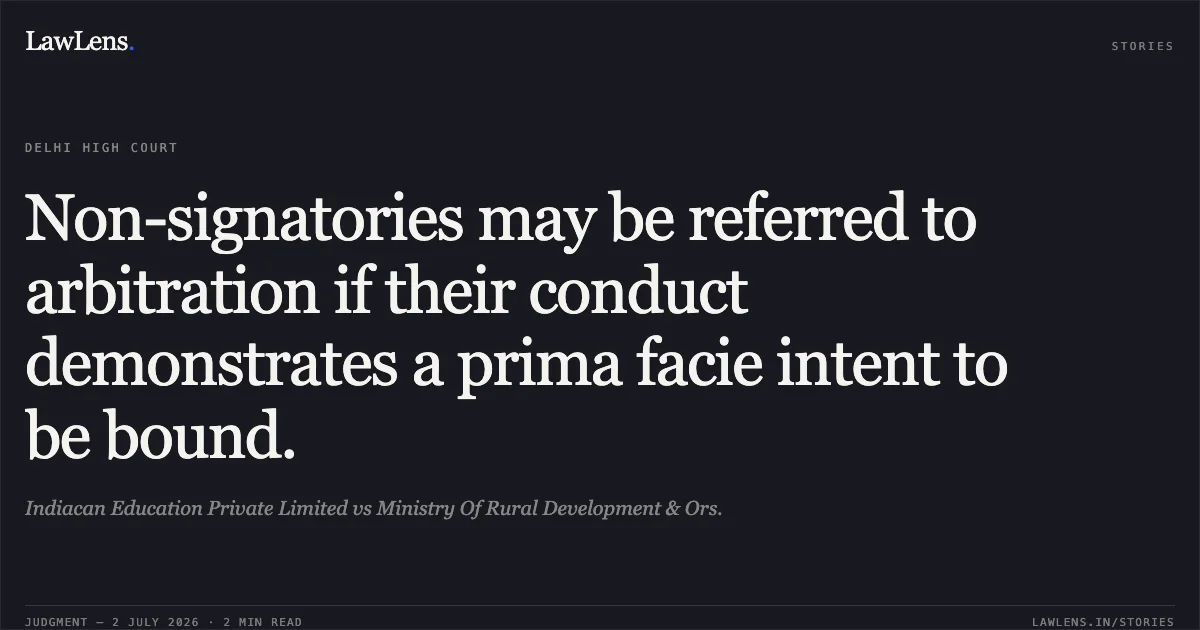
Source reference: para 10, 162. Whether non-signatories (Respondents 1 and 3) can be referred to arbitration based on their conduct and relationship with the signatory
Source reference: para 10, 243. Whether the petition is barred by limitation given the disputes originated in 2017–2018
Source reference: para 38Law Applied
Where an arbitration agreement is silent on the "seat," territorial jurisdiction is determined via Section 2(1)(e) of the Arbitration Act read with Sections 16–20 of the CPC, focusing on where the cause of action arises or where the respondent resides
Source reference: para 11, 18Under the "Group of Companies" and "Veritable Party" doctrines, non-signatories may be bound if their conduct, involvement in negotiations, performance, or termination of the contract signifies an intent to be bound
Source reference: para 32–33This is supported by Cox & Kings Ltd. v. SAP India (P) Ltd. regarding the definition of "parties" under Section 2(1)(h)
Source reference: para 32Section 18 of the Limitation Act, 1963, provides that a written acknowledgment of liability starts a fresh period of limitation
Source reference: para 45Reasoning
The Court found that although the MoU was signed in Hyderabad, Respondent No. 1 (MoRD), headquartered in Delhi, exercised "imperative" administrative and financial control over the project, including the power to terminate and audit
Source reference: para 23, 26, 37This established a material part of the cause of action in Delhi
Source reference: para 36Regarding non-signatories, the Court observed that Respondent No. 1 was the primary sanctioning/funding authority and Respondent No. 3 currently held the project funds; their active participation in meetings and correspondence regarding payments made them prima facie "veritable parties" to the arbitration
Source reference: para 25–29On limitation, the Court noted that Respondents repeatedly acknowledged the Petitioner’s eligibility for payment in communications spanning 2018 to 2025 (e.g., the minutes of the meeting on Oct 12, 2021), which constituted valid acknowledgments of debt under Section 18 of the Limitation Act
Source reference: para 43–44Holding
The Court held that it possessed territorial jurisdiction and that Respondents 1 and 3 were prima facie subject to arbitration
The petition was found not to be ex-facie time-barred
Source reference: para 47The Court appointed a Sole Arbitrator to adjudicate the disputes. However, it left the final determination regarding the liability of non-signatories and the specific issue of limitation open for the Arbitral Tribunal to decide upon a full review of evidence
Source reference: para 48, para 34, 47, 48(v)Acts & Sections Cited
14 provisions across 3 statutes referred to in this judgment. Each provision opens on LawLens.
Arbitration and Conciliation Act, 19967
Limitation Act, 19632
Code of Civil Procedure, 19085
Original Court PDF
Indiacan Education Private LimitedvsMinistry Of Rural Development & Ors.
Click to open original judgment
Original judgment, available to read, download and summarize on LawLens.in