Facts
The petitioner sought regular bail following his arrest on April 24, 2026, in connection with FIR No. 153/2026 under Sections 308(6) and 351 of the Bharatiya Nyaya Sanhita (BNS), 2023, involving allegations of extortion and intimidation
Source reference: p. 1-2The petitioner challenged the legality of his arrest, asserting that the grounds of arrest were not supplied to him in a timely or legal manner
Source reference: p. 2The prosecution countered that the petitioner signed the grounds of arrest on the day of the arrest and that the Jurisdictional Magistrate had verified compliance during the remand proceedings on April 25, 2026
Source reference: p. 2-3Issues
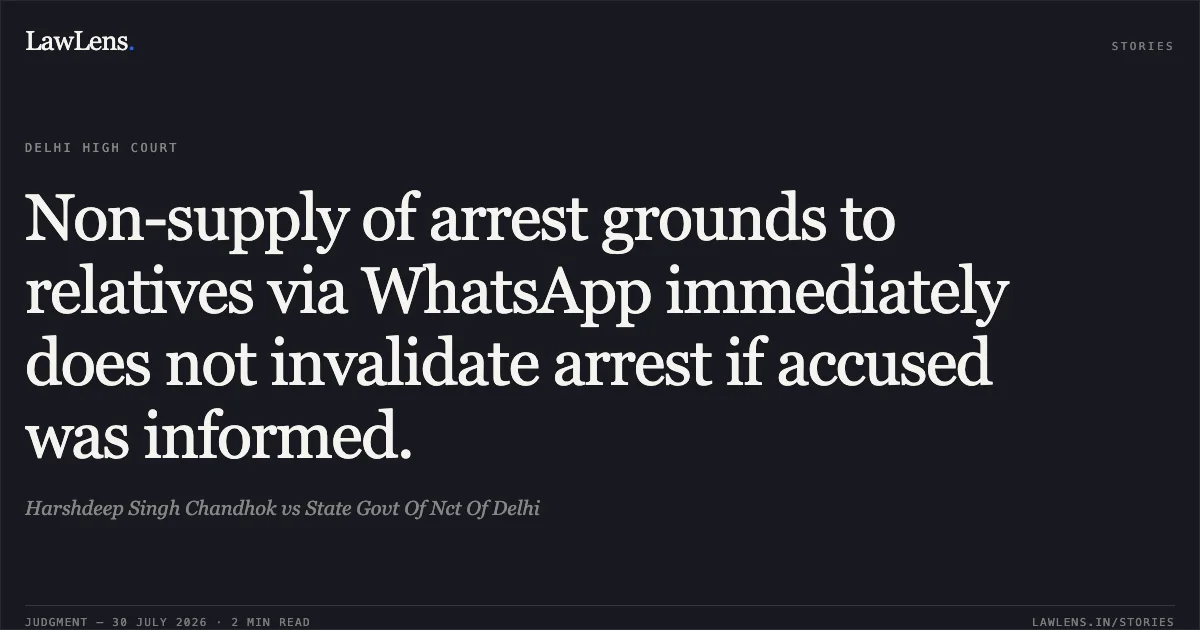
1. Whether the arrest of the petitioner was illegal due to the alleged non-supply of grounds of arrest at the time of arrest
Source reference: p. 2, para. 32. Whether the communication of grounds of arrest to a family member via WhatsApp on the day following the arrest constitutes a violation of statutory or constitutional safeguards
Source reference: p. 3, para. 6Law Applied
The court applied Sections 47 and 48 of the Bharatiya Nagarik Suraksha Sanhita (BNSS), 2023, which mandate that an arrested person must be informed of the grounds of arrest
Source reference: p. 3, para. 8The court also relied on the precedent set by the Supreme Court in Kasireddy Upender Reddy v. State of Andhra Pradesh & Ors. (2025 INSC 768), which holds that the core requirement is that the accused be effectively informed of the basic facts constituting the arrest, and technical objections regarding the timing or mode of communication to family members do not invalidate an otherwise lawful arrest where statutory safeguards are met
Source reference: p. 3, para. 8Reasoning
The court found that the document containing the grounds of arrest bore the petitioner’s signature and the date of arrest (April 24, 2026) in his own handwriting, contradicting the claim of non-supply
Source reference: p. 3, para. 6The court reasoned that the requirement to inform a family member is an independent procedural step, and doing so via WhatsApp the following day did not nullify the primary notification given to the accused
Source reference: p. 3, para. 6Furthermore, the court observed that the petitioner failed to raise any grievance regarding the arrest procedure before the Magistrate during the remand hearing. Since the remand order—which recorded that the Magistrate informed the petitioner of the grounds and that legal requirements were satisfied—was never challenged, it attained finality
Source reference: p. 3, para. 7, 9Holding
The court held that there was no constitutional or statutory infirmity in the petitioner’s arrest as the record demonstrated substantial compliance with the law
The direct answer to the issues is that the arrest was lawful and the delayed electronic communication to the father did not invalidate the arrest
Source reference: p. 4, para. 9The petition for bail was dismissed
Source reference: p. 4, para. 10Original Court PDF
Harshdeep Singh ChandhokvsState Govt Of Nct Of Delhi
Click to open original judgment
Original judgment, available to read, download and summarize on LawLens.in


