Facts
Naresh Kumar joined the Delhi Transport Corporation (“DTC”) as a conductor on 17 March 1985. During an inspection on 8 June 1991, two passengers were allegedly found travelling without tickets despite having paid the fare to him. It was further alleged that he refused to sign the challan, failed to hand over the waybill, and misbehaved with the checking staff.
Source reference: p.3, para 3.1Following a domestic enquiry, DTC imposed the penalty of removal from service on 24 November 1992.
Source reference: p.3, para 3.2Since an industrial dispute concerning implementation of the Fourth Pay Commission recommendations was pending, DTC sought approval of the removal under Section 33(2)(b) of the Industrial Disputes Act, 1947 (“ID Act”). The Industrial Tribunal first held the enquiry proceedings to be perverse because the workman’s defence statement was not on record; after evidence was led, it rejected DTC’s approval application on 13 November 2002, finding that the misconduct was not proved.
Source reference: pp.3–4, para 3.3Separately, the workman raised an industrial dispute under the ID Act. The Labour Court, by award dated 9 November 2009, held that the enquiry violated the principles of natural justice, found the misconduct unproved, and directed reinstatement without back wages, while awarding litigation expenses of ₹25,000.
Source reference: p.4, para 3.5DTC challenged both decisions under Article 226 of the Constitution. During the writ proceedings, the workman died in 2016 and his legal representative was substituted.
Source reference: p.2, para 2Issues
Whether the domestic enquiry was vitiated by violation of the principles of natural justice, particularly due to non-supply of relevant documents and failure to properly consider the workman’s defence?
Source reference: pp.5–10, paras 15–16Whether the misconduct of non-issuance of tickets despite receipt of fare was proved on the evidence adduced before the Tribunal and Labour Court?
Source reference: pp.10–15, paras 17–22Whether the High Court, exercising supervisory jurisdiction under Article 226, should interfere with the concurrent findings of the Tribunal and Labour Court?
Source reference: pp.6–7, paras 11–13What relief should be granted in view of the workman’s death and the long passage of time since his removal?
Source reference: p.15, para 23.1Law Applied
Jurisdiction under Article 226 is supervisory, not appellate, and the Court should not reappreciate evidence or disturb a plausible finding of a Labour Court or Tribunal unless it is arbitrary or perverse.
Source reference: pp.6–7, paras 11–12In domestic enquiries, strict rules of evidence do not apply; misconduct is assessed on the standard of preponderance of probabilities.
Source reference: pp.7–9, para 13Under Section 33(2)(b) of the ID Act, the Labour Court or Tribunal must examine whether the enquiry was fair, consistent with natural justice, and disclosed a prima facie case; where the enquiry is defective, the parties may lead evidence on the merits.
Source reference: pp.7–9, para 13The scope of Section 33(2)(b) proceedings is distinct from adjudication of the industrial dispute under Sections 10 and 11-A, where the Labour Court may examine the justification and proportionality of the punishment.
Source reference: pp.7–9, para 13, relying on John D’Souza v. Karnataka State Road Transport Corporation, (2019) 18 SCC 47Absence of cash verification is not an indispensable requirement in every case of alleged non-issuance of tickets, although it may assume significance where the remaining evidence is materially deficient.
Source reference: pp.12–15, paras 21–21.6Reasoning
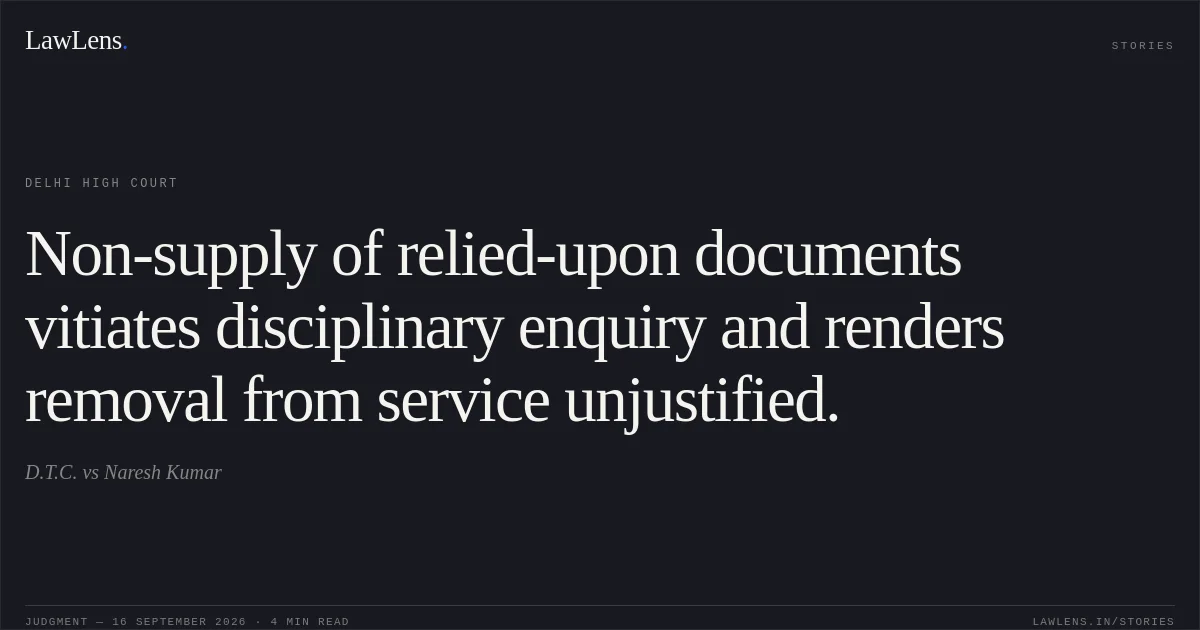
The Court found that the domestic enquiry was materially defective because crucial documents, including the passenger’s written reply, were not shown to have been supplied to the workman, and there was no proof that he had been informed that the documents were available for collection.
Source reference: p.10, para 15The earlier finding that the enquiry report was perverse due to the absence of the workman’s defence statement and non-consideration of defence evidence had also not been challenged by DTC.
Source reference: p.10, para 15These defects were substantive and could not be treated as harmless procedural irregularities merely because the workman participated in the proceedings.
Source reference: no citationOn the merits, the Court held that DTC’s evidence was substantially unreliable. The challan and passenger statements did not bear the workman’s signatures; the driver stated that his signatures had been obtained on blank paper; and the relevant passenger was neither properly identified nor examined to substantiate the allegation.
Source reference: pp.10–12, paras 18–20The passenger’s written reply did not establish that the workman had refused to issue tickets after receiving the fare and was not supported by direct evidence.
Source reference: p.11, para 19Although cash verification was not legally mandatory, its absence assumed importance because the other evidence was inconsistent and inadequate.
Source reference: pp.12–15, paras 21–22The findings of the Labour Court and Tribunal were therefore plausible and supported by the record, warranting no interference under Article 226.
Source reference: p.15, para 23Holding
The High Court dismissed DTC’s challenge to the finding that the domestic enquiry was vitiated and that the misconduct was not proved.
It upheld the Tribunal’s order refusing approval under Section 33(2)(b) of the ID Act and affirmed the Labour Court’s conclusion that the removal was unjustified.
Source reference: p.15, para 23However, since the workman had died in 2016, the removal dated back to 1992, and he had served DTC for approximately six to seven years, the Court modified the reinstatement direction and substituted it with lump-sum compensation of ₹3,00,000 payable to his legal heir(s) within four weeks.
Source reference: pp.15–16, paras 23.1–24Acts & Sections Cited
9 provisions across 1 statute referred to in this judgment. Linked provisions open on LawLens.
Industrial Disputes Act, 1947
Original Court PDF
D.T.C.vsNaresh Kumar
Click to open original judgment
Original judgment, available to read, download and summarize on LawLens.in