Facts
The petitioner was arrested on 13.10.2024 from Ankleshwar, Gujarat, following a raid where 518.18 kg of a substance (later identified as mephedrone) was recovered from the premises of M/s Aavkar Drugs Pvt. Ltd.
Source reference: para. 7The petitioner, a marketing consultant, had facilitated a job-work agreement between Aavkar Drugs and Pharma Solution Services.
Source reference: para. 8The petitioner sought regular bail under Section 37 of the NDPS Act and Section 483 of the BNSS, primarily on the ground that he was never served with written "grounds of arrest" at the time of arrest or prior to his production for remand.
Source reference: para. 9The State opposed bail, alleging the petitioner was a key member of an international drug cartel and argued that the requirement for written grounds was prospective under the Mihir Rajesh Shah verdict.
Source reference: paras. 23-25Issues
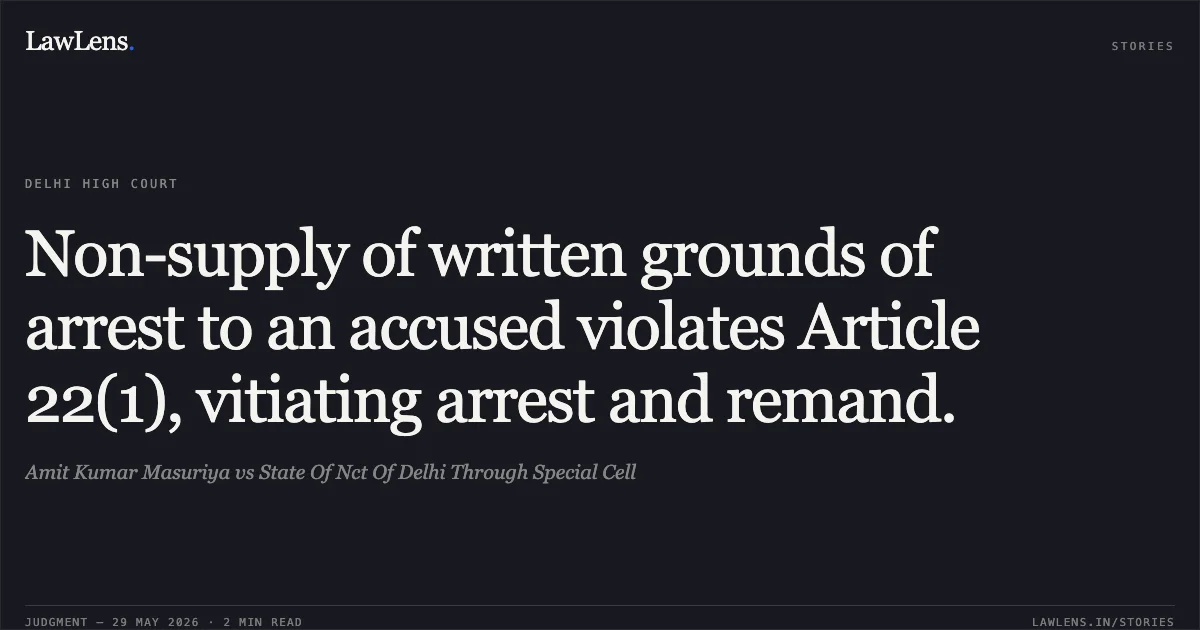
1. Whether the non-supply of written "grounds of arrest" to the petitioner violates the constitutional mandate under Article 22(1) and justifies the grant of bail.
Source reference: para. 10-112. Whether the requirement for written grounds of arrest as laid down in Mihir Rajesh Shah applies to arrests made prior to the date of that judgment.
Source reference: para. 25-27Law Applied
Article 22(1) of the Constitution of India, which mandates that no person shall be detained without being informed of the grounds of arrest.
Source reference: para. 10Section 47 of the Bharatiya Nagarik Suraksha Sanhita (BNSS), 2023.
Source reference: para. 30.1Pankaj Bansal v. Union of India and Prabir Purkayastha v. State (NCT of Delhi), which established that "grounds of arrest" must be communicated in writing.
Source reference: para. 9Mihir Rajesh Shah v. State of Maharashtra, which held that grounds must be served no later than two hours prior to production before a Magistrate.
Source reference: para. 10Dr. Rajinder Rajan v. Union of India, which applied these protections retrospectively to arrests made before the Mihir verdict.
Source reference: para. 30.3Reasoning
The court found that the petitioner’s arrest stood on the same footing as his co-accused, Brijesh Kothia, whose arrest was previously held vitiated.
Source reference: para. 30.1The court observed that the petitioner’s arrest memo contained only generic "reasons" rather than person-specific "grounds".
Source reference: para. 30.4The court rejected the State’s argument that the written requirement was only prospective, noting that Dr. Rajinder Rajan applied the Mihir dictum to arrests as early as May 2025, reinforcing that Article 22(1) is a pre-existing constitutional right.
Source reference: para. 30.3Since the transit and police custody remand applications were not served on the petitioner at least two hours prior to the hearing, he was deprived of a meaningful opportunity to consult counsel and challenge the legality of his detention.
Source reference: paras. 12, 30.5The court noted the petitioner’s long incarceration (over 1.5 years) and satisfactory jail conduct.
Source reference: para. 30.6Holding
The court answered the issues in the affirmative, holding that the constitutional infraction of non-supply of written grounds of arrest entitled the petitioner to liberty.
The petition was allowed, and the petitioner was granted regular bail subject to furnishing a personal bond of Rs. 1,00,000, surrendering his passport, and other standard conditions.
Source reference: para. 31The court clarified that while the arrest was vitiated for bail purposes, the underlying investigation and the State's power to effect a fresh, lawful arrest remained unaffected.
Source reference: para. 30.7Acts & Sections Cited
15 provisions across 4 statutes referred to in this judgment. Each provision opens on LawLens.
Narcotic Drugs and Psychotropic Substances Act, 1985
Bharatiya Nagarik Suraksha Sanhita, 20233
Bharatiya Nyaya Sanhita, 20232
Code of Criminal Procedure, 19731
Original Court PDF
Amit Kumar MasuriyavsState Of Nct Of Delhi Through Special Cell
Click to open original judgment
Original judgment, available to read, download and summarize on LawLens.in


![Subsequent exoneration does not retrospectively invalidate a finalized promotion select list.. UNNIKRISHNAN M vs M/o Environment And Forests. CAT - ['Ernakulam']. LawLens](/stories/thumbnails/subsequent-exoneration-does-not-retrospectively-invalidate-a-finalized-promotion-select-li-ce80a0e84f2f4887857271e8b4341c42.webp)