Facts
On January 17, 2025, the Petitioner was apprehended from a flat in Kotla Mubarakpur following secret information.
Source reference: p. 1A search resulted in the recovery of 1.516 kg of charas (commercial quantity).
Source reference: p. 1-2The IO (Naveen Gurjar) sealed the contraband with the seal ‘NG’, and the SHO (Prahlad Matsaya) subsequently counter-sealed it with ‘PSM’ before depositing it in the malkhana.
Source reference: p. 2, para. 7The Petitioner was interrogated, during which he disclosed procuring drugs from a co-accused, Thomas, for sale in Delhi.
Source reference: p. 10, para. 9The Petitioner sought regular bail on two grounds: first, that discrepancies in the malkhana register regarding who deposited the parcels vitiated the recovery; and second, that his arrest was illegal due to the non-supply of written grounds of arrest.
Source reference: p. 2, para. 4.1-4.2Issues
1. Whether the alleged discrepancies in Register No. 19 regarding the depositor and the counter-sealing of parcels constitute "reasonable grounds" to believe the accused is not guilty under Section 37 of the NDPS Act.
Source reference: p. 4, para. 72. Whether the failure to provide detailed, individualized written grounds of arrest at the time of apprehension entitles the accused to bail, notwithstanding the statutory restrictions of the NDPS Act.
Source reference: p. 4, para. 8Law Applied
Section 37 of the NDPS Act, which mandates a "negative" burden where bail for commercial quantities requires the court’s satisfaction that the accused is not guilty and unlikely to commit further offences.
Source reference: p. 3-4, para. 6Article 22(1) of the Constitution and Section 50 CrPC (Section 47 BNSS) regarding procedural requirements of arrest.
Source reference: p. 4-8Prejudice-oriented test from State of Karnataka v. Sri Darshan (2025), which holds that procedural lapses in furnishing grounds of arrest do not ipso facto render custody illegal unless demonstrable prejudice is shown.
Source reference: p. 7, para. 8.4Prospective clarification in Mihir Rajesh Shah v. State of Maharashtra (2025) regarding the mandatory written communication of grounds of arrest.
Source reference: p. 8-9, para. 8.5-8.6Reasoning
The court found that the discrepancies in Register No. 19 were sufficiently explained by the SHO’s counter-sealing process (PSM seal) intended to maintain the purity of the seized material, thus failing to meet the "not guilty" threshold of Section 37 NDPS.
Source reference: p. 4, para. 7The court observed that the Petitioner was arrested in January 2025, prior to the definitive elucidation of the "written grounds" rule in Mihir Rajesh Shah (November 2025).
Source reference: p. 12, para. 11The court held that Paragraph 9 of the Arrest Memo, while titled "Reasons for Arrest," substantially contained the "grounds" required for the accused to understand the basis of his detention.
Source reference: p. 12-13, para. 13Applying the prejudice-oriented test, the court determined that the Petitioner suffered no prejudice as he was provided legal counsel at the first remand stage and was fully aware of the allegations.
Source reference: p. 14, para. 14The court emphasized that in drug trafficking cases, technical procedural lapses should not outweigh the "pernicious impact" of the trade on national security and social stability.
Source reference: p. 15, para. 16-17Holding
The court answered Issue 1 in the negative, holding that the sealing process was valid and did not create reasonable doubt regarding the recovery.
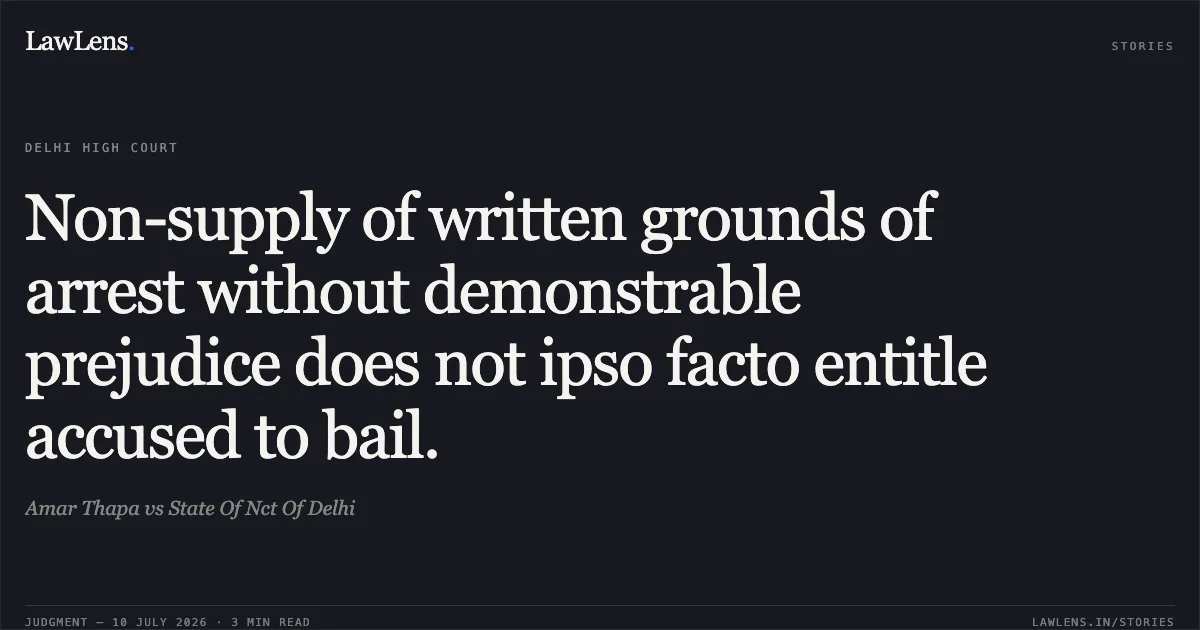
For Issue 2, the court held that the non-supply of written grounds did not warrant bail as the defect was curable, no prejudice was shown, and substantial compliance was met through the arrest memo and remand proceedings.
Source reference: p. 13-14The court dismissed the bail application, concluding that the gravity of the offence and the risk of the Petitioner absconding to Nepal outweighed the procedural arguments raised.
Source reference: p. 14-15, para. 15, 17Acts & Sections Cited
10 provisions across 5 statutes referred to in this judgment. Each provision opens on LawLens.
Narcotic Drugs and Psychotropic Substances Act, 19855
Code of Criminal Procedure, 19732
Bharatiya Nagarik Suraksha Sanhita, 20231
Prevention of Money-Laundering Act, 20021
Indian Penal Code, 18601
Original Court PDF
Amar ThapavsState Of Nct Of Delhi
Click to open original judgment
Original judgment, available to read, download and summarize on LawLens.in


