Facts
On 26 November 2020, the appellant alleged that respondent No. 2 drove a tractor repeatedly towards him and his family in their agricultural field, striking the appellant’s mother, and that respondent No. 2 and others then assaulted the family with sharp-edged agricultural weapons. The appellant and his father sustained deep incised wounds
Source reference: para. 3.1–3.2An FIR was registered under Sections 143, 307, 323, 341 and 447 IPC; after investigation, the Sessions Court framed charges against respondent No. 2, including under Section 307 IPC. On revision, the High Court set aside the Section 307 charge and directed that a charge under Section 308 IPC be framed, reasoning that the injuries were on non-vital parts of the body. The appellant challenged that order before the Supreme Court
Source reference: para. 3.3–3.6Issues
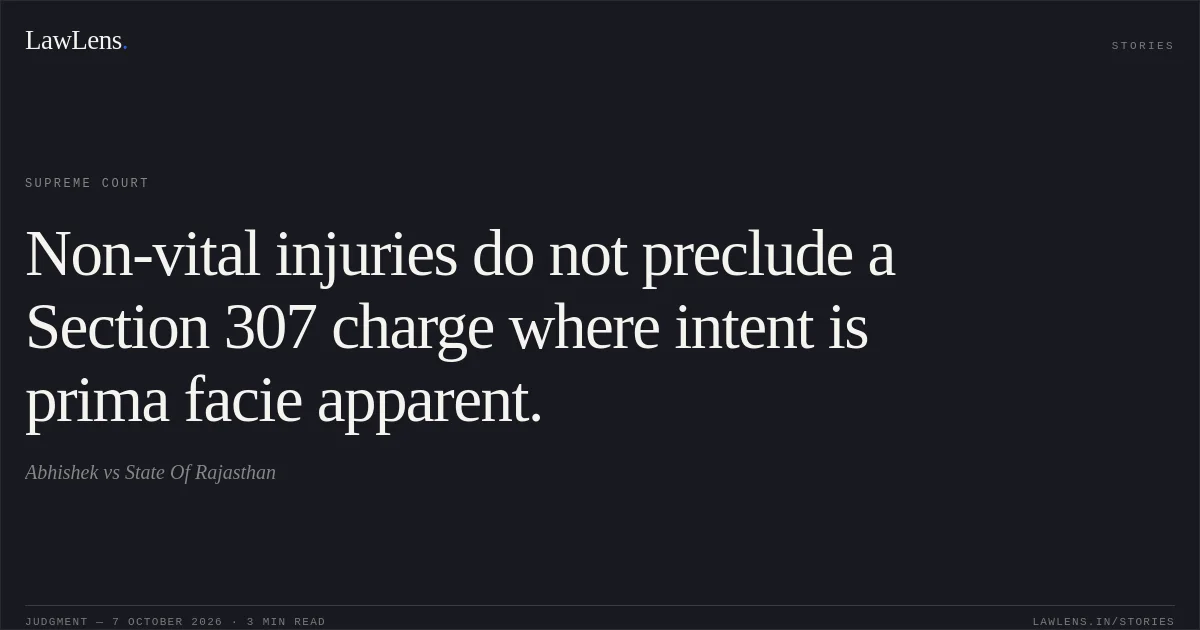
Whether the High Court was justified in setting aside the charge under Section 307 IPC and directing a charge under Section 308 IPC because the victims’ injuries were on non-vital parts of the body
Source reference: para. 7Law Applied
Under Section 307 IPC, the relevant inquiry is whether the accused acted with the intention or knowledge, and in circumstances, such that death would have made the act murder; a fatal or life-threatening injury need not actually be inflicted. The nature and location of an injury may assist in determining intention or knowledge but are not determinative; the court must consider the totality of circumstances, including the weapons used, the manner and persistence of the attack, and prior animosity (State of Maharashtra v. Balram Bama Patil, (1983) 2 SCC 28; State of Madhya Pradesh v. Saleem alias Chamaru, (2005) 5 SCC 554; Jage Ram v. State of Haryana, (2015) 11 SCC 366)
Source reference: para. 8At the charge-framing stage, Sections 227 and 228 CrPC require consideration of whether the material discloses a prima facie case or raises suspicion, not a mini-trial
Source reference: para. 10Section 216 CrPC empowers the trial court to alter or add a charge before judgment
Source reference: para. 12Reasoning
The investigation material included witness statements, spot-inspection reports and recoveries. It alleged that respondent No. 2 drove a tractor at high speed repeatedly towards the family, struck the appellant’s mother, and then joined an armed assault with axes or similar weapons. The appellant and his father sustained deep wounds, and the appellant’s statement was that blows aimed at their heads struck their arms or shoulders when they raised their arms to protect themselves
Source reference: para. 11In the Court’s view, the High Court erred by treating the injuries’ location on limbs as decisive and conducting a summary assessment of their significance. The allegations and surrounding circumstances were sufficient at the charge stage to sustain the Section 307 charge; whether the evidence ultimately establishes that offence is for trial. If the evidence does not support that charge, the trial court may alter it under Section 216 CrPC
Source reference: paras. 12–14Holding
The Supreme Court held that the High Court was not justified in replacing the Section 307 IPC charge with one under Section 308 IPC solely because the injuries were on non-vital parts of the body
It allowed the appeal, set aside the High Court’s order, and restored the Sessions Court’s order framing, among other charges, a Section 307 IPC charge against respondent No. 2. The Court directed the trial to proceed in accordance with law and clarified that its observations should not affect the merits of the trial
Source reference: paras. 13–14Acts & Sections Cited
13 provisions across 2 statutes referred to in this judgment. Each provision opens on LawLens.
Indian Penal Code, 1860
Code of Criminal Procedure, 19734
Original Court PDF
AbhishekvsState Of Rajasthan
Click to open original judgment
Original judgment, available to read, download and summarize on LawLens.in