Facts
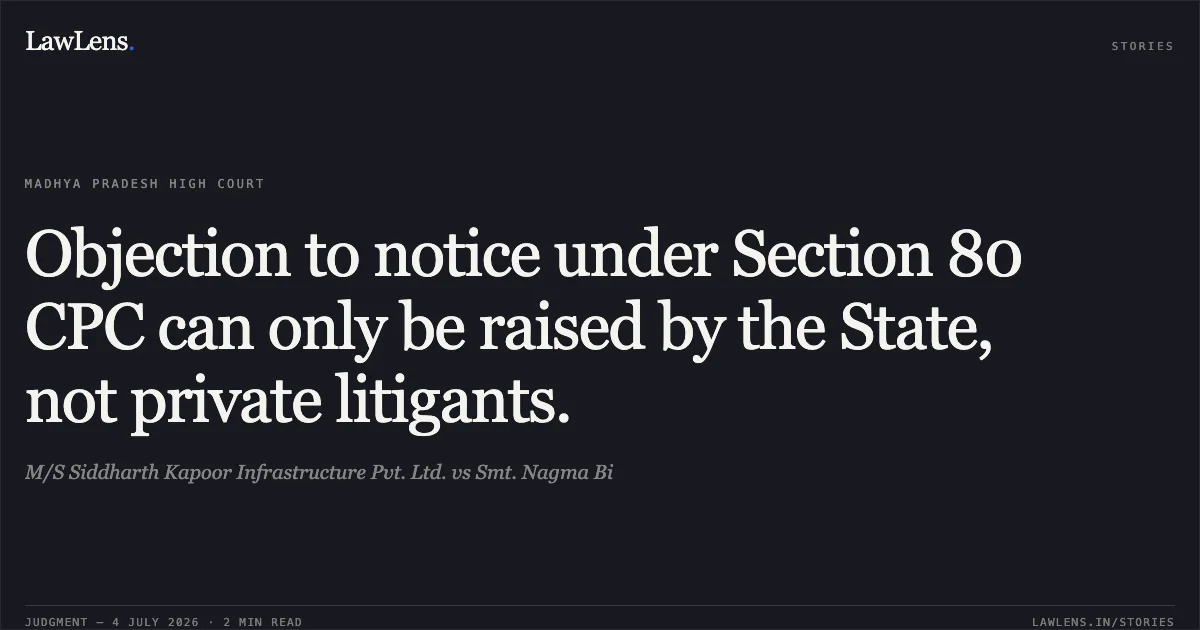
The petitioner (defendant) challenged two orders of the Trial Court: first, the acceptance of a plaint without ensuring compliance with Section 80 of the Code of Civil Procedure (CPC); and second, the rejection of an application filed under Order 7 Rule 11 CPC seeking dismissal of the suit.
Source reference: para. 1The dispute involved private parties regarding agricultural land, where the Tahsildar and Collector were impleaded as formal defendants.
Source reference: para. 3, 7The petitioner argued that the suit was maintainable only if a separate notice under Section 80 CPC was served upon the Tahsildar (Defendant No. 3), as the notice was only issued to the Collector.
Source reference: para. 3, 4Issues
1. Whether a private litigant is competent to challenge the maintainability of a suit on the grounds of non-compliance with Section 80 CPC.
Source reference: para. 9, 122. Whether service of notice upon the Collector under Section 80(1)(c) CPC constitutes sufficient compliance for a suit involving other public officers of the State.
Source reference: para. 13, 14Law Applied
Section 80 CPC, which mandates a two-month notice period before instituting a suit against the Government or a public officer.
Source reference: para. 4The principle that the object of Section 80 is to allow the State to settle claims and avoid unnecessary litigation.
Source reference: para. 8Gaja v. Dasa Koeri (AIR 1964 All 471) and Raj Kumari v. Board of Revenue (1984 SCC OnLine All 664) to establish that Section 80 is for the benefit of the State and can be waived by the authority concerned.
Source reference: para. 9, 11Gangappa Gurupadappa Gugwad v. Rachawwa (1970 3 SCC 716), which holds that a plaint cannot be mechanically rejected if no relief is claimed against the State.
Source reference: para. 10Ghulam Rasool v. State of J & K (AIR 1983 SC 1188), which confirms that notice to the Collector is sufficient compliance under Section 80(1)(c).
Source reference: para. 14Reasoning
The court reasoned that Section 80 is an evidentiary and procedural safeguard intended for the advancement of justice, not a weapon for private defendants to defeat legitimate suits.
Source reference: para. 8Since the State or the public officer did not object to the lack of notice, the right to notice was deemed waivable; a private party has no locus standi to plead a bar under Section 80 that is intended solely for the protection of public officers.
Source reference: para. 9, 12The court observed that the litigation was primarily between private parties and the State was a formal party with no substantive interest in the lis.
Source reference: para. 7Regarding the technicality of service, the court clarified that under Section 80(1)(c) CPC, delivering notice to the Collector satisfies the requirement for a suit against the State Government, and a separate notice to the Tahsildar was unnecessary.
Source reference: para. 13, 14Holding
The Court answered the issues in the negative and affirmative respectively, holding that the petitioner's application under Order 7 Rule 11 CPC was not maintainable.
The High Court found no error in the Trial Court’s refusal to reject the plaint. The Civil Revision was consequently dismissed.
Source reference: para. 15Notice to the Collector was sufficient.
Source reference: para. 14Acts & Sections Cited
1 provisions across 1 statute referred to in this judgment. Each provision opens on LawLens.
Code of Civil Procedure, 19081
Original Court PDF
M/S Siddharth Kapoor Infrastructure Pvt. Ltd.vsSmt. Nagma Bi
Click to open original judgment
Original judgment, available to read, download and summarize on LawLens.in

![Authorities must decide pensionary and retiral-benefit claims through a reasoned order within eight weeks.. Habibullah khan vs HOME DEPARTMENT. CAT - ['Srinagar']. LawLens](/stories/thumbnails/authorities-must-decide-pensionary-and-retiral-benefit-claims-through-a-reasoned-order-wit-d0cbe8a8119c48fbabe7df9f2d353488.webp)
![Continuous temporary-status service entitles dependants to family pension despite absence of formal regularisation.. SMT SUSHILA DEVI vs DEPARTMENT OF POSTS. CAT - ['Allahabad']. LawLens](/stories/thumbnails/continuous-temporary-status-service-entitles-dependants-to-family-pension-despite-absence-0006d1f107144299ac3b945914aae9ff.webp)