01Facts
The dispute concerns land in village Chakwa Gholia and Bechuwa, originally belonging to recorded tenure holder Fateh Bahadur Singh.
¶ 4The petitioners claim that the holder executed a registered Will on 25.11.1971 in their favor.
¶ 4Following the holder's death in 1973, the revenue records were mutated in the name of Raj Narain Singh (petitioners' father) based on a Lekhpal report.
¶ 6On 30.09.1975, the Prescribed Authority declared 26.949 hectares as surplus while the petitioners were minors.
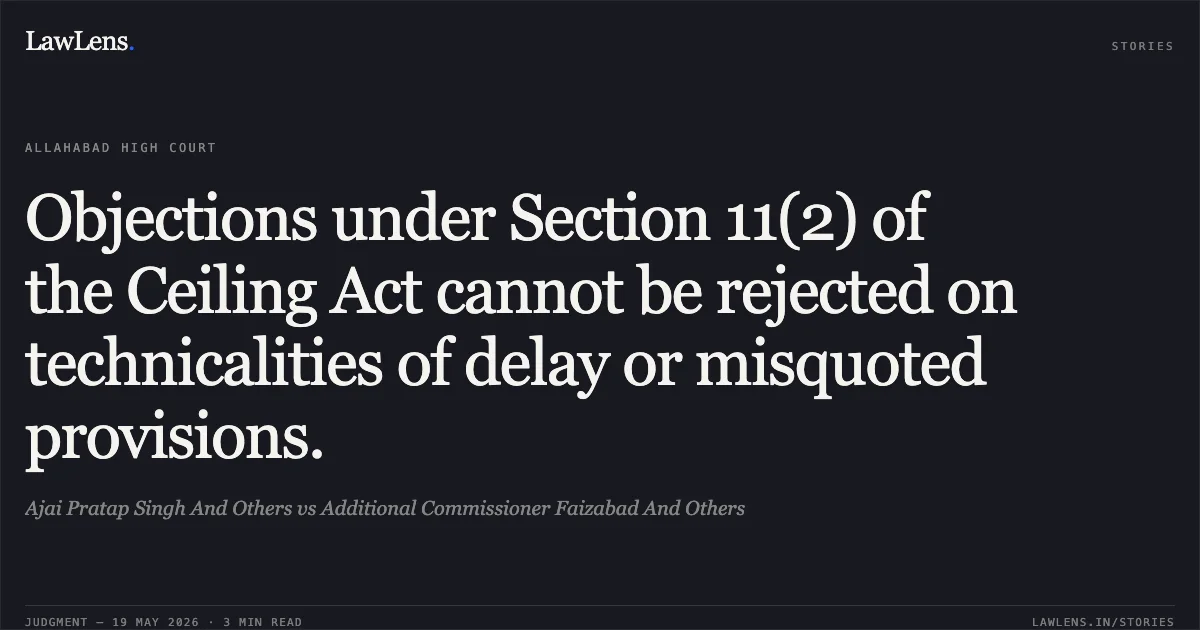
¶ 6–7Upon attaining majority, petitioners filed objections in 1980, which were rejected on 26.04.1982 by the Prescribed Authority due to delay and the incorrect labeling of the application as under Section 13-A instead of Section 11(2) of the U.P. Imposition of Ceiling on Land Holdings Act.
¶ 8–9The Appellate Authority affirmed this rejection on 05.03.1998.
¶ 902Issues
i.1. Whether objections filed by third parties claiming independent rights under Section 11(2) can be rejected solely on technical grounds of delay or mislabelling of statutory provisions.
¶ 37, 42ii.2. Whether the ceiling authorities are mandated to independently adjudicate the validity and effect of a registered Will when determining surplus land.
¶ 14, 48iii.3. Whether the minority of the objectors at the time of the original proceedings constitutes a valid ground to reconsider surplus declarations.
¶ 44-4503Law Applied
The Court applied the U.P. Imposition of Ceiling on Land Holdings Act, 1960, specifically Section 11(2) regarding the right of third parties to file objections.
¶ 41Section 5(6) regarding the investigation of transfers/Wills made after 24.01.1971.
¶ 49-50It relied on Dirvijai Singh v. State of U.P., establishing that third-party rights survive even if the recorded tenure holder already contested the matter.
¶ 40The principle that mislabelling a statutory provision is a curable defect was drawn from Abdul Hafiz Khan v. D.J. Bahraich.
¶ 42Regarding the duties of an appellate court, the Court cited State of U.P. v. Kailash Nath and Order XLI Rule 31 of the CPC, emphasizing the requirement for a reasoned, independent analysis of facts and law.
¶ 52-53Provisions in the judgment · 1 · Linked ones open on LawLens
Code of Civil Procedure, 1908 Section 96
04Reasoning
The Court reasoned that the Prescribed Authority erred by adopting a "hyper-technical approach" in rejecting the petitioners' claims due to their minority and the clerical error in citing Section 13-A.
¶ 42-43Since the petitioners were minors during the original 1975 proceedings, the court held that limitation should not be strictly applied against them without considering their lack of effective representation.
¶ 44-47Applying Shafir v. D.J. Gonda, the Court found that the authorities were legally bound to adjudicate the "substantive and legally triable claim" based on the Will, rather than relying on fiscal mutation entries which do not confer title.
¶ 15, 41, 57The Court determined that the Appellate Authority failed its statutory duty under Order XLI Rule 31 CPC by mechanically affirming the lower order without evaluating the genuineness of the Will or the impact of Section 5(6).
¶ 53-54Finally, it noted that subsequent allotment of surplus land to third parties does not bar judicial review if the foundational declaration was illegal.
¶ 5505Holding
The Court held that independent rights of third parties (especially minors) must be adjudicated on merits regardless of procedural technicalities.
¶ 43, 57The Court allowed the writ petition and quashed the orders dated 26.04.1982 and 05.03.1998, and remanded the matter to the Prescribed Authority to reconsider the objections afresh, specifically to examine the validity of the 1971 Will, the effect of the petitioners’ minority, and the applicability of Section 5(6) of the Act.
¶ 58, 60, 58-59Original Court PDF
Ajai Pratap Singh And OthersvsAdditional Commissioner Faizabad And Others
Click to open original judgment
Original judgment, available to read, download and summarize on LawLens.in