Facts
ONGC issued a Notice Inviting Tender dated 16 May 2025 for an annual rate contract concerning construction of drill sites and other civil works for the Jorhat Asset for three years.
Source reference: p.6, para.3The petitioners submitted bids quoting 16% and deposited an Earnest Money Deposit (EMD) of ₹29,35,000 each.
Source reference: p.6, para.3ONGC rejected their bids on 2 September 2025, alleging violation of Section 2(1)(b) of the Integrity Pact because the bids had been submitted from the same IP address.
Source reference: p.6, para.3ONGC subsequently issued show-cause notices proposing blacklisting.
Source reference: p.6, para.3Although the writ petitions initially challenged both blacklisting and forfeiture of the EMD, the petitioners confined the proceedings to the forfeiture issue.
Source reference: p.6, para.2; p.14, para.20ONGC relied on several circumstances allegedly indicating cartelisation: the identical IP address, certificates issued by the same Chartered Accountant, identical Appendices BP-1, BP-2, BP-3 and GU, and, in the case of two petitioners, their being brothers.
Source reference: p.14, para.22Issues
1. Whether ONGC’s decision to forfeit the petitioners’ EMD on the basis of alleged cartelisation and violation of the Integrity Pact was arbitrary, unreasonable, or unsupported by objective material?
Source reference: pp.14–16, paras.20–262. Whether the petitioners’ common IP address, common Chartered Accountant, identical bid appendices, and familial relationship were sufficient circumstances to sustain ONGC’s decision-making process?
Source reference: pp.14–16, paras.22–253. Whether the Court should interfere under Article 226 with ONGC’s contractual and commercial decision to forfeit the EMD?
Source reference: pp.13–16, paras.17–18, 25–26Law Applied
The Court applied the terms of the tender document and the Integrity Pact, including Section 2(1)(b), which prohibited cartelisation, and Section 4(1)(1), which empowered ONGC to forfeit the EMD; the tender’s techno-commercial evaluation clause also contemplated rejection of bids violating the Integrity Pact.
Source reference: pp.12–13, para.15; p.16, para.25It relied on the Competition Commission of India’s guidelines identifying warning signals of bid rigging, including bids submitted from the same IP address, common email or office details, common professionals, identical mistakes or documents, and related or commonly controlled bidders.
Source reference: pp.11–12, para.14Under the principles governing judicial review of contractual decisions, particularly Air India Ltd. v. Cochin International Airport Ltd., (2000) 2 SCC 617, judicial review is concerned with the decision-making process rather than appellate re-assessment of the commercial decision.
Source reference: p.13, para.17Silppi Constructions Contractors v. Union of India, (2020) 16 SCC 489 further establishes that courts should exercise restraint in contractual matters and interfere only in cases of gross illegality, perversity, or unreasonableness.
Source reference: p.13, para.18; p.16, para.26The Court also considered Rajasthan Cylinders & Containers Ltd. v. Union of India, M/s Versha Technotrade Pvt. Ltd. v. State of Assam, and M/s G.H. Khandelwal v. Amravati Municipal Corporation concerning the assessment of bid rigging and cartelisation indicators.
Source reference: p.8, para.7; p.9, para.8Reasoning
The Court held that the forfeiture decision was based on cumulative and objective circumstances rather than on the petitioners’ familial relationship alone.
Source reference: pp.14–16, paras.22–24The identical IP address, common Chartered Accountant, identical appendices, and, in two cases, the relationship of brotherhood corresponded with the CCI’s recognised warning signals of cartelisation.
Source reference: pp.14–16, paras.22–24The explanation that a common service provider, Shri Durlov Gogoi, had assisted multiple bidders did not adequately displace the inference, particularly because other successful bidders had submitted their bids through different IP addresses.
Source reference: p.15, para.23Likewise, the Court rejected the submission that use of the same Chartered Accountant was merely coincidental, noting that the petitioners’ bid appendices were also identical and that other bidders had used different Chartered Accountants.
Source reference: p.16, para.24The argument that three petitioners could not form a cartel was rejected because ONGC’s allegation concerned 15 of the 30 bidders, while the remaining 12 implicated bidders had not challenged the decision.
Source reference: p.14, para.21Since Section 4(1)(1) of the Integrity Pact authorising EMD forfeiture was not itself challenged, and no gross illegality, perversity, or manifest unreasonableness was established, the Court declined to interfere with ONGC’s commercial decision.
Source reference: p.16, paras.25–26Holding
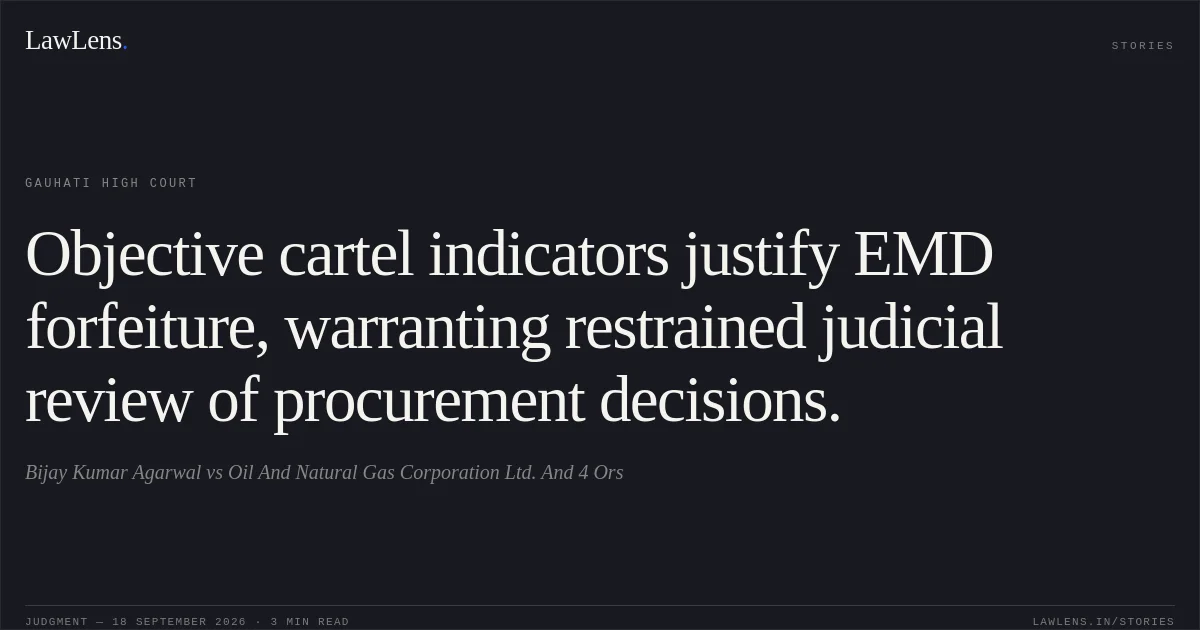
The Court answered the issues against the petitioners and upheld ONGC’s decision to forfeit the EMD.
It held that ONGC’s decision-making process was founded on objective materials indicating possible cartelisation and did not warrant interference under Article 226.
Source reference: p.16, paras.25–26All three writ petitions were dismissed, the interim orders were vacated, and no order as to costs was made.
Source reference: p.17, para.27The Court clarified that the judgment was confined to the forfeiture of the EMD and that the petitioners remained at liberty to separately challenge the blacklisting decision, if so advised.
Source reference: p.17, para.28Acts & Sections Cited
3 provisions across 1 statute referred to in this judgment. Linked provisions open on LawLens.
Companies Act, 19563
Original Court PDF
Bijay Kumar AgarwalvsOil And Natural Gas Corporation Ltd. And 4 Ors
Click to open original judgment
Original judgment, available to read, download and summarize on LawLens.in