Facts
The appellant was convicted by the Trial Court under Sections 302 and 452 of the IPC for the murder of Chetram on the night of June 14/15, 1998
Source reference: para. 1-2The informant (P.W. 1), the deceased's wife, alleged that the appellant jumped into their courtyard at midnight and shot her husband due to a prior land dispute
Source reference: para. 3, 8The prosecution relied on the testimony of P.W. 1 and an alleged chance witness (P.W. 2) who claimed to see the appellant fleeing the scene
Source reference: para. 10The appellant contended he was falsely implicated due to a separate family enmity and that the FIR was ante-timed
Source reference: para. 26, 29Issues
1. Whether the First Information Report (FIR) was ante-timed, thereby casting doubt on the spontaneity and truthfulness of the prosecution’s version
Source reference: para. 29, 332. Whether the ocular testimony of P.W. 1 and P.W. 2 is reliable and consistent with the medical evidence
Source reference: para. 29, 44, 493. Whether the prosecution proved the motive and the identity of the assailant beyond reasonable doubt in light of the dark conditions and the deceased's criminal history
Source reference: para. 42, 46, 48Law Applied
The court primarily applied Section 302 (Murder) and Section 452 (House-trespass) of the IPC
Source reference: para. 2It applied Section 157(1) of the Cr.P.C., which mandates the prompt dispatch of the FIR to the Magistrate to prevent embellishment
Source reference: para. 38The court relied on the precedent Meharaj Singh (L/Nk.) v. State of U.P. (1994), establishing that a delayed special report to the Magistrate and discrepancies in inquest reports under Section 174 Cr.P.C. indicate an ante-timed FIR
Source reference: para. 39It also applied principles regarding "chance witnesses" and "interested witnesses," noting that unexplained omissions of independent witnesses (such as the deceased's brother, Bahadur) create adverse inferences as per Hem Raj v. State of Haryana (2005)
Source reference: para. 44, 47Reasoning
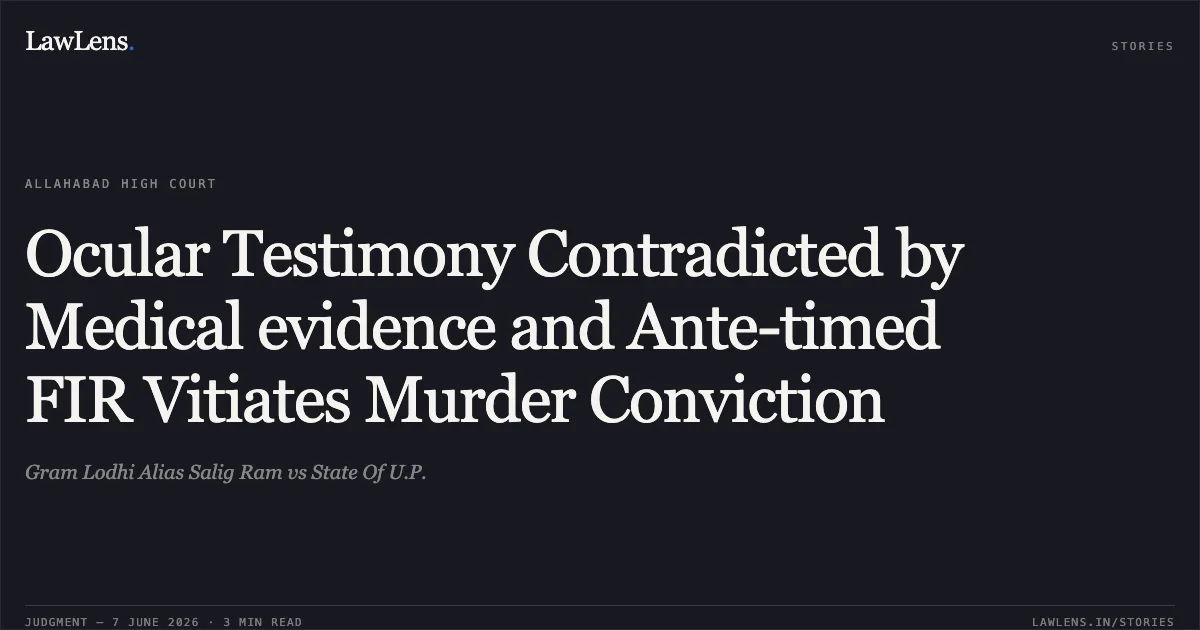
The Court found the FIR to be ante-timed because the informant described herself as the wife of "late" Chetram in the written report, even though the prosecution claimed he was still alive when the report was lodged
Source reference: para. 35-36Furthermore, the FIR reached the Magistrate ten days late, violating Section 157 Cr.P.C.
Source reference: para. 38The Court discredited P.W. 2 as a chance witness because his presence at midnight was improbable and he failed to produce the torch allegedly used to identify the appellant from 50-60 steps away in the dark
Source reference: para. 44P.W. 1’s testimony was found unreliable due to the lack of sufficient light (the lantern's presence was not in the FIR) and a major medical contradiction: she claimed the deceased was shot in the chest, but the post-mortem showed the entry wound was in the back
Source reference: para. 46, 49The Court also noted the deceased's criminal history, suggesting the possibility of a "blind murder" by unknown enemies being pinned on the appellant due to existing enmity
Source reference: para. 48Holding
The Court answered the issues in the negative, holding that the prosecution failed to prove the case beyond reasonable doubt
The High Court set aside the Trial Court’s judgment dated March 16, 2001, and acquitted the appellant of all charges under Sections 302 and 452 of the IPC
Source reference: para. 52The appellant’s bail bonds were cancelled, and he was directed to execute a personal bond under Section 481 of the Bharatiya Nagarik Suraksha Sanhita (corresponding to Section 437-A Cr.P.C.)
Source reference: para. 53-54Acts & Sections Cited
12 provisions across 4 statutes referred to in this judgment. Each provision opens on LawLens.
Code of Criminal Procedure, 19737
Indian Penal Code, 18603
Arms Act, 19591
Bharatiya Nagarik Suraksha Sanhita, 20231
Original Court PDF
Gram Lodhi Alias Salig RamvsState Of U.P.
Click to open original judgment
Original judgment, available to read, download and summarize on LawLens.in


