Facts
The petitioner was booked under Sections 217, 336(2), 338, and 340(2) of the Bharatiya Nyaya Sanhita (BNS) at Gandhigram Police Station, Rajkot
Source reference: p. 2Following the registration of the FIR, the petitioner’s application for anticipatory bail was rejected by the Sessions Court on January 9, 2026
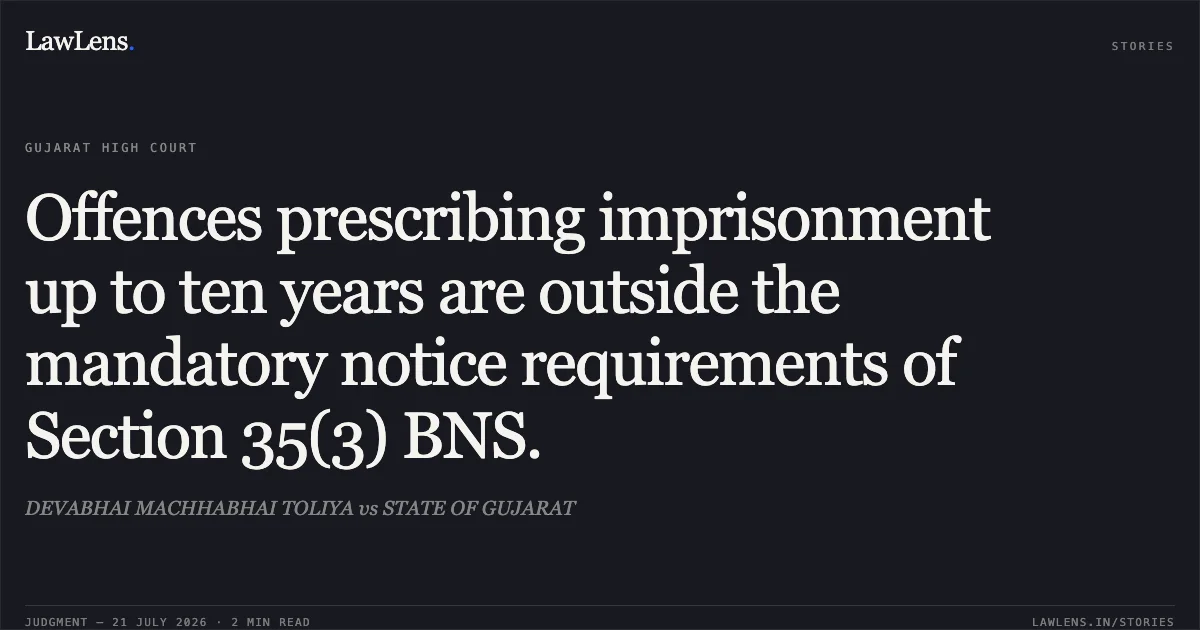
Source reference: p. 2The petitioner subsequently approached the High Court seeking a writ of mandamus to compel the police to issue a notice under Section 35(3) of the BNS—equivalent to Section 41A of the CrPC—before arrest, arguing that the offences, though carrying a potential 10-year sentence, are triable by a Magistrate and thus effectively limited to a 7-year imprisonment threshold
Source reference: p. 2-3Issues
1. Whether the mandatory notice provision under Section 35(3) of the BNS is applicable to an offence punishable with imprisonment up to 10 years solely because the case is triable by a Magistrate
Source reference: p. 42. Whether the Court should grant discretionary relief to an applicant who is deemed to be evading the process of law after the rejection of anticipatory bail
Source reference: p. 4Law Applied
The court primarily interpreted Section 35(3) of the BNS, which mandates the issuance of a notice of appearance in cases where the arrest of a person is not required under Section 35(1) and the offence is punishable with imprisonment for a term which may be less than seven years or which may extend to seven years
Source reference: p. 2, 4It further considered the sentencing jurisdiction of Magistrates, noting that the procedural triability of an offence does not override the statutory maximum punishment prescribed for the offence itself
Source reference: p. 4-5The court also referenced the binding precedent of Satender Kumar Antil v. CBI, which outlines the guidelines for arrest and bail
Source reference: p. 3Reasoning
The court rejected the petitioner's argument that Section 338 of the BNS (punishable by up to 10 years) should be treated as an offence punishable by up to 7 years for the purpose of Section 35(3) just because it is triable by a Magistrate
Source reference: p. 4The court reasoned that the statute prescribes a 10-year maximum, and organized legal mechanisms exist to impose such sentences even in Magistrate-led trials
Source reference: p. 5Furthermore, the court noted that the petitioner failed to raise the Section 35(3) argument before the Sessions Court and had neither challenged the bail rejection nor surrendered, characterizing the petitioner’s conduct as evading the law
Source reference: p. 4The court also declined to evaluate the merits of the forgery charges, as the petition was not for quashing the FIR
Source reference: p. 5Holding
The court dismissed the petition and the connected application, holding that the mandate of Section 35(3) of the BNS does not apply to offences where the prescribed statutory punishment exceeds 7 years
The court concluded that the petition was devoid of merit as the police are not bound by the notice requirement for the specific sections invoked, and the petitioner's conduct did not warrant discretionary intervention
Source reference: p. 5Acts & Sections Cited
5 provisions across 1 statute referred to in this judgment. Each provision opens on LawLens.
Bharatiya Nyaya Sanhita, 20235
Original Court PDF
DEVABHAI MACHHABHAI TOLIYAvsSTATE OF GUJARAT
Click to open original judgment
Original judgment, available to read, download and summarize on LawLens.in