Facts
The Petitioner, proprietor of M/s. Sri Varun Enterprises, allegedly borrowed ₹25,75,765/- from the Respondent and issued a cheque which was returned with the endorsement "Exceeds Arrangement"
Source reference: p. 2The Trial Court (Metropolitan Magistrate FTC-II, Egmore) convicted the Petitioner under Section 138 of the Negotiable Instruments (NI) Act, sentencing her to six months SI and a compensation of ₹25,75,765/-
Source reference: p. 3This conviction was confirmed by the Principal Sessions Judge, Chennai, in C.A.No.632 of 2023
Source reference: p. 4During the pendency of the present Revision Case, the parties were referred to mediation and entered into a Settlement Agreement dated 06.04.2026, where the Respondent agreed to receive a total of ₹12,00,000/- as full and final settlement, which has been paid
Source reference: p. 4-6Issues
1. Whether the order passed by the Appellate Court confirming the conviction of the trial court under Section 138 of the Negotiable Instruments Act can be nullified by the High Court on the basis of a compromise entered between the parties at the revisional stage
Source reference: para. 20Law Applied
Section 147 of the Negotiable Instruments Act, which contains a non-obstante clause making every offence under the Act compoundable
Source reference: para. 21, 31Section 320(6) of the Cr.P.C., which allows a High Court in exercise of its revisional powers to permit compounding
Source reference: para. 21The guidelines established in Damodar S. Prabhu v. Sayed Babalal H. (2010), regarding the graded scheme for compounding post-conviction
Source reference: para. 14M/s Meters and Instruments Private Limited v. Kanchan Mehta (2017), which emphasized the compensatory nature of Section 138 over its punitive aspect
Source reference: para. 15Vinay Devanna Nayak v. Ryot Seva Sahkari Bank Ltd. which affirmed that acquittal is proper upon post-conviction settlement
Source reference: para. 17Reasoning
The Court reasoned that Section 147 of the NI Act, being a special law, overrides the general provisions of Section 320 of the Cr.P.C. due to its non-obstante clause
Source reference: para. 31, 34Although the litigation reached the revisional stage, the Court held that the primary object of Section 138 is to ensure the recovery of money (compensatory) rather than retribution (punitive)
Source reference: para. 36-37The Court noted that even after a conviction is upheld by an appellate court, the High Court possesses inherent and revisional powers to record a compromise to prevent miscarriage of justice and "secure the ends of justice"
Source reference: para. 22-26Since the parties voluntarily settled for ₹12,00,000/- and the amount was duly paid and acknowledged, the Court found it fit to exercise its discretion to allow compounding to provide "justice at the door step"
Source reference: para. 33, 41Holding
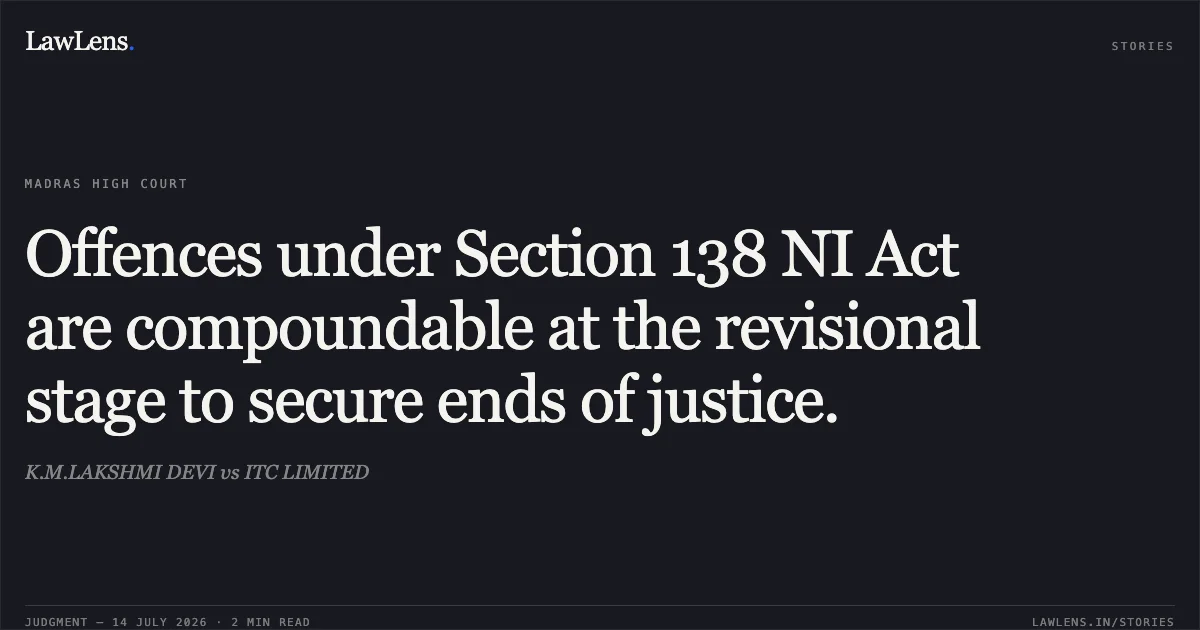
The Court answered the issue in the affirmative, holding that offences under the NI Act can be compounded at any stage of the proceedings, including revision
The Criminal Revision Case was disposed of in terms of the Settlement Agreement dated 06.04.2026. The Court annulled the conviction and sentence passed by the Trial Court and the First Appellate Court, and the Revision Petitioner was officially treated as acquitted on account of the compounding of the offence
Source reference: para. 45, 47Acts & Sections Cited
21 provisions across 4 statutes referred to in this judgment. Each provision opens on LawLens.
Bharatiya Nagarik Suraksha Sanhita, 20232
Negotiable Instruments Act, 18817
Code of Criminal Procedure, 1973
Indian Penal Code, 18603
Original Court PDF
K.M.LAKSHMI DEVIvsITC LIMITED
Click to open original judgment
Original judgment, available to read, download and summarize on LawLens.in