Facts
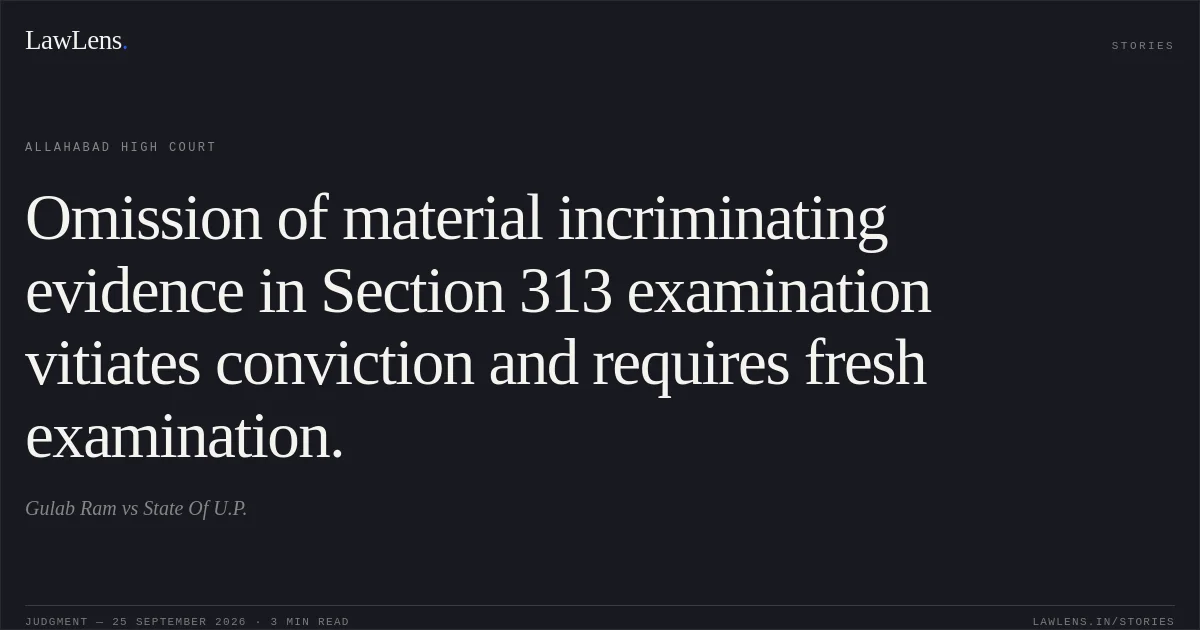
Gulab Ram was prosecuted for murdering his wife, Lalsa Devi, allegedly by slitting her throat after suspecting her character.
Source reference: paras. 2–5The prosecution relied principally on the complainant’s evidence that he saw the appellant and the deceased leave together at about 1:00 a.m., the recovery of the alleged weapon, and the post-mortem and other formal evidence.
Source reference: paras. 2–5The Additional District and Sessions Judge, Ghazipur convicted the appellant under Section 302 IPC and sentenced him to life imprisonment with a fine of ₹20,000.
Source reference: para. 1In appeal, the appellant challenged the reliability of the prosecution evidence, the weapon recovery, the absence of forensic corroboration, and the manner in which his statement under Section 313 Cr.P.C. had been recorded.
Source reference: paras. 8–10The High Court found that the trial court had questioned the accused only regarding the testimony of the Investigating Officer and certain documentary exhibits, without putting to him the incriminating evidence of the other prosecution witnesses.
Source reference: paras. 13–18Issues
Whether the trial court’s failure to put the material incriminating circumstances and prosecution evidence to the accused under Section 313 Cr.P.C. caused prejudice and violated his right to a fair trial under Article 21 of the Constitution.
Source reference: paras. 14–18Whether the conviction and sentence under Section 302 IPC could be sustained despite the defective examination of the accused under Section 313 Cr.P.C.
Source reference: paras. 18–21Whether the matter should be remanded to the trial court for fresh examination of the accused and further proceedings.
Source reference: paras. 19–22Law Applied
The Court applied Section 302 IPC, under which murder is punishable, and Section 313(1)(b) Cr.P.C., which requires the court, after completion of the prosecution evidence and before the accused is called upon to enter his defence, to question him generally on the case and specifically regarding the circumstances appearing against him.
Source reference: para. 16The underlying principle is that every material incriminating circumstance must be distinctly put to the accused so that he has a fair opportunity to explain it; omission to do so may vitiate the trial where it causes prejudice or results in miscarriage of justice.
Source reference: para. 17This procedural safeguard forms part of the accused’s right to a fair trial under Article 21 of the Constitution.
Source reference: para. 18The Court relied on Sanjay Kumar and another v. State of Bihar and others, 2026 Law Finder SC 914, where the Supreme Court held that an inadequate examination under Section 313 Cr.P.C., omitting specific questions on each piece of incriminating evidence, rendered the convictions unsustainable and required fresh examination of the accused.
Source reference: para. 19Reasoning
The High Court examined the statement recorded under Section 313 Cr.P.C. and found that it referred only to the evidence of the Investigating Officer, Hariram Maurya (P.W.9), and limited documentary exhibits, while omitting the evidence of the complainant, alleged last-seen witnesses, recovery witnesses, medical evidence, and other prosecution witnesses.
Source reference: paras. 14–18Since the prosecution case depended on these circumstances to connect the appellant with the murder, the accused was not given a meaningful opportunity to explain the material evidence against him.
Source reference: paras. 14–18The defect was therefore not a minor or technical omission but a violation of the mandatory statutory safeguard and the constitutional guarantee of fair trial.
Source reference: paras. 17–20The Court held that the defect could not be cured in appellate jurisdiction and that the merits of the prosecution case should not be finally assessed until the accused had been properly examined under Section 313 Cr.P.C.
Source reference: paras. 17–20Holding
The Court held that the defective examination under Section 313 Cr.P.C. caused prejudice to the appellant and rendered the conviction and sentence unsustainable.
It accordingly set aside the judgment of conviction and order of sentence dated 2 June 2016, remanded the case to the trial court from the stage of recording the appellant’s statement under Section 313 Cr.P.C., and directed that the trial court proceed afresh thereafter, including consideration of any defence evidence and the prosecution evidence on merits.
Source reference: paras. 20–23As the appellant had remained in custody for more than fifteen years, he was ordered to be released on regular bail during the pendency of the trial, subject to furnishing bonds and sureties to the satisfaction of the trial court.
Source reference: para. 22Acts & Sections Cited
3 provisions across 2 statutes referred to in this judgment. Each provision opens on LawLens.
Indian Penal Code, 18601
Code of Criminal Procedure, 19732
Original Court PDF
Gulab RamvsState Of U.P.
Click to open original judgment
Original judgment, available to read, download and summarize on LawLens.in