Facts
Rekha Mandal married appellant No. 1 in 2002.
Source reference: p. 1–3Her father alleged that, after the marriage, her husband and in-laws demanded a motorcycle and ₹50,000, and that she was harassed when the demand was not met.
Source reference: p. 1–3In November 2007, Rekha and her two children suffered burn injuries; Rekha and one child died.
Source reference: p. 1–3The Sessions Court convicted the accused, including the four appellants in this appeal, under Sections 304B/34 IPC and sentenced each to seven years’ rigorous imprisonment.
Source reference: p. 1–3The appeal challenged that conviction and sentence; the appeals of two other convicted persons had abated.
Source reference: para. 1, 3–7; p. 1–3Issues
Whether the prosecution proved the statutory ingredients of dowry death under Section 304B IPC, including cruelty or harassment for or in connection with a dowry demand soon before the death.
Source reference: para. 15, 18; p. 6, 18Whether the evidence justified applying the presumption under Section 113B of the Evidence Act against each appellant, or whether the conviction of appellants Nos. 2–4 rested only on general and omnibus allegations.
Source reference: para. 15, 22–25; p. 6, 19–20Law Applied
Section 304B IPC applies where a woman’s death is caused by burns, bodily injury, or otherwise than under normal circumstances within seven years of marriage, and she was subjected soon before death to cruelty or harassment by her husband or a relative of her husband for or in connection with a dowry demand.
Source reference: para. 17–19; p. 16–18Once these foundational facts are established, Section 113B of the Indian Evidence Act requires the court to presume that the person who subjected her to such cruelty or harassment caused the dowry death.
Source reference: para. 17–19; p. 16–18The court also referred to the definition of dowry in Section 2 of the Dowry Prohibition Act, 1961, and explained that a death need not be classified as homicidal, suicidal, or accidental to fall within Section 304B IPC.
Source reference: para. 17–19; p. 16–18Reasoning
The court found that the medical evidence established death by burn injuries and that Rekha died within seven years of her marriage.
Source reference: para. 20–21; p. 18–19It accepted the informant’s and other witnesses’ evidence that the husband had demanded a motorcycle and ₹50,000 and that Rekha was harassed for non-fulfilment of that demand; accordingly, it held that the Section 304B ingredients were proved against the husband and that he had not rebutted the Section 113B presumption.
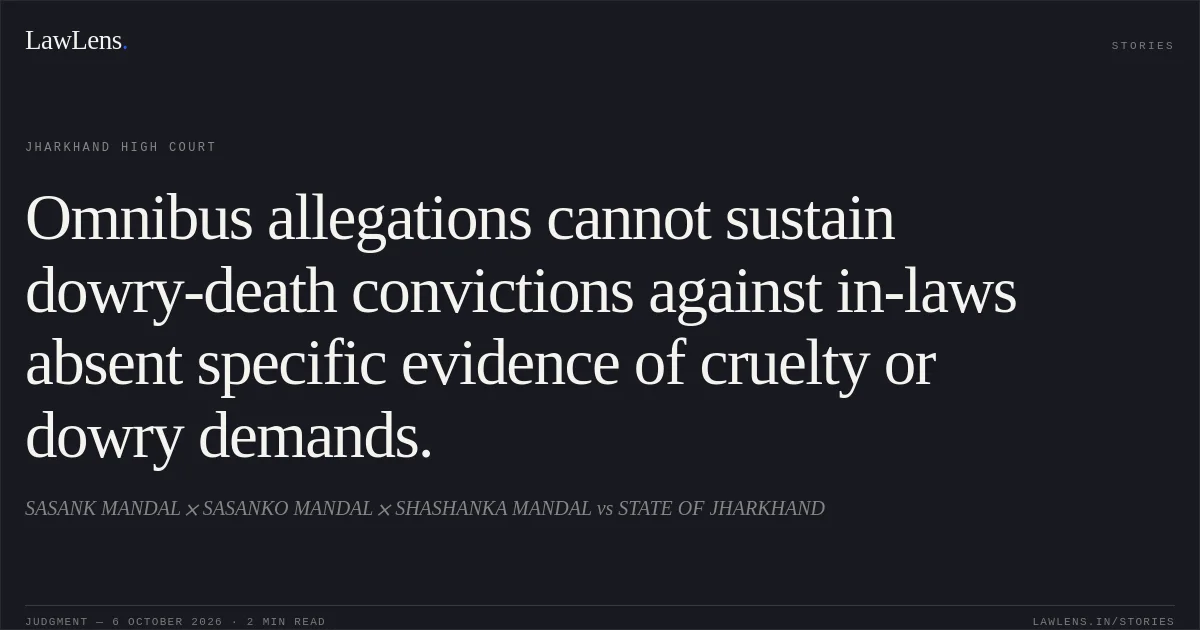
Source reference: para. 22–24; p. 19–20By contrast, the evidence did not specifically establish that appellants Nos. 2–4 demanded dowry or subjected Rekha to cruelty or harassment; the allegations against them were general and omnibus.
Source reference: para. 23; p. 19The statutory presumption therefore could not sustain their convictions.
Source reference: para. 23; p. 19Holding
The appeal was partly allowed.
The conviction and seven-year sentence under Section 304B IPC were affirmed against appellant No. 1, who was directed to surrender within two months and serve the remaining sentence.
Source reference: para. 25–28; p. 20–21The convictions and sentences of appellants Nos. 2–4 were set aside; they were acquitted and discharged from their bail-bond liabilities.
Source reference: para. 25–28; p. 20–21Original Court PDF
SASANK MANDAL SASANKO MANDAL SHASHANKA MANDALvsSTATE OF JHARKHAND
Click to open original judgment
Original judgment, available to read, download and summarize on LawLens.in