Facts
Respondent No. 2 alleged that her husband, petitioner No. 1, and his family demanded dowry, including ₹10 lakh at the time of marriage, and that her husband later subjected her to physical and mental harassment, including in connection with an alleged extra-marital affair.
Source reference: p. 3–6She also alleged that petitioner No. 1’s mother, petitioner No. 2, supported his conduct.
Source reference: p. 3–6Following investigation, police filed a charge sheet against both petitioners for offences under Sections 498A, 504, 506 read with Section 34 of the IPC and Sections 3, 4 and 6 of the Dowry Prohibition Act.
Source reference: p. 3–6The petitioners sought quashing under Section 482 CrPC; the High Court considered the allegations and witness statements in the complaint and charge-sheet materials.
Source reference: p. 3–6Issues
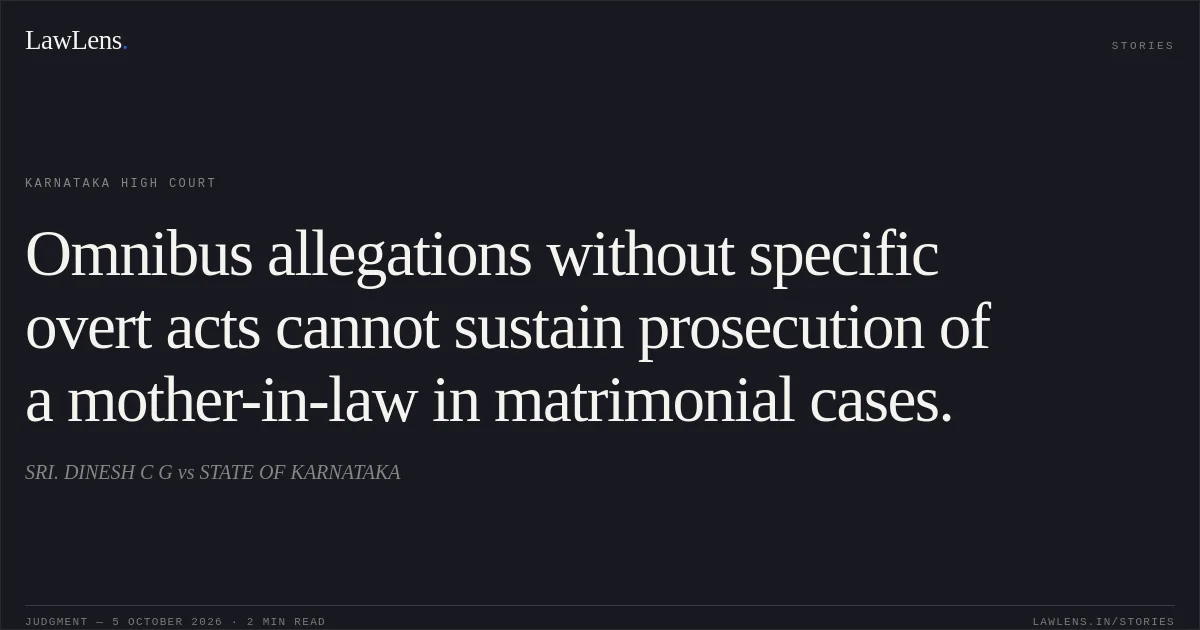
1. Whether the charge-sheet proceedings against petitioner No. 2 should be quashed where the allegations against her were omnibus and did not identify a specific overt act.
Source reference: p. 6–92. Whether the proceedings against petitioner No. 1 should be quashed in light of the allegations of dowry-related and other harassment.
Source reference: p. 6–7, 9Law Applied
The Court considered its inherent jurisdiction under Section 482 CrPC to prevent abuse of the process of the court.
Source reference: p. 7–9It applied the principle that, in matrimonial prosecutions, a relative of the husband should not be prosecuted merely because their name is included in the complaint; specific allegations indicating that person’s active involvement are required.
Source reference: p. 7–9It relied on K. Subba Rao v. State of Telangana, 2024 INSC 960, and Dara Lakshmi Narayan v. State of Telangana, (2025) 3 SCC 735, which caution against criminal proceedings based on vague, generalised accusations against family members.
Source reference: p. 7–9Reasoning
The complaint and witness statements contained allegations that petitioner No. 1 harassed respondent No. 2 over dowry and in connection with his alleged extra-marital affair. The Court therefore declined to quash the proceedings against him.
Source reference: p. 6–9By contrast, the material against petitioner No. 2 consisted only of an omnibus allegation that she supported petitioner No. 1; it disclosed no specific act of harassment attributable to her.
Source reference: p. 6–9Applying the cited principles, the Court held that continuing the prosecution against petitioner No. 2 would amount to an abuse of the process of the court.
Source reference: p. 6–9Holding
The petition was allowed in respect of petitioner No. 2 and dismissed in respect of petitioner No. 1.
The proceedings in C.C. No. 1631/2023 were quashed only against petitioner No. 2; they were to continue against petitioner No. 1.
Source reference: p. 9The Court directed that its observations should not influence the trial court in deciding the case.
Source reference: p. 9Acts & Sections Cited
7 provisions across 3 statutes referred to in this judgment. Each provision opens on LawLens.
Code of Criminal Procedure, 19731
Indian Penal Code, 18603
Original Court PDF
SRI. DINESH C GvsSTATE OF KARNATAKA
Click to open original judgment
Original judgment, available to read, download and summarize on LawLens.in