Facts
The respondent, Mumtaz Khan, was employed as a Chaukidar with the Life Insurance Corporation of India (LIC) and was assigned night-duty at its Divisional Office, Jabalpur.
Source reference: paras. 2–5Ninety-five silver coins belonging to the LIC Employees’ Cooperative Society were found missing from a cupboard in the office of the Society’s President.
Source reference: paras. 2–5Following a police investigation, the respondent and another employee, Prahlad Kori, were arrested and prosecuted after the alleged coins were recovered from their possession.
Source reference: paras. 2–5LIC initiated departmental proceedings against the respondent, culminating in an order dated 10.12.2002 removing him from service.
Source reference: para. 6His departmental appeal was dismissed on 24.04.2003.
Source reference: para. 6On a reference under Section 10 of the Industrial Disputes Act, 1947, the Central Government Industrial Tribunal-cum-Labour Court held on 28.01.2015 that the departmental enquiry was illegal and improper.
Source reference: para. 7Thereafter, the Tribunal passed an award dated 06.09.2016 directing the respondent’s reinstatement with continuity of service and full back wages.
Source reference: para. 1LIC challenged that award under Article 227 of the Constitution, contending, inter alia, that the Tribunal lacked jurisdiction and that the departmental enquiry had complied with natural justice.
Source reference: paras. 8–9Issues
Whether the High Court, in exercise of jurisdiction under Article 227 of the Constitution, should interfere with the CGIT award directing reinstatement with continuity of service and full back wages after the departmental enquiry had been held illegal and the employer had failed to prove the misconduct by leading evidence.
Source reference: paras. 16–18Whether the CGIT lacked jurisdiction to adjudicate the respondent’s employment dispute because his service conditions were governed by the LIC of India (Staff) Regulations, 1960.
Source reference: paras. 9–11, 19Law Applied
The Court applied Article 227 of the Constitution, under which supervisory interference is warranted only where the subordinate tribunal’s decision discloses illegality, perversity, or jurisdictional error.
Source reference: paras. 16–17, 20It considered Sections 2(j) and 2(s), and Sections 10 and 12 of the Industrial Disputes Act, 1947, concerning the status of an industry and workman and the reference and adjudication of industrial disputes.
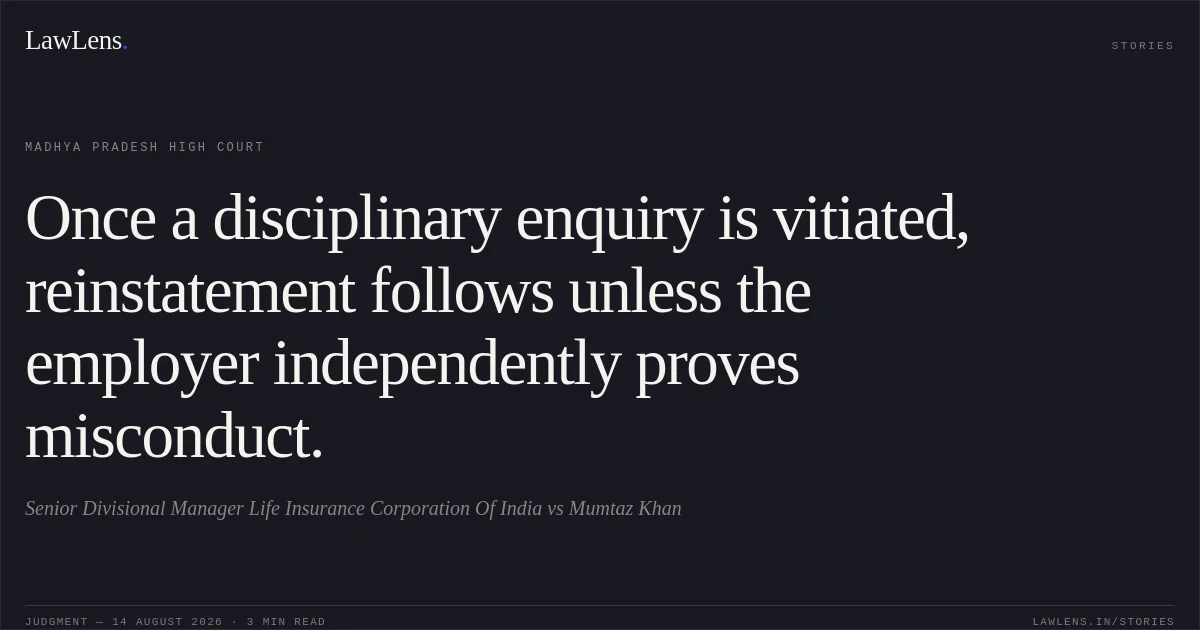
Source reference: paras. 7, 11The Court relied on Shambhu Nath Goyal v. Bank of Baroda , (1983) 4 SCC 491, as applied by coordinate Benches in Union of India v. Pawan Khatod , W.P. No. 4996 of 2015, and Mahendra Singh v. State of Madhya Pradesh , W.P. No. 4686 of 2014, for the principle that where a domestic enquiry is held vitiated, the employer must seek an opportunity to establish the misconduct by leading evidence; if it fails to do so, it cannot complain before a higher forum that such opportunity was denied.
Source reference: para. 18The Court also held that the jurisdictional objection lost force after LIC withdrew its application challenging the Tribunal’s jurisdiction.
Source reference: para. 19Reasoning
The Tribunal had already found the departmental enquiry to be illegal and improper.
Source reference: para. 17Although LIC asserted that the respondent had been afforded adequate opportunity and that natural justice had been observed, the Tribunal further found that LIC failed to prove the alleged misconduct through sufficient and cogent evidence when the matter was adjudicated.
Source reference: para. 17Applying Shambhu Nath Goyal and the coordinate Bench decisions, the High Court held that LIC could not seek further indulgence after failing to establish the misconduct following the invalidation of the enquiry.
Source reference: para. 18The Court also rejected the jurisdictional objection because LIC had previously raised but subsequently withdrawn its application challenging the CGIT’s jurisdiction on 27.01.2011.
Source reference: para. 19Accordingly, no illegality, perversity, or jurisdictional error warranting Article 227 interference was established.
Source reference: para. 20Holding
The High Court answered both issues against LIC.
It held that the CGIT was competent to adjudicate the dispute and that its award was not vitiated by any illegality, perversity, or jurisdictional error.
Source reference: paras. 20–21The writ petition was dismissed, thereby affirming the CGIT’s award dated 06.09.2016 directing Mumtaz Khan’s reinstatement with continuity of service and full back wages.
Source reference: paras. 20–21Acts & Sections Cited
4 provisions across 1 statute referred to in this judgment. Linked provisions open on LawLens.
Industrial Disputes Act, 19474
Original Court PDF
Senior Divisional Manager Life Insurance Corporation Of IndiavsMumtaz Khan
Click to open original judgment
Original judgment, available to read, download and summarize on LawLens.in