Facts
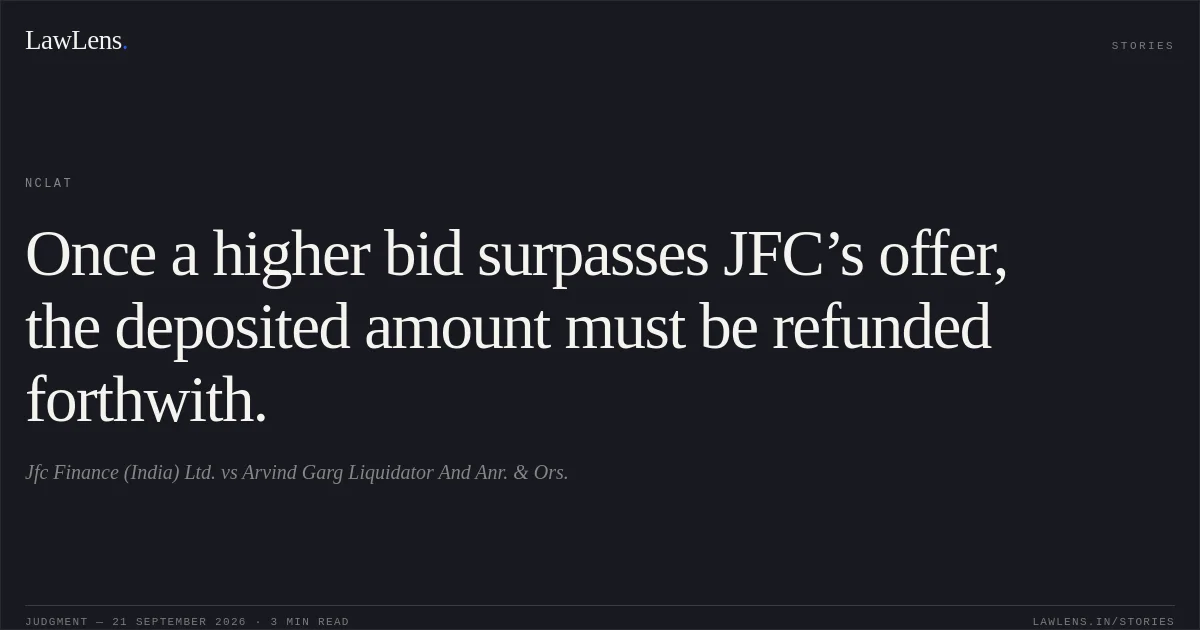
The Applicant-Liquidator sought clarification of paragraph 56(iv) of the NCLAT’s earlier judgment dated 29 May 2026, which directed that the deposit of ₹54 crore made by JFC Finance (India) Limited (“JFC”) be returned forthwith if another bidder surpassed JFC’s bid in the fresh e-auction.
Source reference: p. 1; p. 2Pursuant to the earlier judgment, a fresh e-auction was conducted on 1 July 2026. A highest bidder (“H1”) offered ₹168 crore, while JFC emerged as the second-highest bidder (“H2”) with a bid of ₹167 crore.
Source reference: p. 3Although H1 had not yet deposited the entire sale consideration and had been granted time until 30 September 2026, the Liquidator sought permission to withhold JFC’s ₹54 crore deposit until completion of the sale and receipt of the full amount from H1.
Source reference: p. 4JFC opposed the application, contending that paragraph 56(iv) was clear and required immediate refund once its bid had been surpassed.
Source reference: p. 4The earlier judgment had been challenged before the Supreme Court in Civil Appeal No. 8638 of 2026, which was dismissed on 17 July 2026.
Source reference: p. 5Issues
Whether paragraph 56(iv) of the NCLAT’s judgment dated 29 May 2026 required the Liquidator to refund JFC’s ₹54 crore deposit forthwith once another bidder surpassed JFC’s bid, notwithstanding that the highest bidder had not yet paid the entire sale consideration.
Source reference: p. 2; pp. 5–6Whether the Liquidator’s application, styled as one seeking clarification, could be entertained when it effectively sought modification or review of a final judgment.
Source reference: p. 5; para. 8Law Applied
The Tribunal applied the principle that a court or tribunal cannot review or modify a final judgment under the guise of seeking clarification, particularly where the operative direction is clear and unambiguous.
Source reference: para. 8It further applied the ordinary meaning of the mandatory expression “shall forthwith” in paragraph 56(iv), holding that the direction became operative immediately upon the specified contingency—another bidder surpassing JFC’s bid—occurring.
Source reference: para. 9The Tribunal also relied on the principle of finality of judicial orders, noting that its earlier judgment had attained finality after dismissal of the challenge by the Supreme Court.
Source reference: para. 8Reasoning
The Tribunal examined paragraphs 56(iii) and 56(iv) of the earlier judgment together. Paragraph 56(iii) addressed the situation where no bidder offered more than ₹54 crore, whereas paragraph 56(iv) expressly governed the situation where another bidder surpassed JFC’s offer.
Source reference: p. 3; para. 9Since H1 had bid ₹168 crore and JFC had bid ₹167 crore, the condition in paragraph 56(iv) had indisputably occurred.
Source reference: p. 4; para. 9The use of the words “shall forthwith return” imposed an immediate obligation on the Liquidator and did not make the refund conditional upon H1’s subsequent payment of the entire sale consideration.
Source reference: para. 9The requested postponement would therefore alter the substantive effect of the earlier judgment rather than clarify any ambiguity. Because the judgment had already attained finality, the Tribunal declined to reopen or modify it through the present application.
Source reference: paras. 8–10Holding
The NCLAT held that paragraph 56(iv) was clear and mandatory. Once H1’s bid surpassed JFC’s bid, the Liquidator was required to forthwith refund JFC’s ₹54 crore deposit, notwithstanding the pendency of payment of the balance sale consideration by H1.
I.A. No. 4727 of 2026 was rejected. The connected impleadment applications, I.A. Nos. 5387, 5877 and 5918 of 2026, were also closed.
Source reference: para. 11Original Court PDF
Jfc Finance (India) Ltd.vsArvind Garg Liquidator And Anr. & Ors.
Click to open original judgment
Original judgment, available to read, download and summarize on LawLens.in